
13-week cash forecast: planning for customers who pay late
An invoice due date tells you when a customer should pay, not when the money will arrive. If your forecast assumes every customer pays on time and a regular late payer does it again, the forecast can show a healthy balance in the same week payroll leaves the account. A 13-week forecast works better when each large receipt sits in the week you expect it, based on evidence, and you test what a delay does to the lowest point.
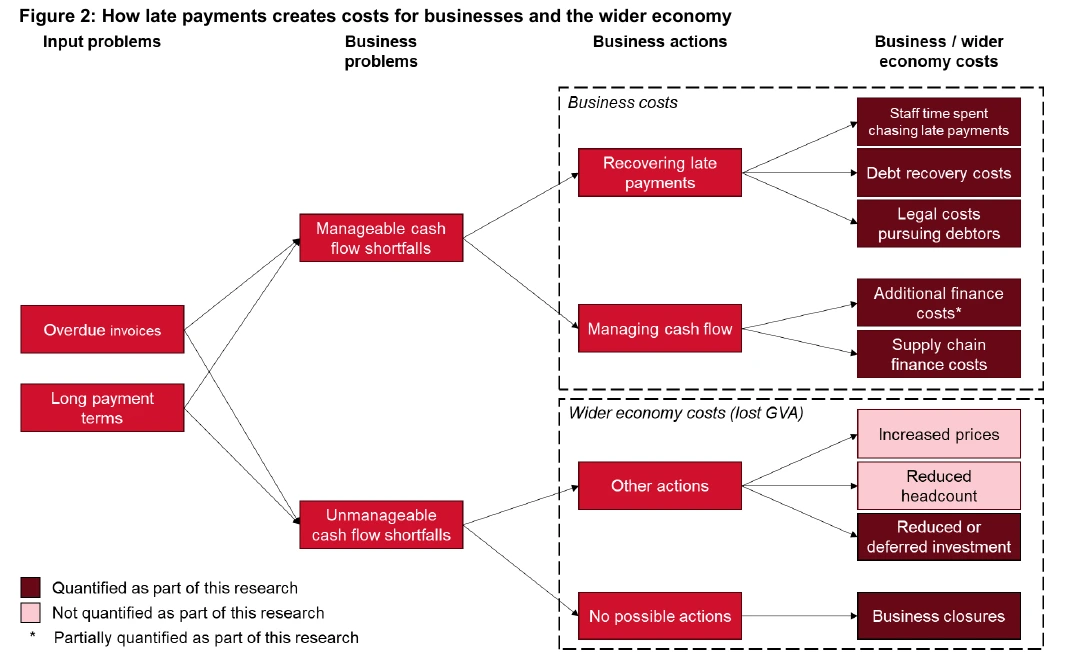
What the UK research measured
Commissioned research published by the UK government in July 2025 estimated that late payment costs the UK economy almost £11 billion a year. It combined a 2025 survey of 1,455 businesses with analysis of secondary data. Its definition covers both overdue invoices and agreed payment terms longer than 60 days, so the figure is not only about missed due dates. It is a modelled estimate: the report notes it could be too low where costs were left out, or too high where activity would simply move to other firms.
The national figure is context. For your business, what matters is the timing of particular receipts.
Sources and context, checked :
Build the base case
BDC's cash-planning page offers 13-week and 12-month templates built around expected inflows and outflows. Thirteen weeks gives a quarter in weekly detail; the horizon is a choice, not a requirement.
Each week, opening cash plus receipts minus payments gives closing cash, which becomes the next week's opening balance. Pick a fixed week-ending day, list the accounts included and leave out restricted balances. Show an agreed overdraft or loan facility separately, and leave out any facility that is not yet signed. The hypothetical example below uses generic currency units and shows the first three weeks.
| Cash item | Week 1 | Week 2 | Week 3 |
|---|---|---|---|
| Opening available cash | 20,000 | 18,000 | 11,000 |
| Customer receipts | 12,000 | 8,000 | 16,000 |
| Supplier payments | (7,000) | (6,000) | (5,000) |
| Payroll and other payments | (7,000) | (9,000) | (6,000) |
| Closing available cash | 18,000 | 11,000 | 16,000 |
Sources and context, checked :
Now move one receipt
Suppose the 8,000 expected in Week 2 comes from one customer who pays a week late. Nothing else changes.
Week 2 now closes at 3,000 instead of 11,000. Week 3 still finishes at 16,000, so the three-week total looks identical. The difference is the low point: after Week 2's payroll and supplier payments, only 3,000 is left, and one unexpected bill that week could leave you short. A base case built on due dates is still a useful starting point, but it needs a delay scenario beside it to show this risk.
| Delayed receipt | Week 1 | Week 2 | Week 3 |
|---|---|---|---|
| Opening available cash | 20,000 | 18,000 | 3,000 |
| Customer receipts | 12,000 | 0 | 24,000 |
| Supplier payments | (7,000) | (6,000) | (5,000) |
| Payroll and other payments | (7,000) | (9,000) | (6,000) |
| Closing available cash | 18,000 | 3,000 | 16,000 |
Give each large receipt evidence and an owner
For every material receipt, record the customer, invoice, due date, expected date, the evidence for that date and the person responsible for chasing it. Useful evidence includes the customer's recent payment history, confirmation that the invoice is approved for payment, a remittance advice or a known dispute. Do not spread the sales budget evenly across the weeks.
Take payments from real obligations: payroll dates, rent, loan repayments, supplier runs and tax payments from a confirmed schedule. Keep a base case and at least one delay case side by side, and note the lowest balance in each. If a week looks tight, also check daily balances around payroll and large payments; a weekly closing balance can hide an earlier shortfall.
Roll it forward each week
When a week ends, replace the forecast with actual bank movements, note why each material figure differed, fix the assumption that caused it and add a new week at the end. Keep the previous version so changes can be explained.
This week, take your three largest unpaid invoices and set an expected date for each. Start from how late the customer has paid recently, then adjust for what you know now: whether the invoice is approved for payment and what the customer confirms when you ask. If the lowest balance no longer covers the next payroll with room to spare, agree who will chase which customer and what you will do if the money is still late.