
Bill-and-hold sales: prove control before the goods leave
A customer can obtain control of a product while it still sits in the seller's warehouse. Under UK-adopted full IFRS for 2026 annual periods, without early adoption of IFRS 18, an invoice and a label on the pallet do not prove it. The seller needs the general control assessment and all four bill-and-hold conditions, then assesses whether custody or other remaining services are performance obligations that should receive part of the transaction price.
The reverse of consignment
In a bill-and-hold arrangement the seller bills the customer for a product but keeps physical possession until a later date. That is the converse of consignment, where a dealer holds goods the supplier still controls. Physical possession need not coincide with control in either direction. The seller evaluates when the customer obtains control, including the indicators in paragraph 38, and its own custody of the goods is not conclusive. The analysis does not cover FRS 102, IFRS for SMEs, US GAAP or tax treatment.
Four conditions on top of the control test
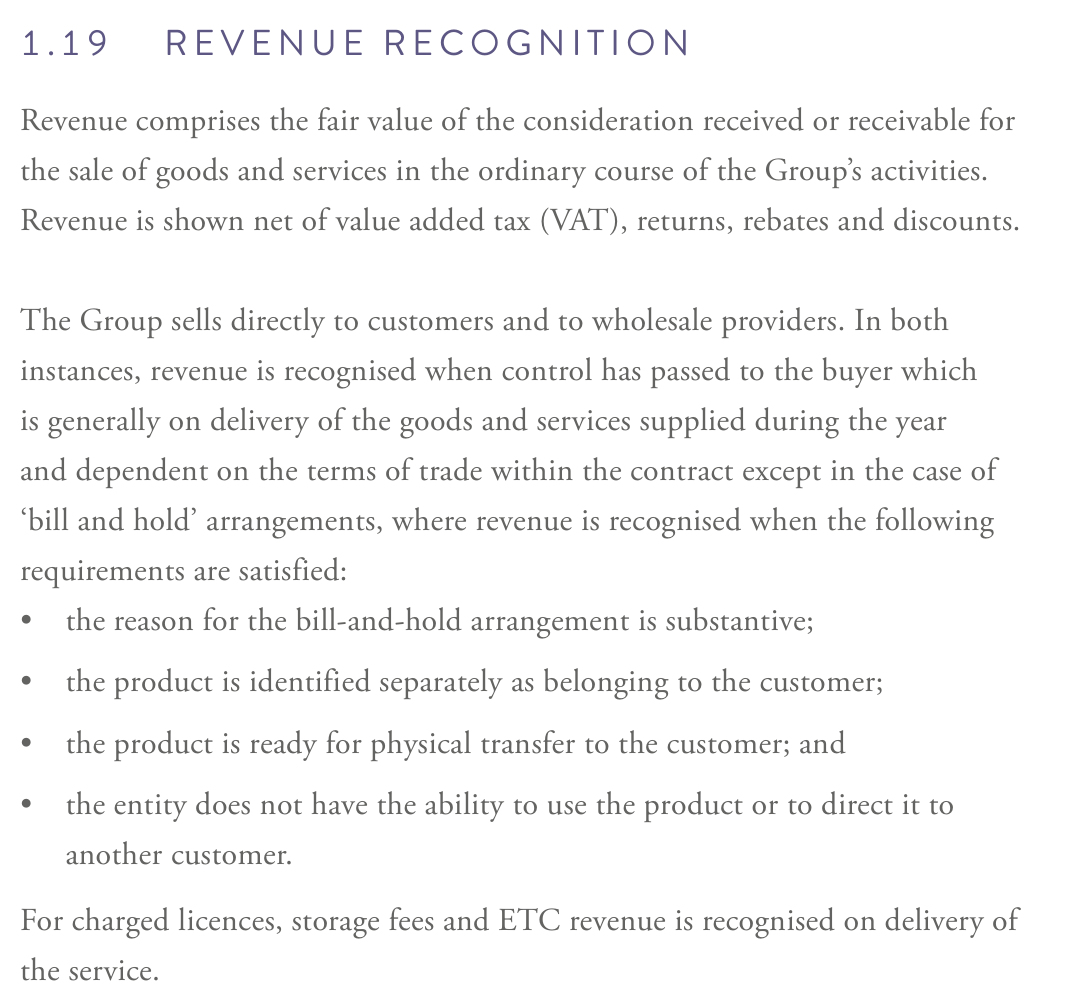
Bill-and-hold revenue needs more than the general control assessment. All four conditions in paragraph B81 must also hold: the reason for the arrangement is substantive, the product is separately identified as belonging to the customer, the product is currently ready for physical transfer, and the seller cannot use the product or direct it to another customer. B81 adds to paragraph 38; it does not replace it.
A customer request is an example of a substantive reason, not a safe harbour. A seller's wish to hit a sales target is not a substantive customer reason at all. Customer acceptance also matters. If the seller cannot objectively show the product meets the agreed specifications, an uncompleted substantive acceptance clause may block control. A signed invoice or an earmarked pallet answers none of these questions.
Worked hypothetical: product sold on 31 December, stored to April
The following facts and amounts are hypothetical, in GBP and excluding VAT and other taxes. A customer asks the seller to store a completed product because its site lacks space. On 31 December 2026 the product is serial-numbered and identified as the customer's, ready for immediate physical transfer, accepted against all specifications, and cannot be used or redirected by the seller. The control assessment establishes that the customer now directs its use and obtains the remaining benefits. Title and significant risks and rewards have passed, payment is unconditionally due and no installation or other product work remains. These facts are assumed established, not inferred from the invoice.
The price is £24,000: £20,000 for the product and £4,000 for distinct uniform storage from 1 January to 30 April 2027, matching observable stand-alone prices. The customer pays £24,000 on 31 December. The product cost £12,000. There is no discount, financing, variable amount or return right.
Once product revenue is recognised, remaining obligations such as custody receive part of the transaction price where appropriate. On 31 December the seller records Dr bank £24,000, Cr product revenue £20,000, Cr contract liability £4,000, and Dr cost of sales £12,000, Cr inventory £12,000. Gross profit is £8,000. The product leaves the seller's inventory although it stays on site. Storage revenue is £4,000 / 4 = £1,000 for each complete month: Dr contract liability £1,000, Cr storage revenue £1,000.
Change one fact and the answer changes. If the product were not ready for physical transfer on 31 December, B81(c) would fail. Billing or cash could not cure that, and the product revenue would not be recognised on the bill-and-hold basis assumed here.
Keep the customer's reason, the completed-product record, the separate identification, the restriction on redirection, readiness and acceptance evidence, the control analysis and the allocation to storage. Track customer-owned goods separately from the seller's stock so a year-end count does not pull them back into inventory.
| Date | Product revenue | Cumulative storage revenue | Storage contract liability |
|---|---|---|---|
| 31 December 2026 | £20,000 | £0 | £4,000 |
| 31 March 2027 | £20,000 | £3,000 | £1,000 |