
Stand-alone selling prices: the list price needs support
A bundled equipment-and-support contract cannot be split until each item has a supportable stand-alone selling price. Under UK-adopted full IFRS for 2026 annual periods, without early adoption of IFRS 18, the best evidence is what the seller actually charges when it sells the item separately to similar customers in similar circumstances. A list price can be that price when evidence supports it, but it cannot simply be presumed to be.
What counts as evidence of a separate price
IFRS 15 allocates the transaction price to each performance obligation in proportion to its stand-alone selling price, determined at contract inception. The ratio is simple arithmetic. The judgement sits in the inputs. The stand-alone selling price is the price at which the seller would sell the promised good or service separately, and the best evidence is an observable price from separate sales in similar circumstances to similar customers.
A contractually stated price or a list price may be that price, but the standard does not let the seller presume it. A brochure price that this customer class never pays shows what the seller asks, not what those customers pay when buying alone. The reverse also holds. A supported list price is valid, and a single discounted separate sale does not automatically override it. The test is whether the comparable sales match the customer class and the circumstances of the bundle.
This article assumes the obligations are already identified under paragraphs 22 to 30; an invoice line or price label does not identify one by itself. It covers UK-adopted full IFRS only, not FRS 102, IFRS for SMEs, US GAAP or tax treatment.
Sources and context, checked :
When no separate price can be observed
Some items are never sold alone. The seller then estimates the stand-alone selling price using reasonably available information, maximises observable inputs and applies the same method consistently in similar circumstances. An adjusted market assessment and expected cost plus a margin are examples of suitable approaches.
The residual approach is narrower. It is available only where the selling price is highly variable or uncertain within the specific conditions of paragraph 79(c). It is an estimation method with its own conditions, not a way to drop the unexplained remainder of a contract price onto whichever line was left.
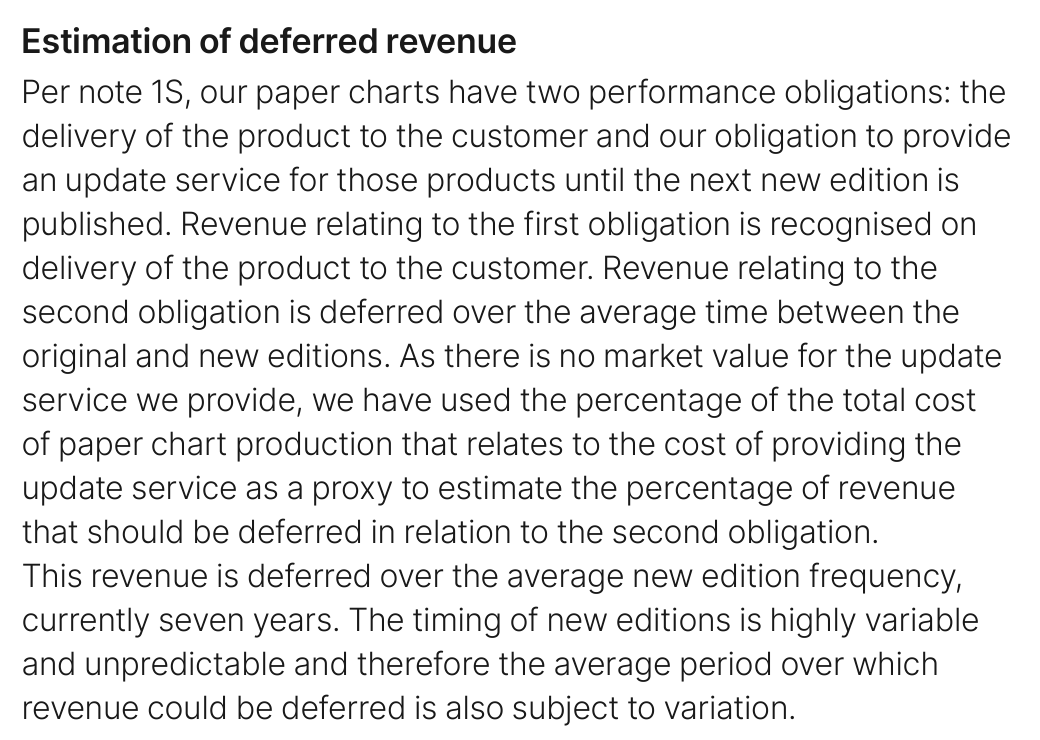
Disclosed estimates show how entity-specific this work is. The UK Hydrographic Office's 2025/26 report says its paper-chart update service has no market value, so it uses the share of production cost relating to updates as a proxy for the revenue to defer. That is one entity's policy for its own facts, not a universal rule, and it does not verify the figures below.
Worked hypothetical: brochure price against comparable sales
The following facts and amounts are hypothetical, in GBP and excluding VAT and other taxes. A customer pays a fixed £10,800 on 1 October 2026 for equipment delivered and controlled that day plus distinct uniform support from 1 October 2026 to 30 September 2027. All contract criteria and both recognition patterns are established. The equipment brochure lists £12,000, but documented recent separate sales to similar customers in similar circumstances are at £9,000. The assessment supports £9,000 as the observable stand-alone price and finds the list price unsupported for these customers. Comparable twelve-month support sells separately for £3,000. There is no financing, return right, variable amount or evidence tying the discount to one obligation.
With supported inputs, total stand-alone prices are £12,000. Equipment receives £10,800 × £9,000 / £12,000 = £8,100 and support £10,800 × £3,000 / £12,000 = £2,700. The brochure figure gives a £15,000 total instead, so equipment receives £10,800 × £12,000 / £15,000 = £8,640 and support £2,160.
Equipment revenue is recognised when control transfers on 1 October, so the wrong input pulls £540 of consideration that belongs to future support into day-one equipment revenue. Because revenue follows each transfer, the error then unwinds slowly through smaller monthly support revenue.
As a brief check at 31 December, supported support revenue is £2,700 / 12 = £225 a month, so three months give £675, cumulative revenue £8,775 and a contract liability of £2,025, together equal to the £10,800 received. The list-price route would show £9,180 of revenue at that date, £405 too high before costs.
| Input basis | Bundle cash | Equipment price | Support price | Total stand-alone prices | Equipment allocation | Support allocation |
|---|---|---|---|---|---|---|
| Supported comparable sales | £10,800 | £9,000 | £3,000 | £12,000 | £8,100 | £2,700 |
| Unsupported brochure list price | £10,800 | £12,000 | £3,000 | £15,000 | £8,640 | £2,160 |
| Difference | £0 | £3,000 | £0 | £3,000 | £540 | -£540 |
Sources and context, checked :
The discount follows the ratio unless evidence says otherwise
In the supported calculation the £1,200 bundle discount is split £900 to equipment and £300 to support. That proportionate result is the normal outcome, not an absolute rule. The discount can be allocated entirely to one or some obligations when all the paragraph 82 conditions are met on observable evidence, and variable consideration has separate allocation conditions. Neither applies here.
Before approving the ratio, keep the actual comparable separate sales, a note of why their customer class and circumstances match the bundle, and the reasons any list price was accepted or rejected. Where no direct evidence exists, document the estimation method and its observable inputs, and record the paragraph 79(c) facts before relying on a residual. A tidy ratio cannot repair an unsupported price.