
UK VAT deposits: date each tax point before choosing the return
One goods order can produce VAT in two quarters even when the customer makes only two payments. Under normal UK VAT accounting, an advance can create a tax point for part of the price, while dispatch and the issued invoice decide the rest. The later balance payment may create no new VAT at all.
Separate the advance from the remaining price
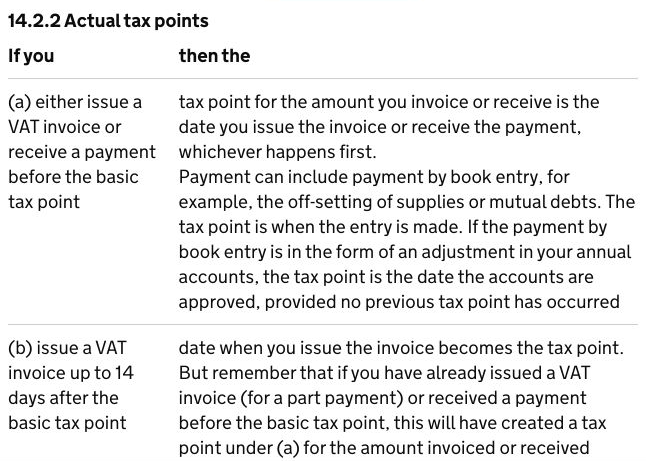
For ordinary dispatched goods, the basic tax point is normally dispatch or collection. An earlier payment or issued VAT invoice creates an actual tax point for the amount it covers. A VAT invoice issued within 14 days after the basic point normally overrides that point for the remaining amount.
That sequence matters when an order crosses a return boundary. The advance does not force the whole contract into its payment date, and the later invoice must not tax the advance again. Keep the amount already covered beside the balance still to be considered.
An invoice must actually be issued to the customer. Preparing a draft or entering an internal invoice date is insufficient. Also examine what a deposit represents: an advance payment normally creates a tax point, while genuine security for hired goods can differ. Calling money refundable does not automatically make it outside VAT.
A hypothetical order across September and October
The following events and amounts are hypothetical, in GBP. Ordinary goods have a fixed net price of £10,000 and the correct VAT rate is assumed to be 20%. The seller uses normal VAT accounting, with quarters ending 30 September and 31 December 2026. No special tax-point rule, approved extension or relevant election applies.
On 25 September the seller receives a gross advance of £3,600, with no earlier VAT invoice. Dividing by 1.2 gives £3,000 net; the £600 difference is VAT. Equivalently, £3,600 divided by six gives the VAT-inclusive fraction. This £600 belongs in the quarter ended 30 September.
The goods are dispatched on 30 September, leaving a net £7,000 balance. On 10 October the seller issues and sends a VAT invoice for that balance plus £1,400 VAT. Because issuance is within 14 days after dispatch, 10 October becomes the actual tax point for this remaining amount. Its £1,400 belongs in the quarter ended 31 December.
The customer pays £8,400 on 5 November. That settlement clears the invoiced balance; it does not create another £1,400 VAT charge. Across the order, £600 plus £1,400 equals £2,000, the VAT on the £10,000 net price. Gross receipts of £3,600 and £8,400 total £12,000.
| Event | VAT from this event | Return quarter |
|---|---|---|
| 25 September advance of £3,600 | £600 | Ended 30 September |
| 10 October balance invoice | £1,400 | Ended 31 December |
| 5 November settlement | No additional VAT | Already accounted for |
An invoice issued later can change the answer
In an independent alternative, suppose the balance invoice is first issued on 20 October. That is beyond 14 days after dispatch. With no approved extension or election changing the position, the remaining £1,400 stays at the 30 September basic tax point. Late invoicing does not, by itself, defer that VAT into October.
The amount and customer payment could look identical in the bank account under both scenarios. What changes the VAT period is the supported invoice-issuance event and its relationship to dispatch. This is why a receipts-only reconciliation cannot establish tax points under normal accounting.
For each order, retain dispatch evidence, advance amounts and dates, actual invoice issuance evidence, VAT already accounted for and the remaining amount. Reconcile total output VAT back to the whole price once. The Cash Accounting Scheme and special supplies have separate rules. This tax-point schedule also does not decide when financial-reporting revenue has been earned.
Sources and context, checked :