
Cash flow classification: split the payment before choosing a section
One line on the bank statement shows £5,500 paid to the lender. In the cash flow statement it may become two entries: £5,000 of loan principal in financing activities and £500 of interest in whichever section the business's policy uses. Under full IFRS, IAS 7 classifies cash flows by the nature of the activity, not by the bank description or the payee. Identify the components of each payment first, then choose the section for each one.
Nature decides the section
Operating activities are the entity's main revenue-producing activities and anything that is not investing or financing. Investing covers acquiring and disposing of long-term assets. Financing covers changes in equity and borrowings. A single transaction can contain cash flows in different sections, and a loan instalment made up of interest and principal is the standard's own example (IAS 7 paragraphs 6 and 10 to 17). Paying for a machine is investing even though the bank shows a supplier as payee.
Transactions that involve no cash, such as recognising a new lease liability and the related asset, are left out of the statement and disclosed elsewhere (paragraphs 43 to 44). This article is about ordinary trading businesses under full IFRS. Financial institutions and entities whose main business is investing or lending to customers need a specific assessment, and FRS 102 and US GAAP have their own rules.
Sources and context, checked :
One hypothetical month
The business pays £30,000 for a machine, draws £20,000 of new borrowing and makes the £5,500 repayment. Before any IFRS 18 adoption, it has a consistent policy of classifying interest paid as operating.
The sections total a £15,500 decrease, which must agree to the movement in cash. That agreement proves the bridge, not the categories. Putting the whole £5,500 in financing, or the machine in operating, would still balance.
| Component | Section | Inflow or (outflow) |
|---|---|---|
| Machine purchase | Investing | (£30,000) |
| New loan drawn | Financing | £20,000 |
| Loan principal repaid | Financing | (£5,000) |
| Interest paid | Operating, under this policy | (£500) |
| Net decrease in cash | (£15,500) |
Interest and dividends before IFRS 18
Current IAS 7 requires interest and dividends received and paid to be disclosed separately and classified consistently from period to period (paragraph 31). For entities other than financial institutions, interest paid may be operating or financing, interest and dividends received may be operating or investing, and dividends paid may be financing or operating (paragraphs 33 to 34). These choices are a policy, not an option to move items each year to improve a subtotal.
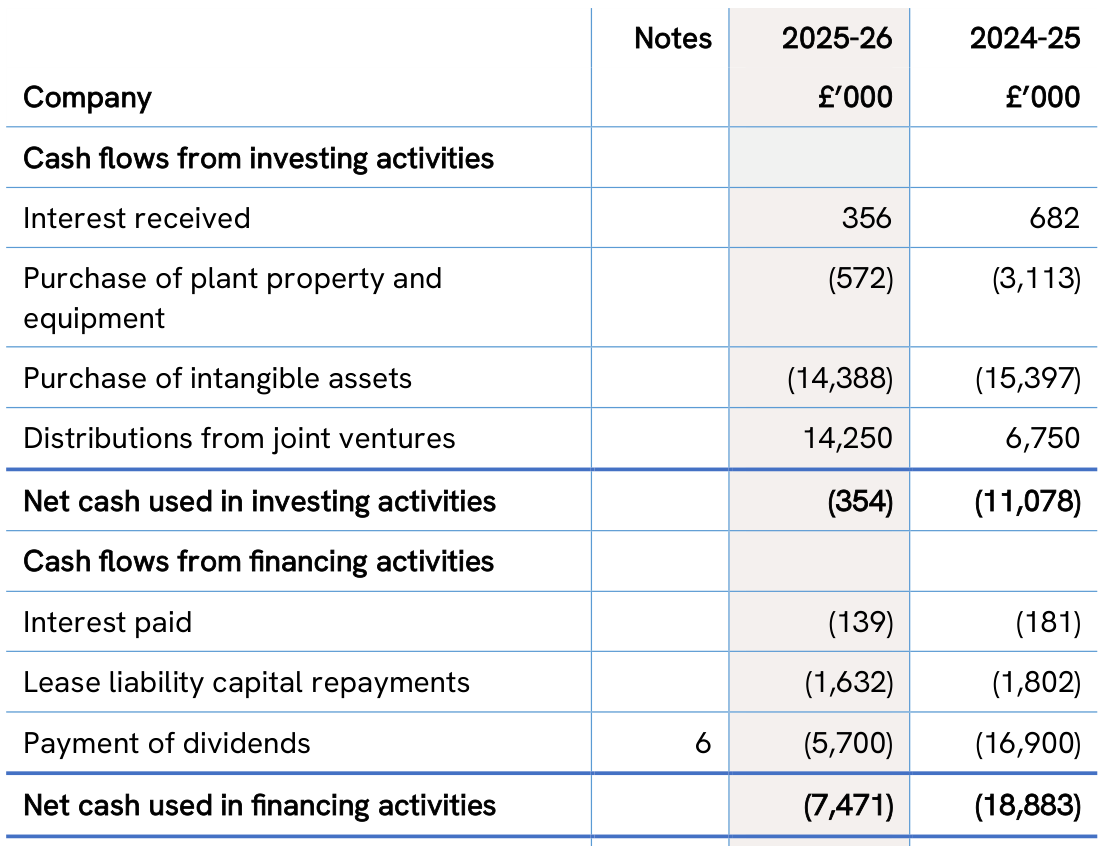
Ordnance Survey's company cash flow statement for 2025/26 is one published example: interest received appears in investing, and interest paid, lease principal and dividends paid appear in financing. It shows one entity's presentation under its framework, not a rule that applies to everyone today.
What changes with IFRS 18
IFRS 18 applies to annual periods beginning on or after 1 January 2027, with earlier application permitted where the relevant framework allows it. Once its amendments to IAS 7 apply, dividends paid are financing. An entity without the specified main business activities classifies interest paid as financing and interest and dividends received as investing. Entities that do have those activities follow separate rules that place each type of flow in a single category, so they need their own assessment. These cash flow sections are also not the same as the new IFRS 18 categories in the income statement.
In the example, the £500 of interest would move from operating to financing. Operating cash flow improves by £500, financing falls by £500, and the £15,500 decrease in cash does not change.
Keep a mapping file
List each recurring payment type with its components, the section each component goes to, the accounting policy that decides interest and dividends, and the reporting framework and effective date in use. Reconcile the sections to the cash movement after classifying. When IFRS 18 is adopted, update the mapping and expect operating cash flow to move with no change in the bank balance.