
Cloud software setup costs: expense, prepayment or intangible asset?
A business moving to a cloud finance system receives three bills: £24,000 from the software vendor for configuration, £6,000 from an independent consultant and £10,000 for new code linking the service to an existing system. Booking all £40,000 as one software asset hides three different questions. Under full IFRS, when the contract only gives access to software the supplier controls, configuration and customisation often create no asset the customer controls. The accounting then turns on who performs each service, whether it is distinct from the access, and when it is delivered. The amounts and assessments here are hypothetical.
Start with control of the software
The IFRS Interpretations Committee addressed this fact pattern in an agenda decision published in April 2021: a customer pays for the right to access the supplier's application software over the contract term, which makes the arrangement a service. The decision explains how existing standards apply. It did not introduce a new effective date, and it is not a summary of US GAAP or FRS 102 rules for cloud costs.
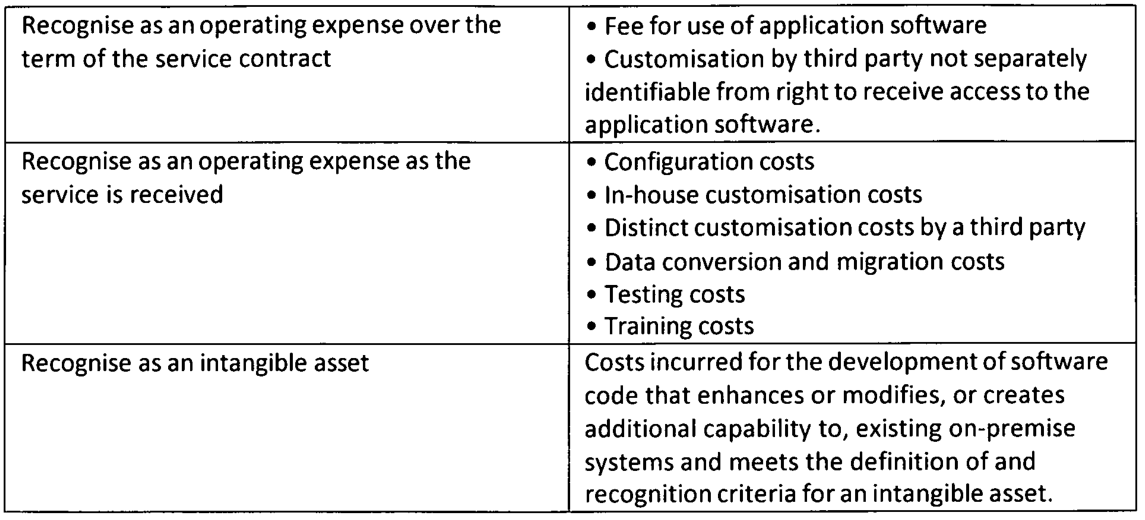
Configuration usually sets options within the supplier's existing application. Customisation can change that code or add new code. The label does not decide the result. Additional code is an intangible asset only if it meets the IAS 38 definition, including control by the customer, and the recognition criteria. Being able to use a configured service is not control of a software asset, and an expectation of long-term benefit is not enough on its own.
Without an asset, timing follows the service
If no intangible is recognised, the decision sets out when the cost becomes an expense. Implementation work by the SaaS supplier that is distinct from the access is expensed when the supplier performs it. Supplier work that is not distinct from the access is expensed as the access is provided over the contract term. Work owed by an independent third party is expensed when that party performs it. Paying before any of these services arrive creates a prepayment, released as the services are received.
Identify which party actually owes each service. A consultant the customer hires directly is not the same as a subcontractor working for the vendor under the vendor's promise. The Student Loans Company's 2025/26 accounts show one published policy that separates spending recognised over the service term, spending recognised as services are received and qualifying code held as an intangible asset. That policy reflects its own arrangements and does not replace the analysis of each contract.
Three bills, three treatments
The vendor's £24,000 is paid before a 24-month access period, the configuration is assessed as not distinct from access, and the benefit is assumed to arrive evenly. On payment: Dr prepayment £24,000; Cr cash £24,000. Each month: Dr software service expense £1,000; Cr prepayment £1,000. After 12 months, £12,000 remains prepaid. That balance is not amortised as a software intangible, and the go-live date alone does not set the expense timing.
| Bill | Assumed facts | Treatment |
|---|---|---|
| Vendor configuration, £24,000 | Paid up front; not distinct from 24 months of access | Prepayment, expensed £1,000 a month as access is provided |
| Independent consultant, £6,000 | Distinct service; no code the customer controls | Expense as the consultant performs the work |
| New integration code, £10,000 | Needs its own assessment | Intangible asset only if the customer controls the code and every IAS 38 criterion is met |
Sources and context, checked :
What to ask procurement and IT
Before assigning a project code, list each promised deliverable, which party owes it, what rights the business has over any code and any restrictions on its use, and when each service is performed and paid for. Keep a delivery schedule for anything prepaid. With that record, the £40,000 splits into treatments that can be explained to a reviewer instead of one asset that cannot.