
Fixed asset registers: trace each asset from purchase to disposal
Take a hypothetical business that sells an old packing machine in March. The buyer pays, collects it and signs a delivery note. In December, the ledger still carries the machine at cost and has charged depreciation every month since the sale, because nobody updated the asset records. A purchase-only list left unreconciled to disposals can miss a sale like this. A register that ties each asset to its documents, location, custodian, book value and disposal, and that is updated from disposal evidence, gives the reviewer a way to catch it.
What belongs on the register
For entities applying IFRS, the IFRS Foundation's overview of IAS 16 describes property, plant and equipment as tangible items held for use in production, supply, rental or administration and expected to be used over more than one period. An item is recognised when future economic benefits are probable and its cost can be measured reliably, and initial cost can include qualifying directly attributable costs as well as the purchase price. The overview sets no universal capitalisation threshold, useful life or register format. This article covers owned tangible equipment. Leases, intangibles and specialist asset classes need their own assessment.
Sources and context, checked :
Columns that make the register checkable
We suggest the fields below, including location and custodian as practical controls. Adapt the layout to your own systems and reporting framework.
- Asset ID, description, serial or tag number and owning legal entity
- Supplier, invoice and commissioning documents
- Acquisition date and date available for use, which can differ
- Recognised cost and its components, and the asset account
- Location and named custodian
- Approved useful life, residual value and depreciation method
- Accumulated depreciation, impairments or other value changes, and carrying amount
- Disposal date, proceeds, supporting document and reviewer
A worked book depreciation example
Now take a newly bought machine, delivered in March, with a recognised cost of 12,000, zero residual value, an approved four-year useful life and straight-line depreciation charged monthly from 1 April 2026, the date it became available for use. These are illustrative inputs for this example. The business must determine its own depreciation policy and estimates under its reporting framework. There are no impairments, additions or disposals, and the reporting date is 31 December 2026.
Nothing in the calculation depends on when the supplier invoice is paid.
| Item | Calculation | Amount |
|---|---|---|
| Annual depreciation | 12,000 / 4 | 3,000 |
| Monthly depreciation | 3,000 / 12 | 250 |
| Charge for April to December 2026 | 250 x 9 | 2,250 |
| Carrying amount at 31 December 2026 | 12,000 - 2,250 | 9,750 |
Keep tax figures separate
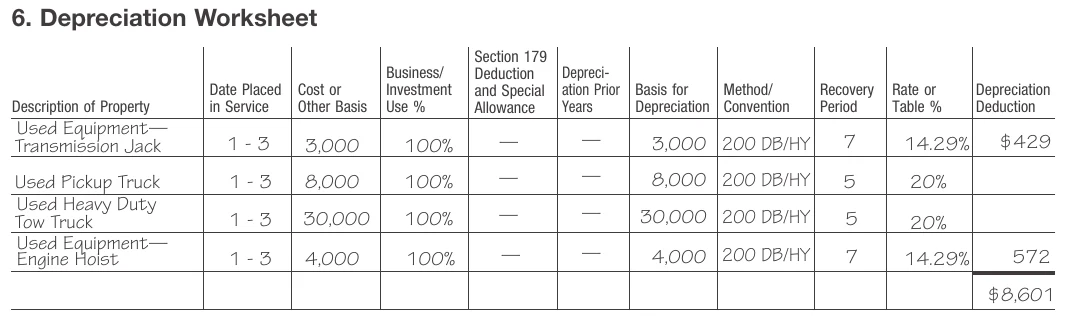
These are book figures. For US federal tax, IRS Publication 946 (2025 edition) treats property as placed in service when it is ready and available for its specific use. MACRS applies to most business property placed in service after 1986. Its calculation uses the property's class, basis, method, recovery period and convention. The result can differ from the monthly book charge, and conventions can change the first-year figure. For business assets, the IRS also lists acquisition, cost, improvements, use, depreciation and disposal details among the records needed, including sale price and selling costs. Keep tax basis and tax depreciation in separate columns or a linked tax schedule.
Check the register against the floor
At review, trace additions to invoices and commissioning evidence, and ask each custodian to locate the material items in their care. A missing item, a replacement arriving or a machine sitting idle is a question to investigate, and none of them by itself establishes a disposal. When a sale is confirmed, as with the packing machine, record the date, proceeds and document so the accountant can remove the asset and account for the sale. Keep disposed items on the register with their status, and keep fully depreciated items that are still in use. Reconcile cost and accumulated depreciation separately to their ledger accounts.
This month, take the five largest items on the register and confirm their location, status and custodian. Then trace their cost, depreciation and carrying amount to supporting records and the ledger.