
Finance staff leaving: remove access and hand over the open work
A contract bookkeeper's last day is Friday. Access removal is scheduled for the authorised departure time on Friday. At Monday's handover review, the finance owner needs evidence for two answers. Can the bookkeeper still reach the ledger, the bank, payroll or the tax portals? And who now owns the supplier questions and half-finished reconciliations the bookkeeper was handling? One is an access question and the other a workload question, and answering one does not answer the other. Both need the IT owner, the finance owner and a successor who works from their own approved account.
Treat leaving as a planned process
The UK National Cyber Security Centre recommends a joiners, movers and leavers process so that access changes or ends when it is no longer needed. Its guidance extends to contractors and to external services where work identities are used. It also covers audit records that tie system actions to individuals, and privileged access, which in finance includes the people who approve payments.
This is cyber security guidance, not a legal deadline or a finance retention schedule. Movers matter too. A role change does not by itself prove that old payment-approval rights have ended.
Sources and context, checked :
List every route in
We recommend starting with an inventory of everything the person could reach:
- The accounting ledger and any reporting tools
- Online banking, payment approvals and bank mandates
- Payroll, expense and tax portals
- Shared inboxes, shared files and password manager entries
- Access delegated to them by others
- Integrations or connections set up under their own account
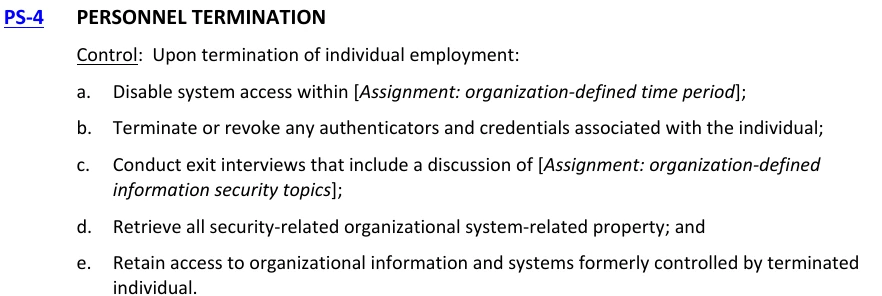
Disabling an account takes several steps
Do not assume single sign-on covers every access route. Check each system for a direct login too. Bank mandates, payee-change approvals and tax portal delegations may need the provider's own process.
Microsoft's guidance for Microsoft 365 separates blocking sign-in, signing the user out of existing sessions and resetting the password, and warns that some of these do not take effect immediately. Saving mailbox contents, giving others access to business content, legal holds and finally removing the licence or deleting the account come as later, separate steps.
Those are Microsoft 365 features; other products work differently, so follow each product's current guidance. Arrange integration ownership and replacement credentials before departure where possible. At the authorised cutoff, revoke the person's access, sessions and individual tokens, and rotate affected shared credentials through the administrator's process. Do not leave their access active while waiting for a handover. If a feed into the ledger stops as a result, pause the affected work, record the interruption and name who will restore it.
Two counts that must both reach zero
In this hypothetical departure, the bookkeeper appears on an inventory of eight systems and has twelve open finance items.
| Check | Total | Handled | Still open |
|---|---|---|---|
| Access: systems on the inventory | 8 | 5 through the central identity, verified after disabling | 3 direct logins to remove separately |
| Work: open finance items | 12 | 7 supplier questions to one colleague, 5 reconciliations to another | 0 unassigned |
Read the counts separately
The arithmetic is 8 - 5 = 3 and 12 - 7 - 5 = 0. The counts are independent. Zero unassigned tasks says nothing about whether the three direct logins still work, and zero active logins says nothing about whether the reconciliations have an owner. Each reassigned item needs a due date and the location of its evidence. Pending payment runs and filing deadlines belong on the same list.
Keep the records, not the login
Ending access does not mean deleting the person's historical approvals or audit trail. Before deleting anything, preserve the records and audit trails the business must keep, under its retention policy and any legal hold. A product's recovery window is not a retention schedule.
The successor works from their own account. Do not share the former employee's password or leave their login active to reach old files; either breaks the link between each action and one person. For every system and every reassigned item, record who verified the result and when. That record is what the finance owner signs at Monday's review.