
Asset grants under IAS 20: release the grant as the asset depreciates
A company receives 40,000 from a government scheme towards a 100,000 machine. The cash is in the bank, but under IAS 20 as adopted in the UK receipt alone does not decide when a grant reaches profit. Because this grant funds a new machine that will be depreciated in future periods, it is not profit on the day it arrives. It is recognised only once there is reasonable assurance that the company will comply with the conditions and that the grant will be received. It then reaches profit or loss over the periods in which the machine's depreciation does. The finance team chooses one of two presentations: deferred income released alongside depreciation, or a deduction from the asset's carrying amount. Both give the same profit. Mixing them counts the grant twice.
Is it a grant, and is it assured?
IAS 20 covers government grants: transfers of resources to an entity in return for past or future compliance with conditions relating to its operating activities. It excludes certain tax-based benefits, government participation in ownership and grants covered by IAS 41 on agriculture (IAS 20, paragraphs 1 to 3). A government body paying for goods it buys is a customer, not automatically a grantor.
Recognition needs reasonable assurance of two things: that the entity will comply with the attached conditions and that the grant will be received. Receiving the cash does not by itself show that the conditions will be met (paragraphs 7 to 8). Reasonable assurance does not require every future condition to have been fulfilled already, but it does require evidence that the entity will fulfil them.
Two presentations, one result
Grants are recognised in profit or loss on a systematic basis over the periods in which the entity expenses the related costs. For a depreciable asset that usually means in proportion to depreciation (paragraphs 12 and 16 to 19). IAS 20 then permits two presentations. The grant can be shown as deferred income, or deducted in arriving at the asset's carrying amount, so the benefit arrives through lower depreciation (paragraphs 24 to 27).
This example is hypothetical, in generic currency units, and assumes the recognition conditions are already supported. Equipment costs 100,000 and the grant is 40,000. The asset has a five-year life, nil residual value, straight-line depreciation and a full first year of use. There is no tax, impairment, revaluation or repayment.
Under the deferred income method, the receipt is Dr cash 40,000, Cr deferred grant income 40,000, and the year-end release is Dr deferred grant income 8,000, Cr grant income 8,000. Under the net method, the receipt is Dr cash 40,000, Cr equipment 40,000, and depreciation is 60,000 ÷ 5 = 12,000. Use one method. Reducing the asset's cost and also releasing 8,000 counts the grant twice. Neither release brings in any cash.
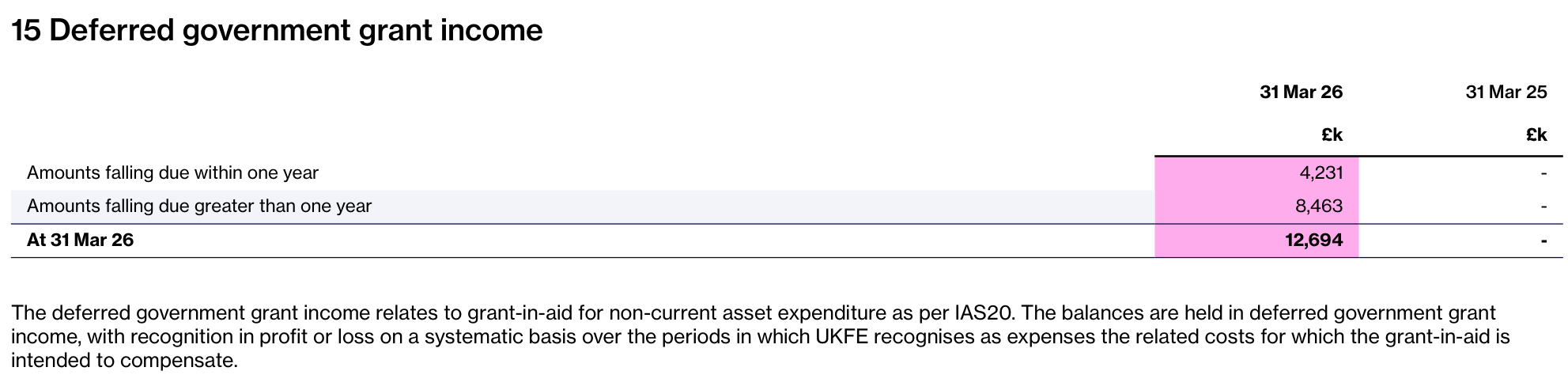
UK Fusion Energy's 2025/26 accounts, published on 13 October 2026, show the deferred income approach in a public-sector company. Note 15 reports £12.694 million of deferred grant income for non-current asset grant-in-aid, £4.231 million due within a year and £8.463 million after, and describes releasing it in line with the related costs. Its accounts also apply Treasury FReM interpretations, so its arrangement is an example rather than the rule for every grant.
| Hypothetical year 1 | Deferred income method | Net asset method |
|---|---|---|
| Asset recognised | 100,000 | 60,000 |
| Deferred grant at start | 40,000 | Nil |
| Depreciation charge | 20,000 | 12,000 |
| Grant income released | 8,000 | Nil |
| Net cost in profit or loss | 12,000 | 12,000 |
| Asset carrying amount at year end | 80,000 | 48,000 |
| Deferred grant at year end | 32,000 | Nil |
| Asset less deferred grant | 48,000 | 48,000 |
When a condition is at risk
A grant whose conditions may be breached is not permanently earned. If a grant becomes repayable, IAS 20 treats the repayment as a change in accounting estimate. For an asset grant, the repayment reduces the deferred income balance or, where the grant was deducted from the asset, increases the asset's carrying amount. In that second case, the cumulative additional depreciation that would have been charged without the grant is recognised immediately (paragraphs 32 to 33). Under the deferred income method the asset has already been depreciated on its full cost, so there is no depreciation catch-up. Disclose the accounting policy and presentation method, the nature and extent of grants recognised, and unfulfilled conditions and other contingencies (paragraph 39).
Not every grant follows depreciation. A grant that compensates for expenses or losses already incurred, or gives immediate financial support with no future related costs, is recognised in profit or loss when it becomes receivable (paragraph 20). Grants for non-depreciable assets or with mixed conditions need their own allocation. This article covers a depreciable asset grant under full UK-adopted IFRS, not FRS 102, tax reliefs or scheme eligibility.
A grant register that holds up at close
We suggest a register tied to both the grant agreement and the asset register. For each grant, record its purpose, asset ID, eligible spending, evidence of receipt or receivable, each continuing condition and deadline, the reasonable assurance assessment, the chosen presentation, the date the asset became available for use, the depreciation pattern, the release calculation, the closing balance and an owner. Reconcile opening deferred grant plus additions, less releases and repayments, to the closing balance.
Review the conditions with the operational owner each close, especially any requirement to keep the asset in a location, use it for a purpose or hold it for a minimum period. A threatened breach goes to the accounting owner before that month's routine release is posted.
Before the next grant journal
Attach the grant agreement and the first-year depreciation schedule to the journal, so the reviewer can see that the release follows the asset it funds.