
Intercompany reconciliation: agree each pair before eliminating it
At month end, Entity A's ledger shows 18,400 owed by its sister company, Entity B. Entity B's ledger shows 15,000 owed to A. The quick fix is a single 3,400 adjustment in whichever ledger is easier to change. But a reconciliation has to explain both sets of records, and a consolidation elimination should remove only amounts that genuinely correspond. Hiding an unexplained difference in either step leaves at least one entity's books wrong.
Reconciliation and elimination are different jobs
Reconciliation happens in the entities' own books. Each side's record of the balance is compared with the other's, and every difference is explained and, where needed, corrected by the entity that made the error.
Elimination happens in the group accounts. Under UK-adopted IFRS 10, paragraph B86(c) requires consolidated statements to eliminate in full intragroup assets, liabilities, equity, income, expenses and cash flows, including profits recognised in inventory and fixed assets. Paragraph B87 deals with adjustments where group members use different accounting policies. Elimination does not delete the balance from either entity's own ledger, which keeps it until settlement or another supported entry. Whether a related company belongs in the consolidation at all is a separate question.
Sources and context, checked :
A worked reconciliation
This example is hypothetical. Both entities report at the same date in the same currency, the balances are reciprocal trade balances, and there is no tax or foreign exchange. B's payable is shown as a positive amount so the two columns compare directly.
Two omissions explain the 3,400. B never recorded a supported 3,000 invoice for work it received, and A never recorded a 400 credit it had agreed and documented. Each correction belongs in a different entity's journal, with different evidence. One 3,400 plug would have made the totals agree while leaving both errors in place.
Each entity now carries an 18,000 balance it can support. The group consolidation eliminates the pair, and both ledgers keep the 18,000 until it is settled.
| Item | A receivable from B | B payable to A |
|---|---|---|
| Balance per ledger | 18,400 | 15,000 |
| Invoice for work received, missing from B's ledger | +3,000 | |
| Agreed credit, missing from A's ledger | -400 | |
| Agreed balance | 18,000 | 18,000 |
Classify the difference before correcting it
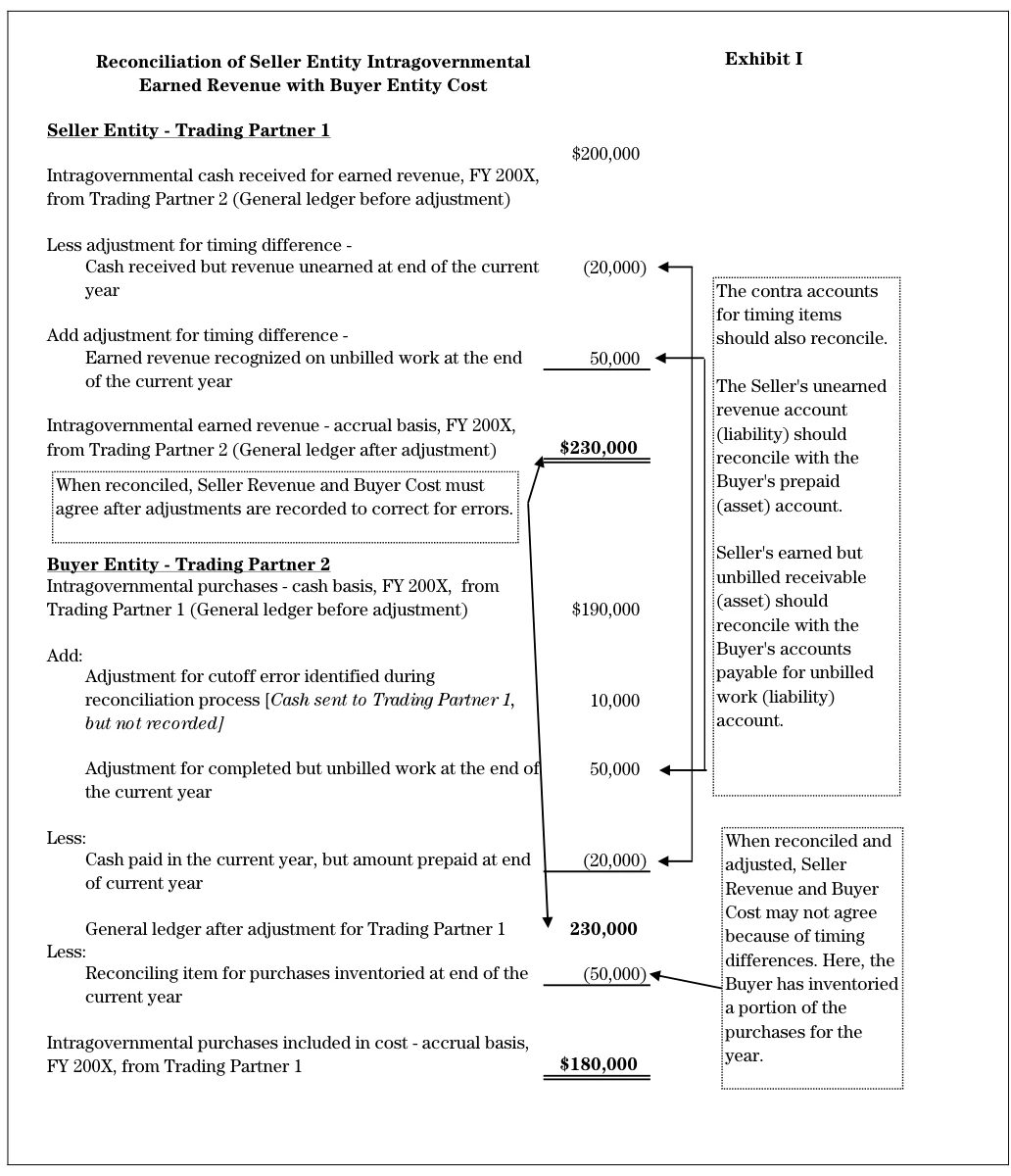
Section 902 of the GAO/PCIE Financial Audit Manual, a July 2008 US federal audit manual, warns against making buyer balances agree to seller records without an adequate reconciliation or confirmation of delivery. It recommends identifying the trading partner, agreeing the ledgers, explaining differences and reviewing elimination entries separately. Its systems and deadlines are historical, but the control lesson still applies.
Its Exhibit I also shows why balances are not the whole test. The seller records 230,000 of revenue, while the buyer records 180,000 of expense because 50,000 of the purchases remain in inventory. Income and expense do not have to mirror each other, so do not force them to.
Before posting anything, give each gap a type: a missing invoice or credit, a cut-off difference, cash in transit, a wrong counterparty, a coding or policy difference, or translation. Each needs different evidence. Two items with the same amount are not necessarily the same transaction.
Sources and context, checked :
Currency differences can survive elimination
Under UK-adopted IAS 21, an intragroup monetary asset and liability cannot be eliminated without showing the results of currency fluctuations in the consolidated statements. Paragraph 45 generally points those differences to profit or loss. Where paragraph 32 applies, as with a qualifying net investment in a foreign operation, they go to other comprehensive income instead.
So a matched intragroup loan or invoice does not make every exchange difference disappear, and an unexplained plug should not be used to zero one. Keep the transaction currency, each entity's functional currency and the group's presentation currency in separate columns.
Sources and context, checked :
A pairwise sign-off
Our recommended routine for each intercompany pair:
- Record both legal entity names and identifiers, the period, the relationship, the account type and the original transaction currency, and use one sign convention for the comparison.
- Match invoices, credits and settlements by reference at transaction level before comparing translated totals.
- Agree supported corrections with both entity owners, and keep the references, journal IDs, any remaining differences and the approvals.
- Give consolidation staff the agreed balances with a separate elimination schedule.
At the next close
Start with the pair that has the largest unexplained difference, and match it at invoice level before anyone proposes an adjusting entry. This routine does not settle transfer pricing or legal set-off questions; those need their own review.