
Inventory net realisable value: when counted stock is worth less than cost
The year-end count finds all 100 units on the shelf, exactly as the records expect. Each unit cost 40. The expected selling price of 45 looks safe until the 8 it costs to finish each unit and the 3 it costs to sell it are taken off. That leaves 34. The stock is all there, and it is still overstated by 600. For ordinary goods held for sale under UK-adopted IFRS, a full shelf does not settle the valuation. A count confirms quantity. Net realisable value asks what the business expects to recover.
What IAS 2 asks
UK-adopted IAS 2 defines net realisable value as the estimated selling price in the ordinary course of business, less the estimated costs of completion and the estimated costs necessary to make the sale. Paragraph 9 measures inventory at the lower of cost and net realisable value. Paragraphs 28 to 31 explain why cost may not be recoverable, such as damage, obsolescence, falling prices or rising costs to complete or sell. They expect a write-down usually item by item, based on the most reliable evidence available when the estimate is made, and treat inventory held for firm sales contracts separately.
IAS 2 allows similar items to be grouped in some cases, but not a write-down of a whole class, such as all finished goods, or a whole segment because some lines are impaired. This article covers ordinary goods for sale. Raw materials, commodity broker-traders and agricultural produce have their own scope or measurement points, and US GAAP and tax rules can differ, particularly on reversals.
Sources and context, checked :
The first estimate
This example is hypothetical. The batch holds 100 identical units, already counted and still on hand. Amounts are in pounds, with no tax or foreign exchange. The table identifies the per-unit figures and the batch total. Finishing and selling costs are supported estimates and are not part of the recorded inventory cost.
Under paragraph 34, the 600 write-down is an expense in the period it occurs. The count needs no adjustment, because nothing is missing. Quantity and value are separate questions.
| Measure | Amount |
|---|---|
| Expected selling price | 45 |
| Less cost to complete | -8 |
| Less costs necessary to sell | -3 |
| Net realisable value | 34 |
| Cost | 40 |
| Carrying amount, the lower of the two | 34 |
| Write-down per unit | 6 |
| Write-down for 100 units | 600 |
Support each input
Each of the three inputs needs its own evidence. Our recommended file supports the selling price with sales contracts and actual recent selling prices for the same goods in the same condition, the cost to complete with the production estimate for the remaining work, and the selling cost with what the business actually spends to make that kind of sale. An ageing percentage applied across the board, or a sales target, is not evidence of net realisable value on its own. Date the estimate and name who prepared it.
When the estimate improves
Paragraph 33 requires a fresh assessment each period. Suppose that at the next reporting date all 100 units are still held and supported evidence now points to a selling price of 49, with the same finishing and selling costs. Net realisable value becomes 38. The carrying amount rises to 38 a unit, or 3,800, and the 400 reversal reduces the inventory expense recognised in that period.
The reversal has a ceiling. It is limited to the original write-down, and the new carrying amount is the lower of original cost and revised net realisable value. If supported net realisable value had risen to 43 instead, the units would return to their cost of 40, a total of 4,000, and the reversal would stop at 600. Inventory is never written above cost.
Sources and context, checked :
A published example
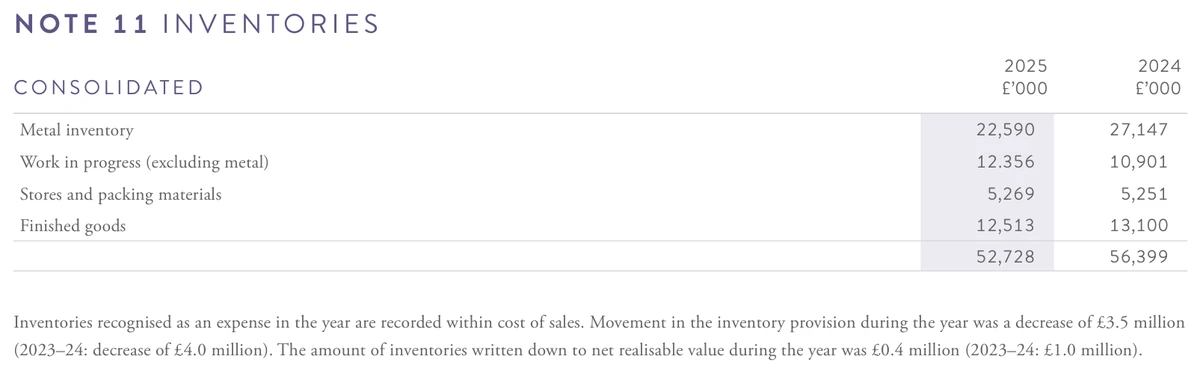
The Royal Mint Trading Fund's 2024-25 inventory note reports £0.4 million of inventory written down to net realisable value in the year. The same note shows a £3.5 million decrease in its inventory provision, which is a different figure and should not be read as a £3.5 million reversal. These are public-sector accounts prepared under their own framework, an illustration rather than a template.
Sources and context, checked :
At this reporting date
List the stock lines with recent price falls, damage or slow sales. For each, record a dated estimate showing the price evidence, cost to complete, selling cost, net realisable value and carrying amount, and put the next reassessment in the close calendar for the following reporting date.