
Project profitability: add the cost to finish before trusting the margin
Partway through a fixed-fee job worth 120,000, the job report shows 35,000 of supplier bills against a 90,000 cost budget. With 55,000 of budget apparently unused, the job looks on course for its planned 30,000 margin. That view leaves out work already done but not yet invoiced, and the cost of the work still to do. Once both are counted, the forecast margin can turn out to be a fraction of the plan, while there is still time to act on it.
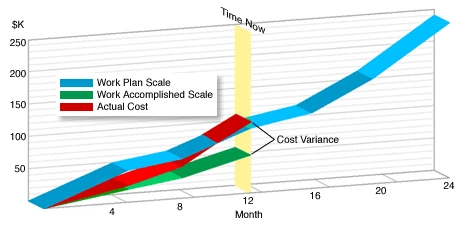
Spending is not progress
NASA's earned value management tutorial separates three measures: the work planned to date, the work actually accomplished valued at its budget, and the cost actually incurred. In its illustration, planned value is 100,000, earned value is 60,000 and actual cost is 110,000, a cost variance of minus 50,000. The tutorial says the task manager uses that performance information, together with knowledge of the task, to project the cost to finish.
The lesson for a business job is narrower than adopting NASA's method. Comparing spending with budget does not measure progress. Spending less than planned can simply mean less work has been done.
Sources and context, checked :
A worked forecast
This example is hypothetical. It is a management job-cost view that ignores tax and assumes the fixed fee stays at 120,000. It says nothing about when revenue is recognised in the accounts.
The latest estimated cost is 20,000 over the original budget. The 25,000 commitment is already inside the 65,000 estimate to finish, so it must not be added again. An order for work not yet performed is a commitment, not a cost incurred. When the supplier later invoices the 10,000 of work already captured, that invoice is matched against the cost already captured rather than added to it.
| Line | Amount |
|---|---|
| Fixed fee | 120,000 |
| Original estimated cost | 90,000 |
| Original expected margin (25% of fee) | 30,000 |
| Supplier costs posted to date | 35,000 |
| Work done and evidenced, not yet invoiced | 10,000 |
| Cost incurred to date | 45,000 |
| Revised estimate to finish, including 25,000 of committed but unperformed work | 65,000 |
| Latest estimated total cost | 110,000 |
| Forecast margin (about 8.3% of fee) | 10,000 |
Capture the cost to date
Our recommended practice is to put one job ID on staff time, subcontractor bills, materials, expenses and supported accruals, and to agree how direct labour and overhead are charged so margins can be compared across jobs. At each cut-off, reconcile the job-cost detail to the ledger and look for missing time, work done but not yet billed by suppliers, and costs coded to the wrong job.
Estimate what is left
The person running the project is best placed to list the remaining tasks and quantities and price them at currently expected rates, including approved scope changes and any risk items with a stated basis. Track ordered but unperformed work as commitments and show which of them sit inside the estimate to finish.
Keep the original estimate frozen and record each later forecast with a short explanation of what changed. A new forecast does not reset the budget history, and that history is what shows when the margin started to slip.
What the forecast is not
Fee less estimated total cost is a management estimate of whole-job margin. It is not profit already earned, cash in the bank or a percentage-of-completion figure for the accounts. Invoicing, cash collection and revenue recognition each follow their own rules. The forecast is only as good as the task list and the cost inputs behind it.
Start with one job
Choose the fixed-price job with the most work still to do. Ask its project owner for a dated estimate of the cost to finish, add it to the cost incurred to date, and compare the total with the fee while scope and pricing can still be discussed with the client.