
Retained earnings rollforward: keep profit apart from owner movements
An owner compares two year-end balance sheets and sees total equity rise from 50,000 to 67,000. The income statement shows 18,000 of profit after tax. Neither figure explains the other until equity is broken into its components. A rollforward that starts from each opening balance and lists every movement separately stops a share contribution passing for profit and a distribution passing for an expense.
What the standard separates
Under UK-adopted IAS 1, paragraphs 106 to 110, the statement of changes in equity reconciles each component of equity from its opening to its closing balance. It shows profit or loss, other comprehensive income and transactions with owners separately, with contributions by owners and distributions to owners identified on their own lines. Share capital and other contributed equity, accumulated other comprehensive income and retained earnings are separate components. Retrospective corrections and restatements adjust opening balances, usually retained earnings unless another component is affected.
That is a presentation requirement for entities reporting under UK-adopted IFRS. Many smaller UK and US entities report under other frameworks, but the same structure works as an internal review schedule.
Sources and context, checked :
A published example
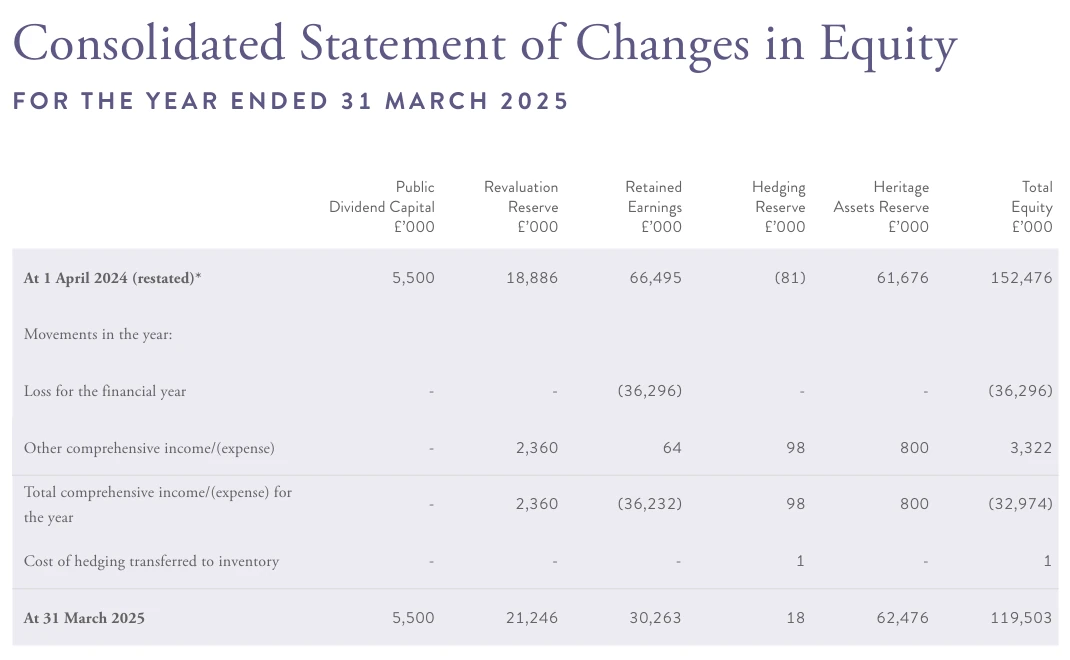
The Royal Mint Trading Fund's 2024-25 consolidated statement of changes in equity shows the structure in use. In thousands of pounds, retained earnings open at a restated 66,495, fall by a loss of 36,296, rise by 64 of other comprehensive income and close at 30,263. Its other reserve columns move separately. These are public-sector group accounts under their own reporting framework, not a template for a small company, and most private businesses will not need the same reserves.
Sources and context, checked :
A worked rollforward
This example is hypothetical. Profit is after tax. The distribution was properly recognised and the share contribution qualifies as share capital. There is no other comprehensive income, restatement, reserve transfer or tax on the distribution.
Total equity moved by 17,000, which is 18,000 of profit, less 6,000 distributed, plus 5,000 contributed. The 5,000 increases contributed equity. It is not sales and it does not touch retained earnings. The 6,000 is a transaction with owners, not an operating expense. Nothing in this schedule shows whether a dividend was legally available to pay.
| Component | Opening | Profit | Distribution | Share contribution | Closing |
|---|---|---|---|---|---|
| Retained earnings | 40,000 | 18,000 | -6,000 | 52,000 | |
| Share capital | 10,000 | 5,000 | 15,000 | ||
| Total equity | 50,000 | 18,000 | -6,000 | 5,000 | 67,000 |
Points to check before signing off
Our suggested checks for each close:
- Start from the prior period's approved closing balances and tie each column to the current trial balance. If an opening figure has been restated, keep the bridge back to the originally approved number.
- Link current profit to the approved income statement, and check whether the software has already closed it into retained earnings so it is not added twice.
- Trace each contribution and distribution to approvals, registers and bank or payable entries. An owner's bank transfer is not automatically profit or a dividend.
- Give retrospective errors and accounting policy changes their own evidenced treatment under the applicable framework rather than posting them through this period's profit.
What the rollforward does not tell you
Retained earnings is not cash available to withdraw. The bridge explains accounting movements, not a bank balance. Opening retained earnings plus profit less distributions is also a simplification that breaks down when other comprehensive income, restatements or reserve transfers are involved. Sole traders and partnerships usually work with owner capital or partner accounts instead, and none of this is a legal test for distributions.
At the next close
Build the rollforward before finalising the balance sheet: one column per equity component, one row per movement, and each row traced to an approved document.