
Three-way invoice matching: separate receipt gaps from price gaps
A supplier invoice for 2,100 arrives against a purchase order for 2,000. The difference looks like 100, and someone might approve it as a small price rise. Compare the invoice with what was actually received and accepted, and the gap is 500: 400 for 20 units not yet received and 100 for a price increase on every invoiced unit. Those are two separate questions for two different people. Three-way matching keeps them apart before anyone approves the bill.
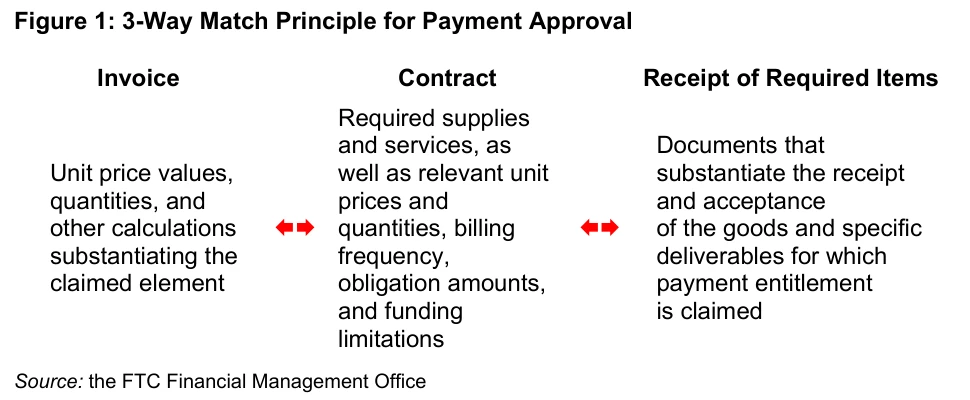
What each document proves
A purchase order records what was agreed: the item, quantity, unit of measure and price. A receipt or acceptance record shows what actually arrived and was accepted. The invoice is the supplier's claim. A three-way match tests the claim against both.
A diagram in a December 2023 audit report by the FTC Office of Inspector General, credited to the FTC's Financial Management Office, sets out this comparison for payment approval: the invoice, the contract terms, and evidence that goods or deliverables were received and accepted. The report covers the FTC's own time-and-materials and labor-hour contracts, so it illustrates the control rather than setting a rule for other businesses.
Sources and context, checked :
How one system checks it
Microsoft's documentation for Dynamics 365 Finance compares the invoice quantity with the quantity on the matched product receipt, and invoice prices with purchase order prices, within tolerances the business configures. Its examples show that a missing receipt entry can fail the quantity match even when the goods arrived, and that a unit price can fail while the invoice total still passes. Depending on configuration, an invoice with a mismatch can be posted after approval.
The tolerance percentages in those examples are illustrations. They are not recommended thresholds, and each business sets its own.
Sources and context, checked :
A worked example
This example is hypothetical, in generic currency units, with tax and freight ignored. A business orders 100 units at 20, receives and accepts 80, and the supplier invoices for 100 units at 21. There are no earlier invoices on the order.
Against the order total, the invoice is only 100 higher. Against what was received at the agreed price, it is 500 higher, and that 500 has two parts:
| Document | Quantity | Unit price | Amount |
|---|---|---|---|
| Purchase order | 100 | 20 | 2,000 |
| Received and accepted | 80 | 20 | 1,600 |
| Invoice | 100 | 21 | 2,100 |
- Quantity gap: 20 units invoiced but not received, at the agreed price of 20, is 400.
- Price gap: 1 more than agreed on each of the 100 invoiced units is 100.
Why the split matters
The price gap is measured on all 100 invoiced units, so the quantity gap values the 20 missing units at the agreed 20. Valuing them at 21 there would count their price increase twice.
The receiving owner deals with the 20 units. A missing receipt entry is not proof that nothing arrived, so they check whether the goods came and were not recorded, were rejected or returned, or are still outstanding. The purchasing owner deals with the price: either there is an approved price change, or the increase is disputed with the supplier.
We suggest recording each exception with its owner and the evidence needed, and approving a genuine change through whoever holds purchasing authority. Editing the order just to clear the warning removes the record of what was agreed.
The 1,600 that does match is not automatically the amount you are legally obliged to pay. Payment rights follow the contract, and the arithmetic alone does not establish a right to part-pay.
Partial deliveries, services and limits
Match line by line on item, unit of measure, net price, receipt reference and accepted quantity. When goods arrive in several deliveries, cumulative receipts and earlier invoices on the same order matter. For services, use contract deliverables, approved hours or milestone evidence rather than inventing a warehouse receipt. Deposits and other contractual payment stages need their own approval route.
Holding an invoice is a payment decision. Goods or services already received may still need recording at month end, so keep the two decisions apart. And a clean match does not verify the supplier's bank details or stop collusion between a buyer and a supplier.
For the invoices now on hold
Before the next payment run, write the receipt gap and the price gap for each held invoice as separate amounts, each with a named owner and the document that would resolve it.