
Corporation Tax: count associated companies across the accounting period
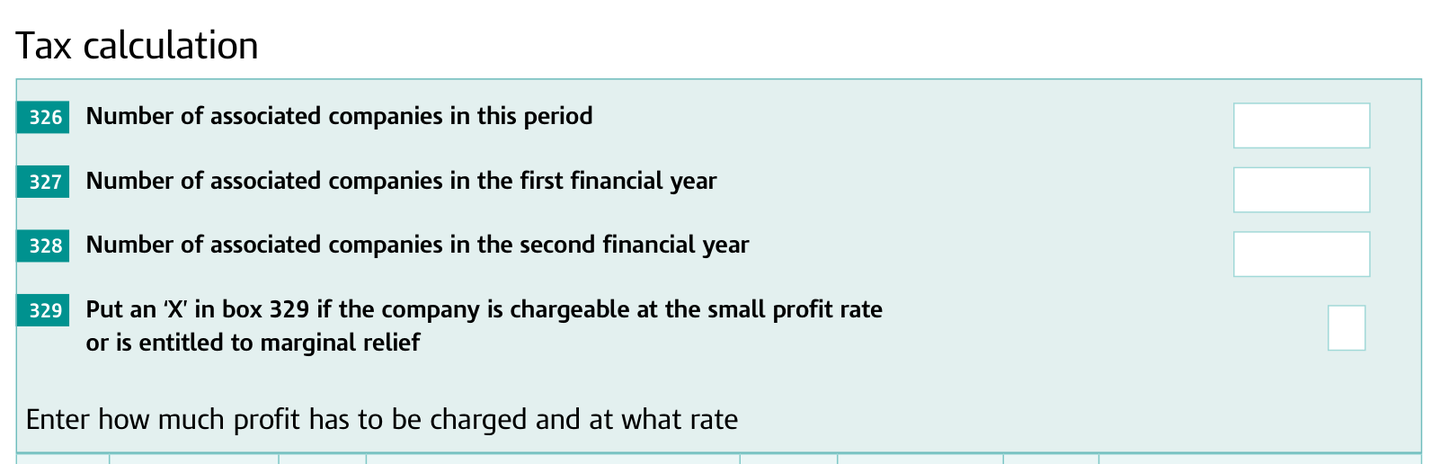
Work out who controlled each related company and when. A company counts if it was associated at any point in the accounting period while carrying on a trade or business. Divide the £50,000 and £250,000 limits by the number of associated companies plus one, then shorten them by actual days for a short period. Where box 326 applies, it shows the associated companies only, excluding the company filing the return.
Start with dates and control
A tax senior is finishing a Corporation Tax return for a six-month accounting period. During that period a sister company was sold to an outside buyer, and another commonly controlled company did nothing at all. Both need a decision before any rate is applied.
Companies are associated if one controls the other or both are under common control, regardless of where they are resident. The test applies at any point in the accounting period, so a company associated for only part of the period counts. A company that carried on no trade or business at any time during its period of association is disregarded. The count is not weighted for how long the association lasted, and the divisor includes the company preparing the return.
Sources and context, checked :
Test control through the underlying rights
Review voting, capital and income rights, and any changes in who held them during the period. A shared shareholder alone does not establish control. Where rights held by associates might be attributed, the special attribution rules and the substantial commercial interdependence test can change the outcome.
Take care with companies that look inactive. A passive investment business is distinct from carrying on no trade or business, and the passive holding exclusion is conditional. Dormant status at Companies House does not settle the question by itself.
Sources and context, checked :
A hypothetical short period
A UK-resident trading company with no special regime and no quarterly instalments prepares a return for 1 July to 31 December 2026 inclusive. That is 184 days of a 365-day year, wholly within FY 2026. One sister company under the same owner's direct control traded while associated and was sold to an independent third party on 30 September. Another commonly controlled company conducted no trade or business at any time in the period. Taxable total profits are £30,000 and there are no distributions, so augmented profits are also £30,000.
The table shows rounded figures for reading; in a real computation, carry unrounded amounts through. HMRC's nine-month example in CTM03930 simplifies by months, while the limits here use actual days. The 3/200 fraction applies directly only because taxable total profits and augmented profits are equal.
| Step | Working | Result |
|---|---|---|
| Box 326 count | Sister company counted; non-trading company disregarded | 1 |
| Divisor | 1 plus the filing company | 2 |
| Lower limit | £50,000 ÷ 2 × 184/365 | about £12,602.74 |
| Upper limit | £250,000 ÷ 2 × 184/365 | about £63,013.70 |
| Main rate tax | £30,000 × 25% | £7,500.00 |
| Marginal relief | 3/200 × (£63,013.70 less £30,000) | about £495.21 |
| Corporation Tax | £7,500.00 less £495.21 | about £7,004.79 |
Sources and context, checked :
Rates, augmented profits and the return
The small profits rate is 19% and the main rate is 25%, with marginal relief between the adjusted limits. Marginal relief can depend on augmented profits, which can include relevant distributions. Reconcile distributions received before assuming the two profit figures match, and avoid treating every dividend as included.
Box 326 applies to companies claiming the small profits rate or marginal relief, and to relevant quarterly instalment cases. It excludes the company whose return is being prepared, so it shows one in the hypothetical while the divisor is two. Boxes 327 and 328 apply only where the guide's stated conditions are met. Quarterly instalment threshold calculations sit outside this example.
Sources and context, checked :
Evidence for the file
This practical evidence list lets a reviewer trace the box 326 figure and the adjusted limits back to dated records.
Draw a timeline of the accounting period showing every control change and trading date for each related company, then, where box 326 applies, fix the count before applying any rate.
- Ownership and voting changes, with dates, for each possibly associated company
- Trading and business activity dates for each company
- A short control memo explaining each inclusion and exclusion
- Accounting period dates and day count
- Reconciliation of distributions to augmented profits
- The filed box 326 figure and the threshold calculation
Sources and context, checked :