
Current tax payable: reconcile the bill separately from tax expense
A tax note shows £28,000 of income tax expense, the bank shows £41,000 paid and the current tax control closes at £9,000 payable. Those amounts can all be correct. The reconciliation starts with unpaid tax brought forward, adds current tax charges and subtracts allocated payments. Deferred tax belongs in its own calculation.
Define the balance you are reconciling
Under UK-adopted IAS 12, current tax for current and prior periods is a liability to the extent it remains unpaid. Payments exceeding the amount due create an asset. Measure current tax using the amount expected to be paid or recovered, with laws and rates enacted or substantively enacted by the reporting date.
A current tax rollforward should therefore distinguish the entity, authority and tax period. A payment against last year can clear an opening liability without reducing this year's charge. An unallocated payment needs investigation before it can explain a balance.
This article covers one entity's ordinary income taxes with one authority. It does not calculate Corporation Tax, recommend a tax rate or set payment deadlines. VAT, payroll deductions, uncertain tax treatments and Pillar Two are outside this example.
Work from the opening payable to the closing bill
All amounts below are hypothetical and assumed to come from separately reviewed tax computations. Opening current tax payable is £18,000 for the prior period. The current-year charge is £30,000 and a revised prior-year estimate adds £2,000. Assume these amounts all enter profit or loss and that the prior-year revision is an estimate change, not a material prior-period error.
The entity pays £20,000 against the prior period and £21,000 against the current period. The prior period closes at £18,000 + £2,000 - £20,000 = nil. The current period closes at £30,000 - £21,000 = £9,000.
The control-account entries are Dr current tax expense £32,000; Cr current tax payable £32,000, then Dr current tax payable £41,000; Cr bank £41,000. Together with the £18,000 opening credit, they leave a £9,000 credit balance.
| Current-tax movement | GBP |
|---|---|
| Opening payable | 18,000 |
| Current-year current tax charge | 30,000 |
| Prior-year current tax adjustment | 2,000 |
| Payments for prior period | (20,000) |
| Payments for current period | (21,000) |
| Closing current tax payable | 9,000 |
Sources and context, checked :
Keep the expense note separate
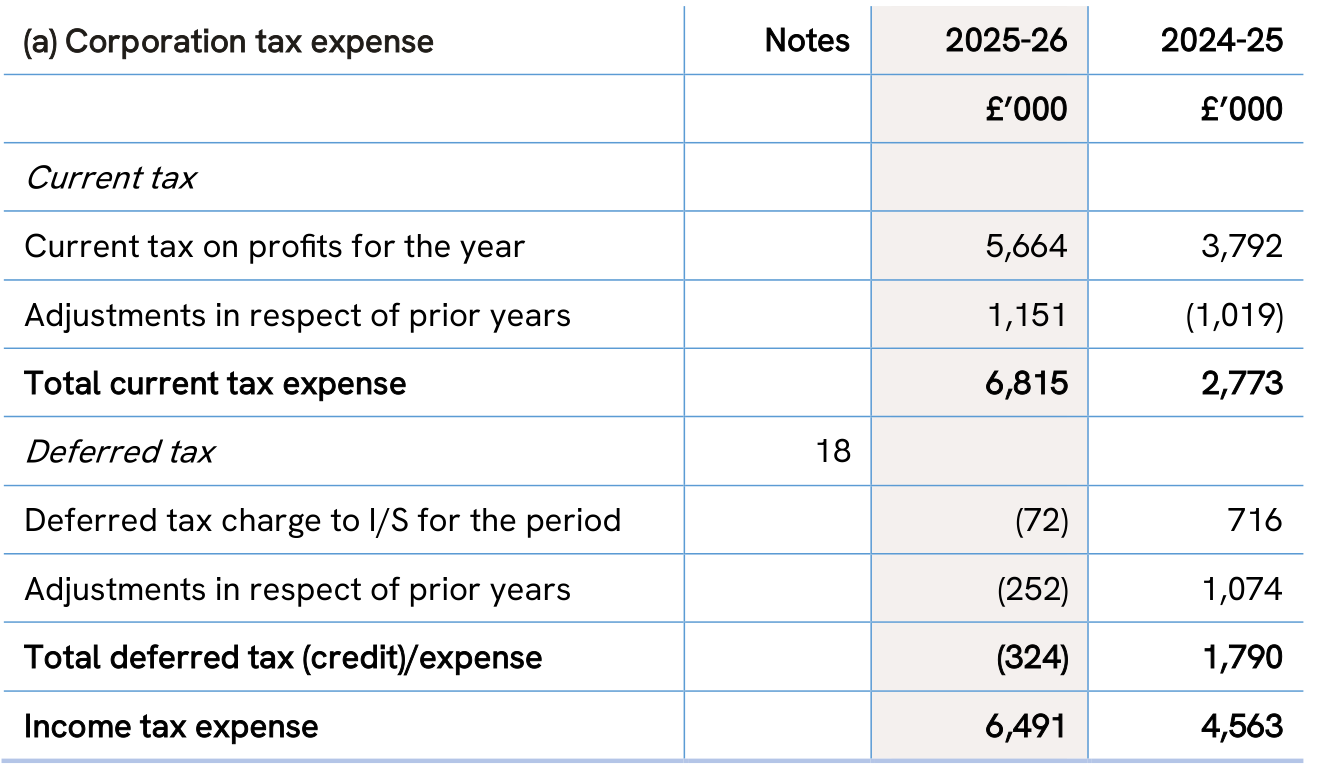
Now assume a separate £4,000 deferred tax credit enters profit or loss. Current tax expense is £32,000, while total income tax expense is £32,000 - £4,000 = £28,000. Cash paid remains £41,000 and current tax payable remains £9,000. The deferred tax credit does not move the current tax control account.
IAS 12 requires separate disclosure of major tax-expense components, including current tax and prior-period adjustments. That expense analysis serves a different purpose from the payable rollforward.
The assumed profit-or-loss destination is also a limit. In actual accounts, tax relating to items outside profit or loss or business combinations can follow a different destination. Show those movements separately rather than forcing every tax entry through expense.
Resolve overpayments and allocation differences
A recoverable overpayment can be a current tax asset. Offsetting assets against liabilities requires a legally enforceable right and an intention to settle net or realise and settle simultaneously. Separate group entities do not qualify for netting merely because they share an owner.
Before approving the reconciliation, complete these suggested checks. A balanced control account proves the movements agree; it does not prove the tax computation or rate is correct.
- Agree the opening amount to prior approved accounts and the tax-period schedule.
- Trace current and prior-year charges to reviewed computations.
- Match payments and refunds to bank evidence and the authority's allocation.
- Investigate unallocated amounts and recoverable overpayments.
- Reconcile deferred tax and any tax outside profit or loss separately.
Sources and context, checked :