
How to reconcile a bank account: timing differences, errors and what to record
Suppose your bank statement closes at 12,900 and your ledger shows 12,000. Before posting anything to clear the 900 gap, separate errors in your books from transactions already recorded but not yet processed by the bank. Only an error or omission in your books needs a ledger correction. Posting a correction for a timing difference creates a new error.
Check the inputs first
Reconcile one account at a time, using the complete statement and the ledger balance at the same date. Confirm that the opening balance agrees with the last reconciled closing balance. If your software uses a bank feed, compare its balance with the bank's own statement, because a feed can miss lines while the screen looks up to date.
Xero's guide to bank reconciliation starts from the same point: compare the bank statement for a period with your own records for that period. It also notes that software can retrieve transactions and suggest matches, but the user is still responsible for checking them.
Sources and context, checked :
Match each line to what is already recorded
Compare amount, date, payee and reference. A customer receipt that settles an existing invoice should be matched to that invoice, not recorded as a new sale, and a supplier payment should clear the bill it pays rather than become a fresh expense. Take care with identical recurring amounts, where a suggested match can point to the wrong month, and check transfers against the other account.
Timing difference or error?
In a US context, IRS Publication 583 explains that bank charges not yet entered in the books, and cheques or deposits that have not cleared, are common reasons the two balances differ.
Those causes fall into two groups. A timing difference is a transaction recorded correctly in your books that the bank has not processed yet, such as a payment sent on the last day of the month. It needs no entry and stays on the reconciliation until it clears. An error or omission is something wrong or missing in the books: an unrecorded fee, a duplicate import, a wrong amount or a payment posted to the wrong account. That needs a correction backed by evidence. If the bank itself has made the error, such as charging the same fee twice, raise it with the bank and list it as a reconciling item until the bank corrects it, rather than inventing a book entry to match.
Sources and context, checked :
A worked example
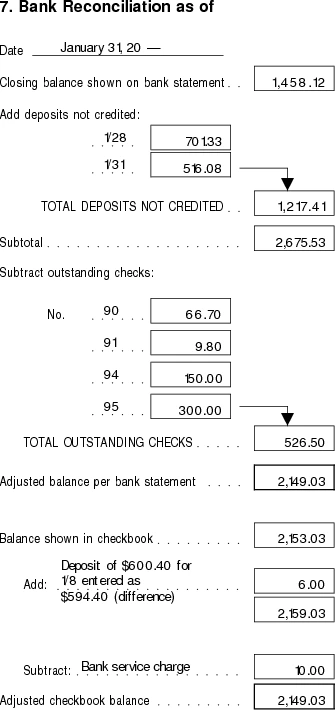
This hypothetical example uses generic currency units and ignores tax and foreign exchange. The ledger shows 12,000 but does not yet include a 100 bank fee. A 1,000 supplier payment is already recorded in the ledger but has not cleared the bank.
| Step | Amount |
|---|---|
| Bank statement closing balance | 12,900 |
| Less recorded payment not yet cleared | (1,000) |
| Adjusted bank balance | 11,900 |
| Ledger balance before correction | 12,000 |
| Less evidenced bank fee | (100) |
| Corrected ledger balance | 11,900 |
- The 100 fee is an omission, so it needs a ledger entry supported by the statement.
- The 1,000 payment is a timing item. Recording it again would understate ledger cash by 1,000.
- If the adjusted balances still differed, the reconciliation would stay open until the cause was found.
What to keep, and what a reconciliation proves
Save the statement, the ledger export, approved corrections and the schedule of outstanding items together, so a second person can reproduce the result. A reconciled balance shows that cash in the books agrees with the bank once the differences are explained. It does not show that every transaction is coded to the right account.
Investigate items that stay outstanding longer than expected, such as a cheque never presented or a payment the bank returned. Escalate any unexplained difference with its amount and age instead of parking it in a suspense account.
For the example above, record the 1,000 payment's date, payee, reference and expected clearing date on the schedule now, then tick it off against next month's statement. If it has not cleared by then, ask the supplier whether they received it.