
Deferred tax: build it from carrying amounts and tax bases
A machine has been depreciated by 20,000 in the books, while the tax rules have already given 40,000 of deductions. This year's tax payment can be exactly right and the accounts still incomplete, because deductions taken early leave less to deduct later. Under IAS 12 as adopted in the UK, deferred tax records that future consequence. Build it from closing balances: compare each asset or liability's carrying amount with its tax base, measure the difference at the rate expected when it reverses, then explain the movement from the opening balance.
The gap that creates deferred tax
A temporary difference is the difference between a balance's carrying amount and its tax base. For an asset, the tax base is the amount that will be deductible against the taxable benefits the entity receives when it recovers the asset. For a liability, it is broadly the carrying amount less any amount that will be deductible in future (IAS 12, paragraphs 5 and 7 to 8).
Taxable temporary differences generally give rise to a deferred tax liability, subject to the exceptions the standard lists. Tax depreciation that runs ahead of book depreciation is a typical source (paragraphs 15 to 17). Deductible temporary differences work differently. A deferred tax asset is recognised only to the extent that it is probable that taxable profit will be available to use them, again subject to exceptions, and its carrying amount is reviewed at each reporting date (paragraphs 24, 28 to 31 and 56).
Not every book and tax difference counts. An expense that tax law will never allow is a permanent difference. It reduced book profit but creates no future deduction, so it produces no deferred tax.
Sources and context, checked :
A hypothetical machine over two years
This example is hypothetical and uses generic currency units. A machine costs 100,000. The tax deductions and the 25% rate are assumptions chosen for the arithmetic, not a statement of current UK capital allowances or tax rates. There is no opening deferred tax, no recognition exception, no rate change, no item outside profit or loss and no offsetting.
At the end of year 1 the required liability is 20,000 × 25% = 5,000. The journal is Dr deferred tax expense 5,000, Cr deferred tax liability 5,000. No cash moves, and current tax for the year is calculated and paid separately. In year 2 the books depreciate another 20,000 while tax deductions are 10,000, so the difference narrows to 10,000 and the liability falls to 2,500. If nothing else moves, the 2,500 reduction is a deferred tax credit: Dr deferred tax liability 2,500, Cr deferred tax expense 2,500.
Measure using tax rates enacted or substantively enacted by the reporting date that are expected to apply when the difference reverses, reflecting how the entity expects to recover or settle the balance. Deferred tax is not discounted (paragraphs 47 to 53). The movement normally goes to profit or loss, but tax on an item recognised outside profit or loss follows that item (paragraphs 58 and 61A). Deferred tax assets and liabilities are offset only when the conditions in paragraph 74 are met, so group balances are not netted automatically.
| Hypothetical item | End of year 1 | End of year 2 |
|---|---|---|
| Carrying amount | 80,000 | 60,000 |
| Tax base | 60,000 | 50,000 |
| Taxable temporary difference | 20,000 | 10,000 |
| Deferred tax liability at assumed 25% | 5,000 | 2,500 |
| Movement in the year | 5,000 charge | 2,500 credit |
Sources and context, checked :
A close file that explains the number
We suggest a close file with one row per asset or balance: closing carrying amount traced to the ledger, tax base traced to the reviewed tax schedule and the law it relies on, the expected manner of recovery or settlement, the temporary difference, any recognition exception, the rate with evidence of enactment, closing deferred tax, opening deferred tax, the movement, where the movement goes (profit or loss, other comprehensive income or equity) and the reviewer. Reconcile the total movement, keeping acquisitions and other comprehensive income separate. For every deferred tax asset, file the evidence of future taxable profit.
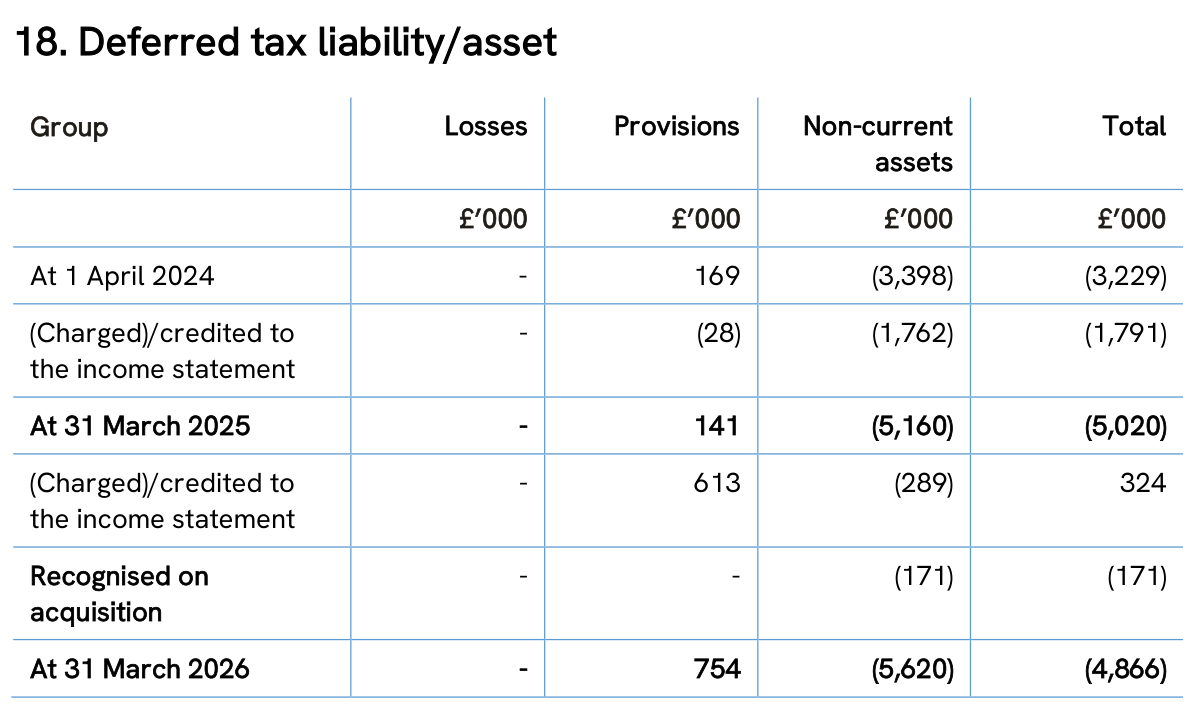
Published accounts show the result. Ordnance Survey's 2025/26 report, published in July 2026 for the year ended 31 March 2026, includes a group deferred tax rollforward in note 18 with provisions and non-current assets shown as separate categories. Those categories reflect its own balances, and its figures say nothing about the rate another business should use.
Sources and context, checked :
Where a simple schedule stops
The current IAS 12 text also contains the single-transaction amendments, effective for annual periods beginning on or after 1 January 2023, and a temporary exception for Pillar Two income taxes (paragraphs 4A and 98J to 98M). Leases, goodwill, tax losses and Pillar Two need their own analysis, and a deferred tax asset for losses is never assumed.
Sources and context, checked :
Start with the largest asset
Before the next close, take the largest asset in the schedule, open its tax computation and prove the deductions still to come. For an asset whose recovery is taxable, those future deductions are the tax base the calculation needs. Applying this year's cash tax rate to every book and tax difference is not a substitute.