
Director beneficial loans: calculate the tax-year interest benefit
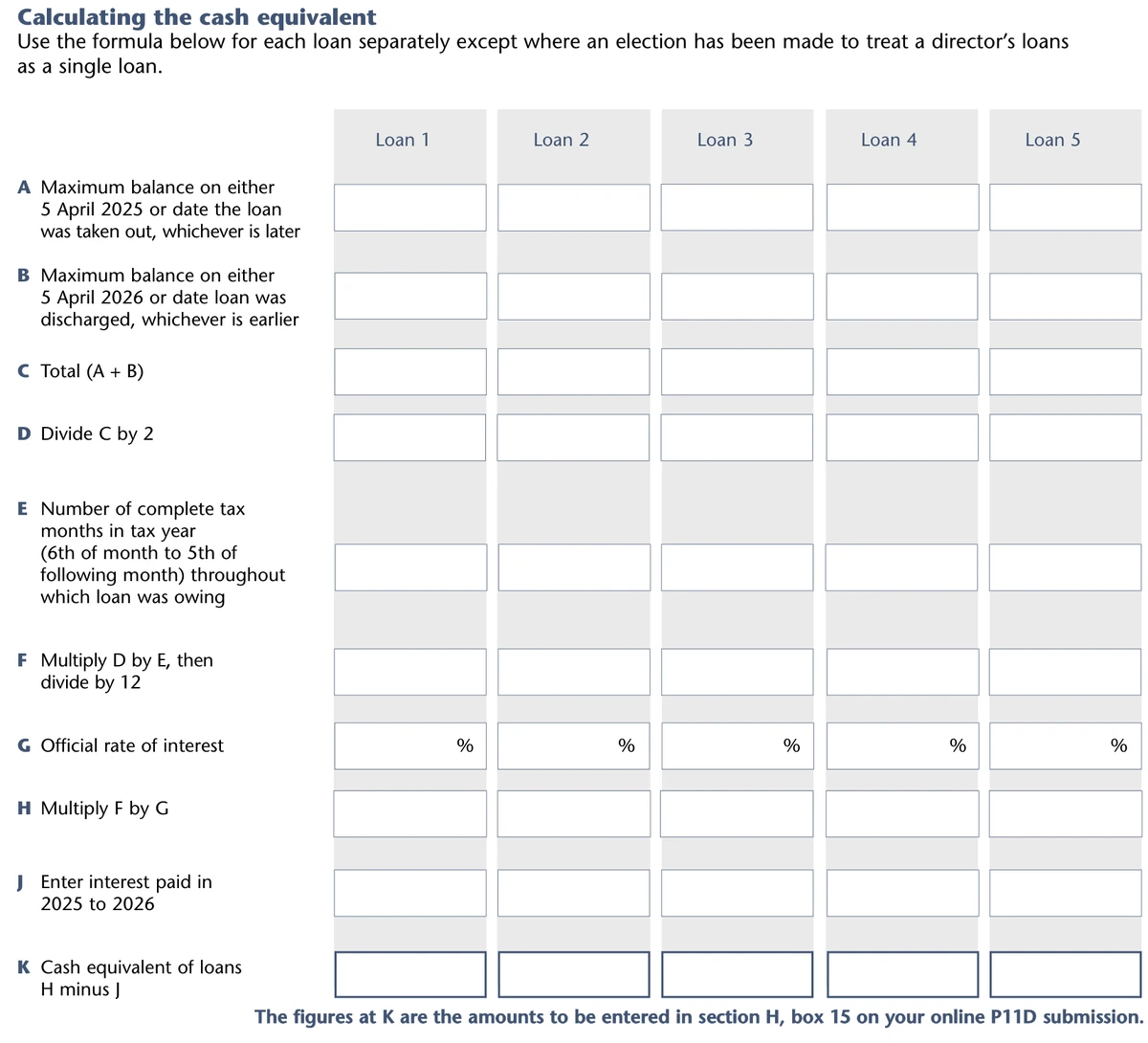
If a company lends a director money interest-free or at a low rate and no exemption applies, the company calculates a cash equivalent for each tax year. By default it uses the averaging method: the average of the relevant maximum balances, multiplied by the whole tax months the loan was outstanding divided by 12 and by the appropriate average official rate, less interest actually paid for that year under an obligation. The result is reported on form P11D, and the company pays Class 1A National Insurance on it.
Where this fits alongside s455 and the £10,000 exemption
The s455 charge on a loan to a participator is a separate company tax question, covered in our year-end repayment article; this article deals with the director's employment benefit.
The ordinary small-loan exemption applies only if the total of the director's outstanding beneficial loans does not exceed £10,000 at any time in the tax year. Going above £10,000 does not make only the excess taxable. It removes the small-loan exemption for that year, so the benefit is calculated on the full balances, while any other exemption still needs testing.
Optional remuneration arrangements and the other exemptions need separate consideration. Writing off a loan is a different event with its own rules and sits outside this calculation.
Sources and context, checked :
Averaging or precise method
The normal averaging method applies automatically. The precise method applies instead if the employee or director elects for it, or if HMRC gives notice that it should be used.
Under the averaging method, the cash equivalent is the average of the maximum balances outstanding at the start and end of the tax year, or on the dates the loan was made or discharged during it, multiplied by the number of whole tax months the loan was outstanding divided by 12, multiplied by the appropriate average official rate, less eligible interest actually paid for the year. Tax months run from the 6th of one month to the 5th of the next.
An election for the precise method covers all of that person's beneficial loans for the year. It cannot be applied to some loans and not others. The deadline is 31 January in the next tax year but one after the relevant year, which for 2025/26 means 31 January 2028.
| Feature | Averaging method | Precise method |
|---|---|---|
| When it applies | Automatically | On election by the employee or director, or on notice from HMRC |
| Balances used | Maximum balances outstanding at the start and end of the tax year, or on the dates the loan was made or discharged during it | Maximum balance outstanding on each day |
| Time measured | Whole tax months | Each day the loan is outstanding |
| Rate | Appropriate average official rate | Official rates in force during the period |
| Deduction | Interest actually paid for the year | Interest actually paid for the year |
Sources and context, checked :
Interest counts only when actually paid under an obligation
Interest reduces the cash equivalent only if it is actually paid for that year and the obligation to pay it existed in that year. A charge posted to the director's loan account or an accrual in the ledger is not enough on its own. A voluntary payment made later to cover a past year does not count either.
The payment does not have to fall within the same tax year. Chapter 17 allows interest paid later to count, provided it is actually paid for the relevant year under an obligation that existed in that year.
HMRC's P11D working sheet 4 for 2025/26 is an optional blank working paper. Keep a completed copy with the year's records; it is not sent to HMRC. Its line refers to interest paid in 2025/26, which is form shorthand and should be read alongside the wider Chapter 17 rule.
Sources and context, checked :
Hypothetical example: £20,000 outstanding for 2025/26
In this hypothetical, a company lends a director £20,000 under an ordinary sterling loan that is not a qualifying loan. The balance stays at £20,000 throughout 6 April 2025 to 5 April 2026. There are no other loans, no other exemption and no salary sacrifice. The loan agreement requires interest, and the director actually pays £300 of interest for 2025/26 under that obligation.
The balance is above £10,000 throughout, so the small-loan exemption does not apply. The £450 is the value of the benefit. It is neither the director's income tax nor an s455 amount. The director's tax depends on their own circumstances, and Class 1A is not calculated here.
The 3.75% figure is the official average rate for the completed 2025/26 year. The current rates table shows 3.75% from 6 April 2026, but official rates can change, so treat it as unconfirmed for the 2026/27 average until that year ends.
| Step | Figure |
|---|---|
| Average of opening and closing balances, both £20,000 | £20,000 |
| Multiplied by the 2025/26 official average rate of 3.75% | £750 |
| Less interest actually paid for 2025/26 under the obligation | £300 |
| Cash equivalent | £450 |
Sources and context, checked :
Reporting and the year-end file
Non-exempt beneficial loans are reported on form P11D, and the employer pays Class 1A National Insurance on the value of the benefit. The general deadlines are 6 July after the end of the tax year for reporting, 22 July for an electronic Class 1A payment and 19 July for payment by cheque.
Some benefits can be payrolled, but beneficial loans cannot be voluntarily payrolled for 2026/27, so plan for P11D reporting.
A useful file for each director and tax year holds the items below.
- Loan balances at the start and end of the year, with the dates and amounts of any advances and repayments
- The agreement or board minute that creates the obligation to pay interest
- Evidence of each interest payment and the year it relates to
- The method used, and any precise-method election with its date
- The official rate applied and the page it was taken from
- The completed working sheet or equivalent calculation
- The P11D, P11D(b) and Class 1A payment evidence