
VAT bad debt relief: test each unpaid invoice before claiming
A UK sales-ledger ageing report shows a £1,200 invoice from January with £900 still unpaid, and someone asks whether the VAT can come back on the next return. Age is one test of several. VAT bad debt relief needs the VAT to have been paid to HMRC, the debt to be written off in the VAT records, a waiting period measured from the right date, and a record that ties these together.
The conditions behind a claim
HMRC's VAT Notice 700/18 sets several conditions for modern supplies. The VAT on the supply must already have been accounted for and paid to HMRC. The debt must be written off in the day-to-day VAT accounts and transferred to a separate bad debt account. The supply must not have been charged above its customary price, and the debt cannot have been paid, or sold or factored in a way that disqualifies it.
The waiting period is at least six months from the later of the date payment was due and the date of supply. A longer agreed payment term moves the clock, so counting from the invoice date can start it too early. For supplies after 30 April 1997, claim within four years and six months of that same later date. The first eligible return is the period in which every condition is met; a later return is permitted within that time limit.
An accounting provision or an ageing bucket does not meet these conditions. Writing a debt off in the accounts and claiming VAT relief are separate decisions.
A worked claim and a later receipt
This example is hypothetical. It is an ordinary supply at 20% VAT, with the supply date and payment due date both 31 January 2026. All the conditions are assumed to be met, including VAT already paid and the write-off. There is no factoring, security, mutual debt, insurance or agreed price change.
The invoice was £1,000 plus £200 VAT. The customer paid £300, leaving £900 unpaid. Six months from 31 January ends on 31 July 2026, so the claim can first go on the return for the period in which that date has passed and every other condition is met.
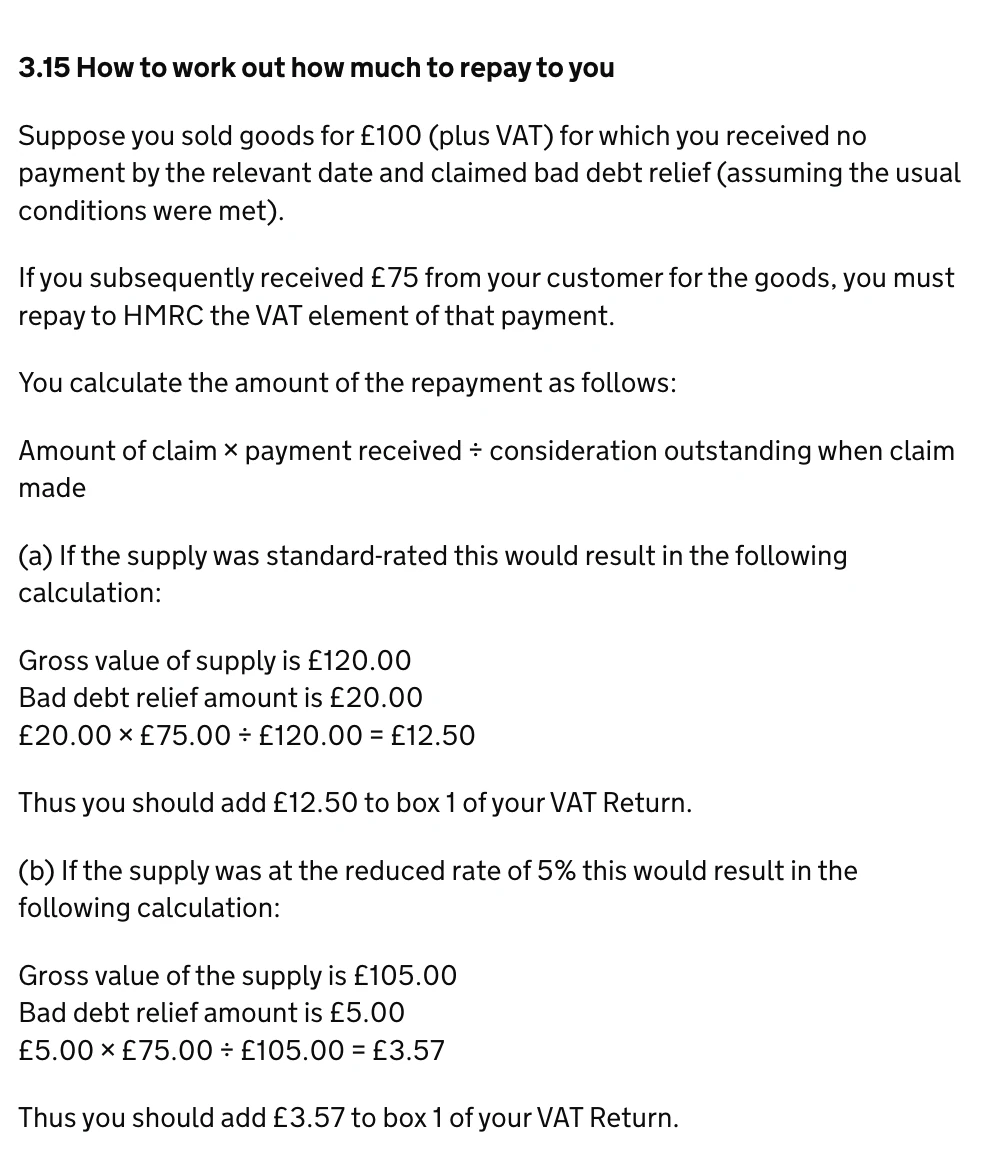
Only the VAT on the unpaid part qualifies. When money later arrives, Notice 700/18 requires the VAT element to be paid back on the return for the period of receipt: the claim, multiplied by the payment received, divided by the amount outstanding when the claim was made. The £110 still relieved is one-sixth of the £660 still owed.
| Step | Calculation | Amount |
|---|---|---|
| Unpaid balance, including VAT | £1,200 - £300 | £900 |
| VAT in the unpaid balance, claimed in box 4 | £900 x 1/6 | £150 |
| Later customer receipt | £240 | |
| Relief repaid in box 1 for the receipt period | £150 x £240 / £900 | £40 |
| Relief retained | £150 - £40 | £110 |
| Gross debt still unpaid | £900 - £240 | £660 |
Sources and context, checked :
What the bad debt account should show
The notice expects the invoice or an equivalent document and a separate bad debt account. For each claim, that account identifies the customer and the supply, the original VAT and the period it was declared, payments received, the write-off, the VAT claimed and the claim period. Later receipts and repayments go into the same account.
Claim records must be kept for four years from the claim. That does not shorten the standard six-year retention period for VAT records.
Sources and context, checked :
When relief is the wrong route
Under the Cash Accounting Scheme, output VAT on an ordinary unpaid sale has usually not been paid, so there is nothing to relieve. Leaving the scheme can change that, because VAT on old unpaid supplies may then become due, and any later claim needs its own assessment.
A credit note for a genuine price reduction follows a different route, and nonpayment does not show that a lower price was agreed. Customers have their own rules on input VAT for purchases they have not paid for, which are separate from the supplier's relief. Factoring, securities, insurance under the supplier's own bad debt policy, margin schemes and older supplies covered by historical rules sit outside the example above.
Sources and context, checked :
Trace one debt end to end
Take the oldest invoice on the ageing report that someone wants to claim. Find the VAT return where its output VAT was declared and confirm that return was paid. Fix the six-month clock from the later of the payment due date and supply date, and confirm the write-off entry in the VAT records. Only then add the debt to the bad debt account for the right return.