
UK record retention: calculate the date before deleting the archive
A bookkeeper looking after the archives of two UK businesses, one a sole trader and one a limited company, wants to clear out old years. 'Six years' is the figure most people remember, and it is incomplete. In this hypothetical case, the sole trader's clock and the company's clock start from different events, VAT records carry their own rule, and an HMRC enquiry, a late return or a long-lived asset can keep records needed for longer. Each set of records needs a calculated review date before anything is deleted.
Sole traders: count from the filing deadline
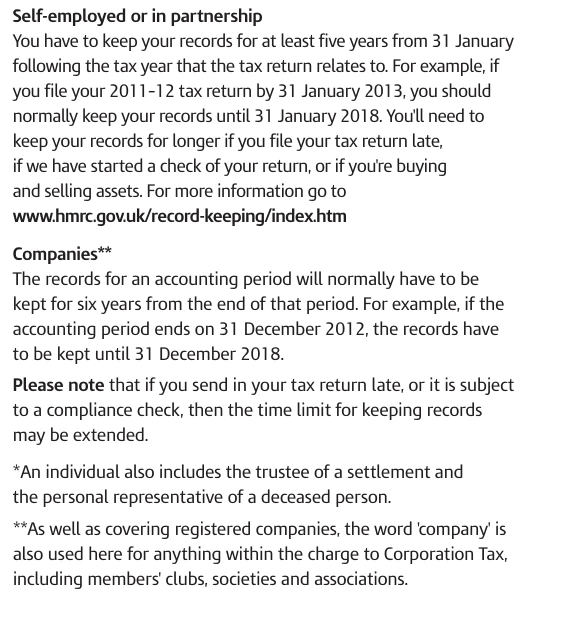
GOV.UK says self-employed people must keep business records for at least five years after the 31 January submission deadline for the relevant tax year. The clock does not start on the invoice date or at the end of the tax year. GOV.UK's own example is a 2022 to 2023 return sent by 31 January 2024, with records kept until at least the end of January 2029.
A very late return changes the date. If the return is sent more than four years after the deadline, the records must be kept for 15 months after it is sent.
Sources and context, checked :
Limited companies: count from the financial year end
A limited company generally keeps its records for six years from the end of the last company financial year they relate to. GOV.UK lists cases where they must be kept longer: a transaction that covers more than one financial year, an asset bought that is expected to last more than six years, a Company Tax Return sent late, or an HMRC compliance check that has started.
That six-year rule is about accounting and tax records. The registers a company keeps under company law are a separate duty, so check them separately rather than putting them on this clock.
Sources and context, checked :
Enquiries and other rules can move the date
For Income Tax and Capital Gains Tax business records, HMRC's Compliance Handbook page CH14530, updated 16 October 2026, explains that records must be kept until the latest of three points: the normal retention date, the completion of an enquiry, or the date by which HMRC can no longer open one.
VAT records follow their own rule of at least six years, or 10 years for One Stop Shop and Mini One Stop Shop records where those schemes apply. An income tax date for the same business does not override a separate VAT duty. Payroll, data protection, contract terms and litigation holds are further rules again, and this article does not cover them.
Sources and context, checked :
Two worked dates
These are hypothetical, ordinary on-time cases with no extension and no other duty applying.
The two dates sit two months apart, but they come from different rules, and a change in one business's facts moves only its own date. If the company bought machinery that year expected to last more than six years, the purchase records would need keeping longer. Both dates are the earliest point at which a review can start. Neither is a date for automatic deletion.
| Records | Clock starts | Baseline | Earliest review date |
|---|---|---|---|
| Sole trader, 2024 to 2025 tax year | 31 January 2026 online filing deadline | 5 years | 31 January 2031 |
| Company, financial year ending 31 March 2025 | 31 March 2025, end of the financial year | 6 years | 31 March 2031 |
Keep a retention register
Our recommended approach is a simple register, kept separately for each legal entity:
- List record sets by entity, tax or financial year, purpose and the rule that governs them.
- For each set, store the start event, the baseline end date, any extension or hold and its reason, the owner and where the evidence sits.
- Before deleting, check asset purchase and improvement history and any open HMRC enquiry.
- Before closing old accounting software, export readable records and test that you can retrieve them. Cancelling a subscription does not end the duty to keep records, and an export on its own does not show that you meet Making Tax Digital record rules.
- Delete only through a documented review once every applicable reason to keep the records has ended.
Start with one folder
Take the oldest folder you are tempted to clear. Write down which entity and year it belongs to and which clock applies, check for extensions and holds, and record the review date before anyone deletes it.