
VAT on staff parties and business entertainment: who benefits decides
A VAT-registered business books an evening party, and the invoice is coded to staff welfare. Some guests are not employees, a few staff spent the night looking after clients, and the directors came too. How much of the VAT can be reclaimed? HMRC's business entertainment guidance ties the answer to who the hospitality benefits. VAT on entertaining employees is generally recoverable. VAT on entertaining business contacts is normally blocked. A mixed event has to be split. This article assumes a wholly taxable business using normal VAT recovery, without the Flat Rate Scheme or partial exemption.
Guests are business entertainment
HMRC treats free hospitality provided to anyone who is not an employee as business entertainment. VAT on entertaining UK business contacts, and overseas contacts who are not customers, is normally blocked from recovery.
The nominal code does not change this. Booking a client dinner to marketing or advertising leaves the entertainment restriction in place.
Sources and context, checked :
Staff events and directors
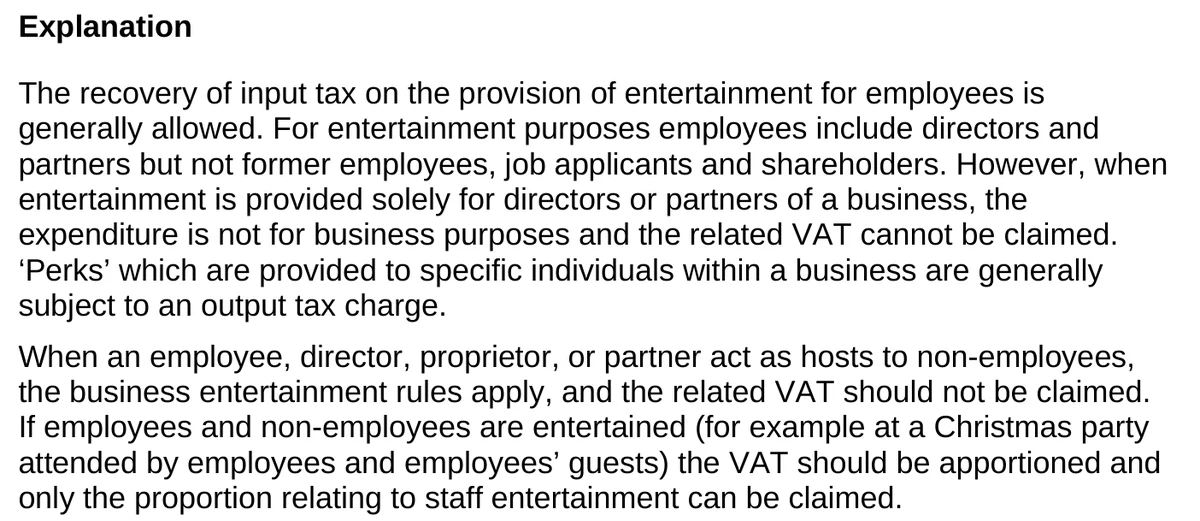
Entertainment provided to benefit employees, including events held to improve morale, is generally treated as being for business purposes. The VAT can be input tax, subject to the normal requirements of a valid VAT invoice and use for taxable business.
Directors and partners are the exception to watch. Where only directors or partners are entertained, the VAT is not input tax. Where directors attend a wider staff party alongside employees, their share can qualify.
Income tax rules on staff parties and employee benefits are a separate question. Meeting an income tax exemption does not settle how much VAT can be recovered.
Sources and context, checked :
Employees as hosts and mixed events
Employees do not turn client entertainment into staff entertainment just by being present. Where employees act solely as hosts to entertain non-employees, HMRC blocks the related VAT.
At a mixed staff event, where employees and non-employees are both entertained, only the portion relating to employee entertainment can be recovered.
Sources and context, checked :
Overseas customers
Entertaining overseas customers is an exception to the input tax block. The exception rarely produces a clean recovery, though. HMRC says a private-benefit output tax charge commonly cancels the VAT recovered. Hospitality that a customer expects as part of building a relationship is not automatically a strict business necessity.
So neither shortcut holds. Not every customer meal is blocked, and not every meal with an overseas customer leaves VAT recoverable.
Sources and context, checked :
Hypothetical: a staff party with guests
Hypothetical: a wholly taxable UK VAT-registered business holds a genuine staff morale party for 20 employees and 10 non-employee guests. It is not a client-hosting event. The supplier charges £50 plus £10 VAT for every attendee and issues a valid VAT invoice. No partial exemption restriction or special scheme applies.
Equal per-head apportionment works here because every attendee costs the same. If costs per person differed, the split would need to reflect what was actually spent.
| Item | Amount |
|---|---|
| Net cost for 30 attendees at £50 | £1,500 |
| Total VAT charged | £300 |
| Employee share, 20/30 of £300 | £200 recoverable |
| Guest share, 10/30 of £300 | £100 not recoverable |
Records to hold before reclaiming
Before claiming VAT on the next event invoice, record who attended and why, then allocate the VAT. Avoid reclaiming the full amount simply because the cost was coded to staff welfare.
- Valid VAT invoice, event date and stated purpose
- Attendance list separating employees from guests and former employees
- Evidence that employees were beneficiaries rather than solely hosts for clients
- The cost allocation and why it reflects actual expenditure