
Postponed import VAT: a matching statement total can still contain a duplicate
A postponed import VAT statement can add correctly and still contain the same import twice. Match the movement reference and VAT amount to customs records before transferring the total to the return. Then check tax due, recoverable tax and import value separately; equal box 1 and box 4 amounts are conditional on recovery entitlement.
Check what the statement total contains
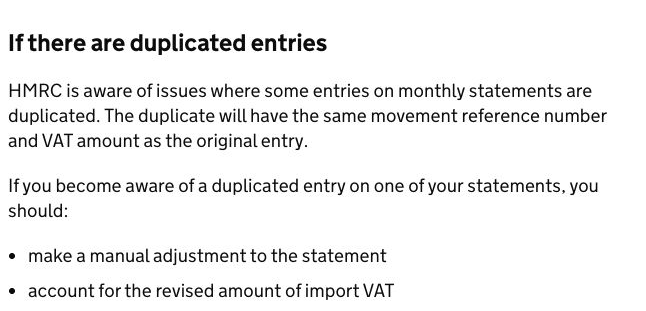
HMRC's statement guidance distinguishes the summary from detailed entries and includes instructions for duplicates. Matching the summary to port totals is useful arithmetic, but it does not establish that every line represents a separate import. A duplicate shares the movement reference and VAT amount; underlying customs records support whether it is genuinely repeated.
The same VAT amount alone is insufficient. Two real imports can produce equal tax amounts. Retain the original statement, identify the repeated movement and document the supported adjustment rather than deleting a line simply to make a reconciliation work.
Check that the statement and declaration belong to the correct importer and EORI. Missing entries can require investigation of allocation by an agent or to another entity. Do not fill a gap with another company's tax. Likewise, evidence for VAT paid at the border is not a reason to claim the same amount again through postponed accounting.
A hypothetical £8,000 statement and £5,000 tax amount
The following entries, amounts and circumstances are hypothetical. A UK VAT-registered business uses postponed VAT accounting for ordinary Great Britain imports in October 2026, within its quarter ending 31 December. Eligibility, ownership rights, valid evidence and full input-tax recovery are assumed established. The duplicate is found before filing. Assume the October statement is reviewed after month-end.
Import A has verified VAT-exclusive value of £10,000 and VAT of £2,000. Import B has value of £15,000 and VAT of £3,000. Each physical import occurred once, but the statement lists A for £2,000 and B for £3,000 twice. Its £8,000 detail total can agree perfectly with its own summary.
The repeated B line has the same movement reference and VAT amount, and customs records establish that there was no second B import. The documented statement adjustment is £3,000, leaving £8,000 minus £3,000, or £5,000 VAT to account for. The supported import values total £25,000, not a value increased for an imaginary extra import.
These imports contribute £5,000 to box 1, £5,000 to box 4 under the full-recovery assumption, and £25,000 to box 7. They are contributions from the two imports, rather than totals for the whole business return.
| Entry | Verified import value | Statement VAT | VAT accounted for |
|---|---|---|---|
| A | £10,000 | £2,000 | £2,000 |
| B | £15,000 | £3,000 | £3,000 |
| Repeated B | No additional import | £3,000 | £0 |
| Total | £25,000 | £8,000 | £5,000 |
Reconcile recovery and the return period independently
Account for postponed import VAT in the period covering the import date, using the statements and customs evidence. The zero net effect of £5,000 in box 1 and £5,000 in box 4 depends on full recovery. It does not make overstating both boxes acceptable.
If normal input-tax rules permit only £4,000 recovery against £5,000 due, box 4 is £4,000 and the net contribution is £1,000. That independent contrast shows why recovery must be assessed; it is not a partial-exemption calculation or a promise of recovery for every importer.
Build a monthly bridge holding the original summary, line detail, movement and customs references, importer EORI, import dates, supported corrections and return period. Reconcile boxes 1, 4 and 7 separately. Keep the software posting trail so a VAT adjustment does not duplicate a supplier bill or import cost already recorded. HMRC's May 2026 duplicate guidance supplies a correction process, not evidence of how often duplicates occur.