
Acquired goodwill: check basis and start month for US tax
Hypothetical: a calendar-year business buys the assets of an operating company and closes on 15 October 2026. The bookkeeper plans to start the goodwill schedule in November, when the first customer payment arrives. For US federal income tax, that start date is wrong. If the buyer has supported tax basis in acquired goodwill, section 197 recovers it evenly over 15 years from the month of acquisition. This article covers only that federal tax schedule. It does not cover book accounting, valuation or state rules.
What section 197 does with purchased goodwill
Section 197(a) allows a deduction for the adjusted basis of an amortizable section 197 intangible, spread evenly over 15 years starting with the month the intangible was acquired. Goodwill is named in the list of section 197 intangibles at section 197(d)(1)(A). The official text cited here is current through Public Law 119-134 of 20 October 2026.
Fifteen years is 180 months, so the monthly amount is the tax basis divided by 180. The statute sets that period. It does not change with how long the buyer expects the customer base to last, and it is not borrowed from the useful life chosen for the books.
Sources and context, checked :
Check that the goodwill belongs on this schedule
The 15-year rule applies to an intangible acquired and held in connection with a trade or business or a section 212 income-producing activity. Goodwill a business builds itself is generally excluded. Related-party anti-churning rules and other transaction-specific exceptions can also take an acquisition outside the rule, so those facts need review before the schedule starts.
The form of the deal matters as well. Section 197(e)(1) excludes an interest in a corporation. A buyer who purchases shares does not automatically gain tax basis in the target's goodwill. This article does not address share purchases.
Sources and context, checked :
When the 180 months begin and where they are reported
The IRS Instructions for Form 4562 (2025) describe the recovery period as 180 months beginning with the later of the month of acquisition or the month the trade or business or income-producing activity begins. A buyer taking over a business that is already running will often find both point to the same month, but the instructions require checking both.
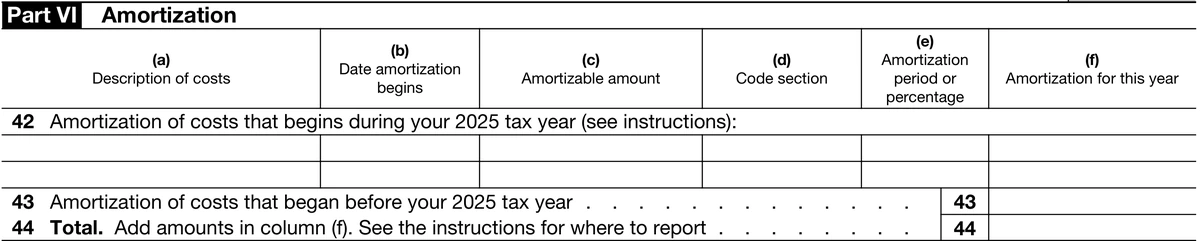
On the 2025 form, amortization that begins during the tax year goes in Part VI on line 42. Amortization of costs that began in an earlier year goes on line 43. Use the form and instructions for the year actually being filed, since line numbers can change.
Sources and context, checked :
A hypothetical first-year schedule
This is an original hypothetical, not a client result. Assumptions: a calendar-year business makes an arm's-length taxable purchase of an operating business's assets on 15 October 2026. The assumed supported allocation gives $180,000 of amortizable section 197 goodwill basis; the example does not derive or test that allocation. There is no anti-churning issue, carryover-basis transfer, tax-exempt-use lease, disposal, contingent price or later basis adjustment.
October counts in full even though closing was mid-month, because the schedule begins with the acquisition month and the business was already operating. Under these facts, 2026 recovery is $3,000 and $177,000 carries into 2027. A later change in basis would need its own review before the schedule is updated.
| Item | Calculation | Amount |
|---|---|---|
| Monthly recovery | $180,000 ÷ 180 | $1,000 |
| 2026 recovery, October to December | 3 months × $1,000 | $3,000 |
| Unamortized basis at 31 December 2026 | $180,000 - $3,000 | $177,000 |
Sources and context, checked :
What the workpaper should hold
The schedule is only as good as the evidence for its first two inputs: basis and start month. Keep these with it.
- The executed purchase documents and the supported asset allocation that sets goodwill basis.
- The acquisition month and the month the business or income-producing activity began.
- The Code provision relied on, total recovery months, months used, accumulated amortization and remaining balance.
- A separate book schedule, since book useful life and tax recovery answer different questions.
- Notes for the return preparer on price changes, later disposals or any related-party history.
Sources and context, checked :
Before the first entry
Ask whether the documents show tax basis in goodwill acquired in a taxable asset purchase. If they cannot, the 180-month calculation is premature, and the open question belongs with the return preparer rather than in the fixed asset register.
Sources and context, checked :