
US business bad debts: an unpaid invoice may have no tax deduction
A customer paid $1,000 of a $4,000 service invoice, and the remaining $3,000 will never arrive. Two businesses could close that invoice in the same way in their bookkeeping systems and still reach different US federal income tax results. The question is whether the unpaid amount was already included in taxable income. If it was not, a fee write-off may produce no bad debt deduction at all.
Start with income and basis
A business bad debt comes from a debt created or acquired in the business, or one closely related to the business when it becomes partly or wholly worthless. It must be a genuine debt. A gift or capital contribution cannot be relabeled as one.
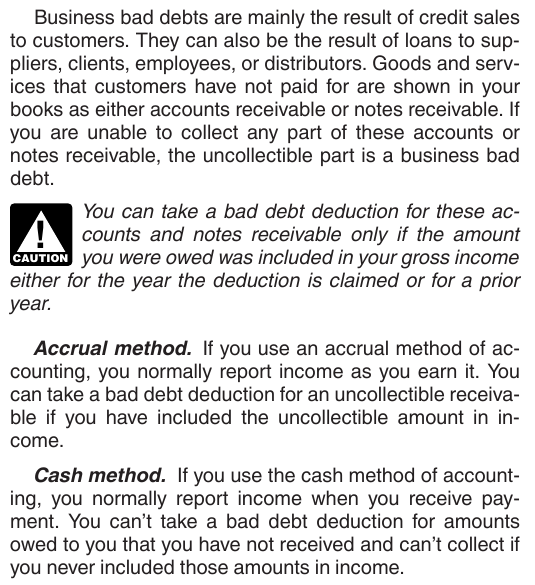
An accrual-method business may be able to deduct an uncollectible receivable that was included in gross income in the current or an earlier year. A cash-method business generally cannot deduct an unpaid fee it never included in income. A receivable on the books does not itself prove tax basis or taxable income. Treasury regulations measure the deduction by the debt's adjusted basis, not by a book provision or the original face value.
This does not bar every cash-method bad debt. Actual cash loaned for a business reason may establish a genuine business debt, as long as basis, the business connection and worthlessness can be proved.
A hypothetical invoice under two methods
Assume no earlier bad debt deduction, and leave interest and sales taxes out of the calculation. The remaining $3,000 is demonstrably wholly worthless this year. The accrual business included the full $4,000 fee in taxable income earlier. The cash business included only the $1,000 it received.
The accrual result is a possible deduction, available once worthlessness and all other requirements are established. The cash result applies only to this unpaid fee. Eligible costs of doing the work that were already deducted are not deducted a second time through the lost invoice.
| Step | Accrual business | Cash business |
|---|---|---|
| Fee included in income | $4,000 | $1,000 |
| Cash collected | $1,000 | $1,000 |
| Income included but not collected | $3,000 | $0 |
| Possible bad debt deduction | $3,000 | $0 |
Date the worthlessness
A debt is worthless when there is no reasonable expectation of repayment. An overdue date alone does not establish that. Keep evidence of reasonable collection steps and the facts supporting the timing. A lawsuit is not required if a judgment would be uncollectible.
The specific charge-off method generally applies. A deduction for a partly worthless business debt is limited to the amount charged off on the books that year. A wholly worthless debt is deducted in the year it becomes wholly worthless, less any earlier deductions, and an actual book charge-off is not mandatory.
The file stays open after the deduction. If the business later collects a debt it already deducted, the amount can be taxable recovery income, limited by the earlier deduction and the tax benefit rules.
Sources and context, checked :
Build the debt file
This discussion covers federal business bad debts, mainly for Schedule C filers. IFRS loss allowances, UK VAT relief, nonbusiness bad debts and specialized banking or nonaccrual-experience methods follow other rules. For each debt under review, keep:
- The original debt, tax method, year and amount recognized, cash collected, remaining basis and prior deductions.
- Collection correspondence, insolvency information and a dated worthlessness decision.
- A specific write-off record kept apart from any general book allowance.
- A note to watch for later recoveries.