
Cash-method year-end receipts: when an undeposited check counts
On 31 December 2026 a customer's valid $3,000 check is available to a US business. Nobody collects it until 4 January 2027, when it goes into the bank. The bank statement puts the money in January. For a business using the cash method for federal income tax, the receipt may still belong to 2026. The question is when the money was available without substantial restriction, not when it was deposited.
Actual and constructive receipt
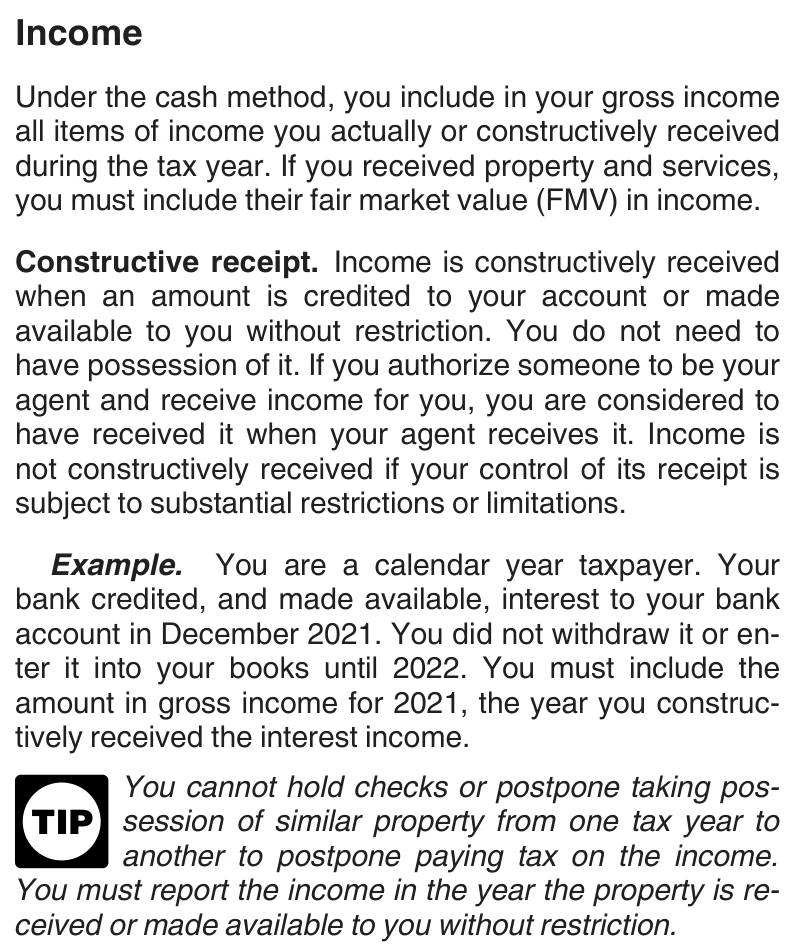
IRS Publication 538 says that under the cash method, gross income includes amounts actually or constructively received in the tax year. Income is constructively received when it is made available without substantial restrictions, even if the business has not yet taken possession of it or drawn on it. The Treasury regulation on constructive receipt sets out the same principle and its restriction boundary. Money received by an agent on the business's behalf is generally treated as received by the business.
The IRS's page on taxable income applies this to checks. A valid check received or made available before the end of the year counts in that year, even if it is cashed or deposited later. Holding on to a check does not by itself defer the income.
The example, and one changed fact
This example is hypothetical. A calendar-year business already permitted to use the cash method is paid for a taxable service. The check is valid and nothing substantially restricts access to the funds. It gives no view on the rest of the return.
Change one fact and the answer changes. If the customer writes 31 December on the check but does not deliver it or make it available until January, the printed date does not establish a December receipt. What counts is when the money was actually available, so an invoice date, a promise to pay or a total on a processor dashboard does not settle the question either. Escrow, disputed amounts and unusual payment arrangements need their own review. A delay the business chooses for itself, such as not collecting the check, is not the same as a substantial restriction.
| Date | What happens | Federal cash-method effect |
|---|---|---|
| 31 December 2026 | A valid $3,000 customer check is available to collect, without substantial restriction | Received in 2026 |
| 4 January 2027 | The business collects and deposits the check | Bank movement only, not a second receipt |
A year-end receipt log
Our suggested log for each receipt near the year end records the date the payment was received or made available and the evidence for that date, the amount and payer, any restriction and the document that creates it, the later deposit date and bank reference, and the invoice or receivable it settles. The deposit date belongs in the log, but it is not the field that decides the year.
Books and tax timing
Cash-method tax timing does not replace the revenue rules of the business's accounting framework. If accrual books already recognised the $3,000 sale in 2026, the January deposit clears the receivable. It is not a new sale. A short books-to-tax schedule can show where the two timings differ.
Publication 538 requires a method to be applied consistently. Changing how receipts are timed is not automatically a permitted method change, and IRS permission may be needed. Not every business can use the cash method, and nothing here decides eligibility. The publication is still the January 2022 revision, so use it for this timing principle rather than for older figures it contains.
Sources and context, checked :
In the first week of January
List every check and payment that reached the bank after 31 December. For each one, record when it was actually received or made available, note any restriction you can document, and send the uncertain items to the return preparer with their evidence.