
US estimated tax for sole proprietors: the 2026 payment target is not the final bill
A sole proprietor who moves a quarter of every customer payment into a tax savings account has a cash habit, not an estimated-tax calculation. Federal estimated tax for 2026 involves three different numbers: the tax you expect to owe for the year, the required annual payment that the installment rules test you against, and the amount you have actually paid by each due date. Paying the required annual amount on schedule can still leave a balance to pay with the return.
Who needs to pay
Form 1040-ES for 2026, dated 12 February 2026, gives the general rule for individuals. Most people must pay estimated tax for 2026 if they expect to owe at least $1,000 after subtracting withholding and refundable credits, and expect withholding and refundable credits to be less than the smaller of 90% of their 2026 tax or 100% of the tax on their 2025 return. The 2025 return must cover all 12 months.
If 2025 adjusted gross income was more than $150,000, or more than $75,000 for someone married filing separately in 2026, the prior-year figure generally becomes 110% instead of 100%. Farmers and fishermen have different rules. These are the rules for individuals. Corporate estimated tax and state tax are outside this article, and not every self-employed person ends up owing estimated tax.
Sources and context, checked :
Why a share of sales is not the calculation
The IRS explains that estimated tax is not only income tax. For a sole proprietor it can include self-employment tax as well. The 1040-ES worksheet builds the figure from expected adjusted gross income, deductions, taxable income, credits and other taxes.
A flat percentage of revenue skips every one of those steps. It ignores business costs, other household income, deductions and credits, so it can be too high or too low with no way of telling which.
Sources and context, checked :
A worked example
This is hypothetical planning arithmetic using assumed worksheet totals, not a return calculation. A calendar-year sole proprietor filed a full 12-month 2025 return showing adjusted gross income of $90,000 and tax of $12,000 for worksheet purposes. Projected 2026 tax is $18,000. There is no withholding, no refundable credit, no 2025 overpayment applied to 2026 and no special rule. The plan uses four equal installments, each paid in full by its due date, starting with the first.
Installments of $3,000 paid on 15 April, 15 June and 15 September 2026 and 15 January 2027 meet the payment target under these assumptions. They do not pay the bill. If the final 2026 tax is $18,000, $6,000 remains due with the return.
If the same person's 2025 adjusted gross income had been $180,000, the prior-year figure would be 110% × $12,000 = $13,200. That is still below $16,200, so each installment would be $3,300 and the balance with the return would be $4,800.
| Step | Calculation | Result |
|---|---|---|
| 90% of projected 2026 tax | 90% × $18,000 | $16,200 |
| 100% of 2025 tax | 100% × $12,000 | $12,000 |
| Required annual payment | Smaller of the two | $12,000 |
| Each of four installments | $12,000 ÷ 4 | $3,000 |
| Balance if final 2026 tax is $18,000 | $18,000 - $12,000 | $6,000 |
Timing counts as well as the total
Publication 505 explains that paying the required annual amount in total is not enough if individual installments were late or short. A penalty can apply to an installment that was underpaid by its due date. If income arrives unevenly through the year, the annualized income installment method may apply, and it needs its own calculation.
As of 21 October 2026, the April, June and September due dates have passed. The remaining 2026 installment is due on 15 January 2027. The $3,000 figure above is not a catch-up amount for someone who has paid nothing so far. A payment made in October does not go back and satisfy earlier due dates, so anyone who missed or underpaid an installment should ask their tax adviser to review the penalty position and the installment method.
Sources and context, checked :
What to take to your tax adviser
We suggest bringing working papers rather than a single revenue figure:
- The 2025 return.
- Year-to-date business profit and a realistic forecast to 31 December 2026.
- Other household income, any withholding and any credits.
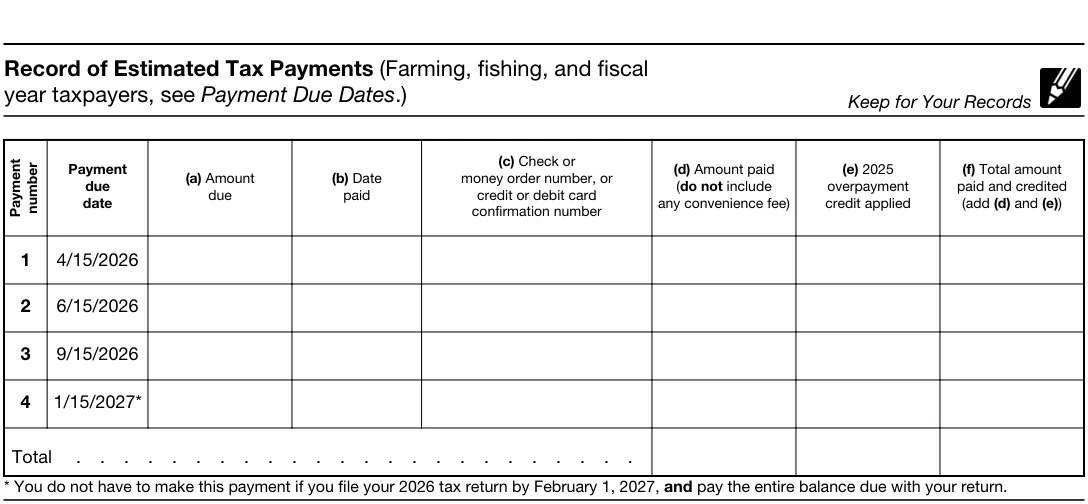
- A record of each 2026 payment showing the date, amount, tax year and confirmation number, plus any 2025 overpayment credited to 2026. The payment record page in Form 1040-ES has columns for these items.
Sources and context, checked :
Before 15 January 2027
Reconcile your confirmed payments and credits against that record now. If earnings or household circumstances have changed since the last calculation, ask your adviser to rerun it, then set aside cash for the January installment and for whatever balance the updated projection shows.