
FBAR records: what to keep for each foreign account
A US person must file a Report of Foreign Bank and Financial Accounts (FBAR) when they have a financial interest in, or signature or other authority over, foreign financial accounts whose aggregate value exceeds $10,000 at any time during the calendar year. The test adds accounts together, so you need each account's maximum value and evidence of who holds interest or authority before you can decide. Keep the records for five years from 15 April of the year after the calendar year reported.
Who and which accounts are in scope
US persons include entities created under US law. A business that is disregarded for income tax purposes still needs its own FBAR analysis.
Location decides whether an account is foreign. Publication 5569 shows a German branch of a US bank as a foreign account and a Texas branch of a French bank as not foreign. Bank brand or currency alone does not settle the question. An account that earns no income can still be reportable.
Overseas customers do not by themselves create an FBAR requirement. Ask whether the business or a person holds a financial interest in, or authority over, a foreign financial account, and whether an exception applies.
Hypothetical example: two small accounts cross the threshold
The $10,000 test applies to the combined value of all foreign financial accounts. Several small accounts can cross the line together.
Hypothetical: a US-created business holds two reportable foreign accounts. Their annual maximum values, converted to US dollars, are $6,000 and $5,500, and both maximums occurred at the same time. Assume no exception applies, US person status is settled and the year-end conversions are valid.
Neither account exceeds $10,000 alone. Their total of $11,500 does, so both accounts go into the FBAR review, including the smaller one.
| Account | Maximum value in US dollars |
|---|---|
| Account A | $6,000 |
| Account B | $5,500 |
| Aggregate | $11,500 |
Sources and context, checked :
Finding and converting each maximum
Publication 5569 says to determine the maximum value in the account's own currency, then convert it using the Treasury year-end exchange rate. Periodic statements issued at least quarterly can be used only if they fairly reflect the maximum value during the year. If no Treasury rate is available, use another verifiable rate and identify its source.
For each account, keep the statement or transaction history showing the maximum, the rate applied and where that rate came from in one place. A reviewer can then rebuild the aggregate without asking the bank again.
Sources and context, checked :
Records to keep for each account
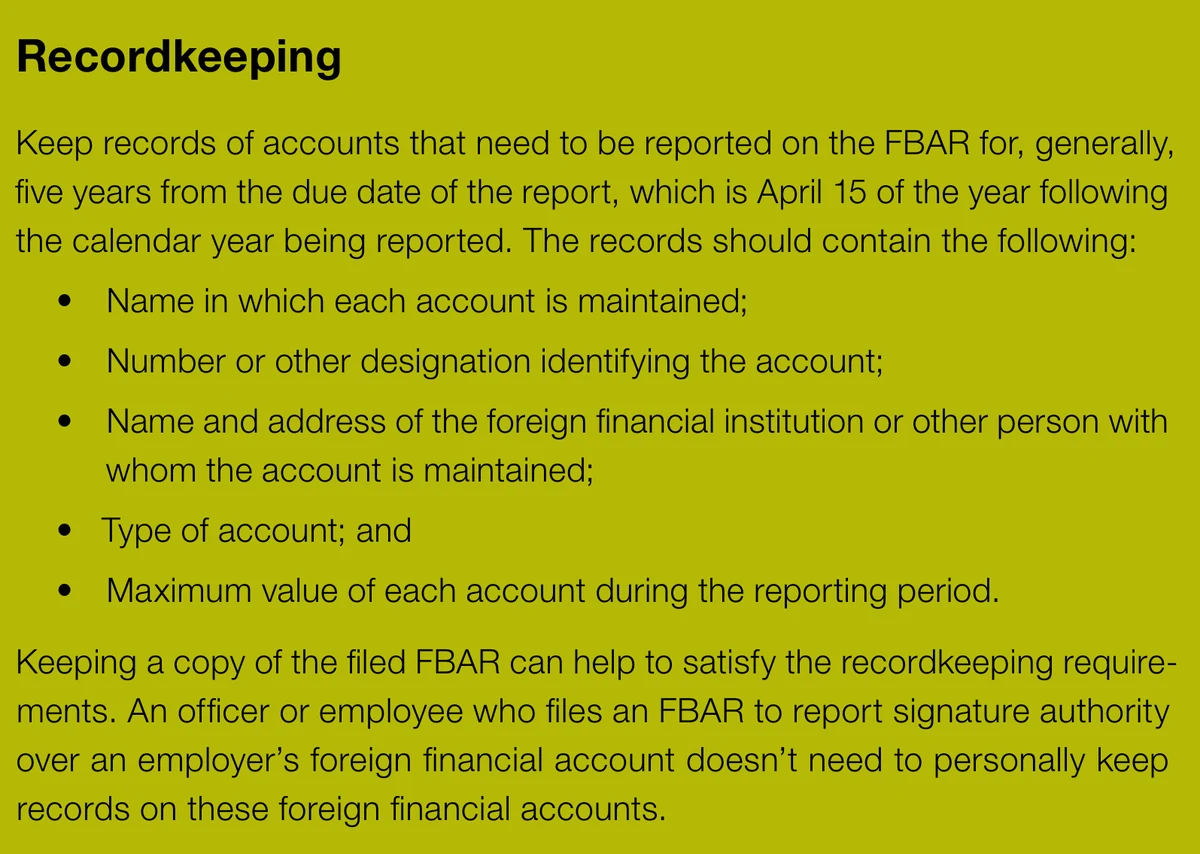
FinCEN lists the information to retain for each account:
Keep these records for five years from 15 April of the year following the calendar year reported. A retained copy of the filed FBAR can serve as the record if it contains all the required information.
An employee or officer who reports only signature authority over employer accounts does not need to keep personal records of those accounts. The employer keeps them.
- Name in which the account is held
- Account number or other designation
- Name and address of the foreign financial institution
- Type of account
- Maximum value during the year
Sources and context, checked :
Filing is separate from the tax return
The FBAR is filed electronically with FinCEN, separately from the federal income tax return. It is a report and does not by itself create tax. The annual due date is 15 April, with an automatic extension to 15 October. Special relief and certain notices for signature-authority filers also exist, so check the current FinCEN and IRS pages for the year you report.
Form 8938 is a separate requirement with its own rules. Treat the two as distinct checks in the year-end workflow.
Sources and context, checked :