
Form 940 Schedule A: calculate the credit reduction by state
Give each employee one $7,000 wage base under the Federal Unemployment Tax Act (FUTA) per employer for the year, even after a move between states. Then trace those capped wages to the unemployment jurisdiction that taxed them and apply the final credit reduction rate only to wages also subject to unemployment tax in a listed state. In the 2025 hypothetical below, the credit reduction adds $108 of FUTA tax.
Which wages Schedule A counts
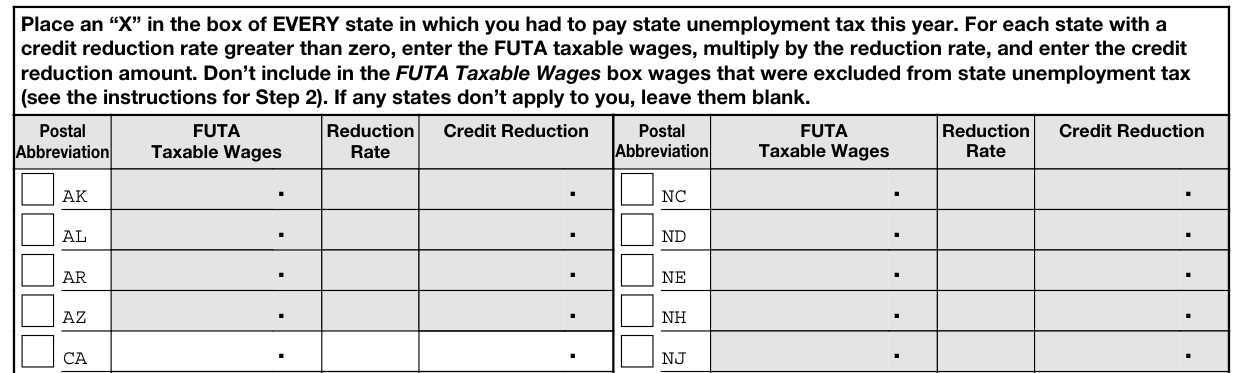
On Schedule A (Form 940), mark every state or jurisdiction where you were required to pay state unemployment tax, including states with no reduction. The reduction applies only to FUTA taxable wages that were also subject to state unemployment tax in a credit reduction jurisdiction. Wages exempt from state unemployment tax stay out even when they are FUTA taxable, and they may need a separate Form 940 adjustment, which can fall on line 10.
State wage bases and localization rules run separately. Example 2 on Schedule A shows a transferred employee keeping the federal wage base already used, so wages in a new state do not restart the $7,000 cap.
Sources and context, checked :
Hypothetical 2025 transfer
One employer pays employee A $5,000 subject to Texas unemployment tax early in 2025, then $20,000 of total payroll in California-covered employment. Employee B earns $8,000 of total payroll in California-covered employment only. The example assumes that wages within each employee's remaining federal cap also meet the applicable state's unemployment insurance (UI) rules, so A's $2,000 and B's $7,000 are California Schedule A wages. All wages are otherwise FUTA eligible, with no state-exempt wages, predecessor, payroll corrections, line 10 adjustment or late payment.
California wages on Schedule A total $9,000. At the 2025 California rate of 1.2%, the credit reduction is $108. Texas is still checked because unemployment tax was required there, with no reduction amount. The $108 goes to Form 940 line 11 as additional FUTA tax.
| Employee | State | Wages paid | Within $7,000 federal base |
|---|---|---|---|
| A | Texas | $5,000 | $5,000 |
| A | California | $20,000 | $2,000 |
| B | California | $8,000 | $7,000 |
Sources and context, checked :
Use final rates only
The Department of Labor lists final credit reductions separately from potential rates. Use the final schedule for the year you are filing.
Attach Schedule A if you are a multi-state employer (line 1b) or paid wages subject to unemployment tax in a credit reduction state (line 2). Treat the credit reduction as fourth-quarter liability. For 2025, if line 12 is over $500, complete Part 5 and include the reduction on line 16d. Apply the normal deposit rules. If fourth-quarter liability plus any earlier undeposited FUTA is $500 or less, you can pay it with the return.
Sources and context, checked :
Build the reconciliation
Work from a payroll export with one row per employee and pay date.
Run the payroll export before filing so you can review the wage cap and state assignments before applying the final rates.
- Record the assigned unemployment state and cumulative federal wage base on each row.
- Flag transfers and successor wages before applying the $7,000 cap.
- Compare with state unemployment returns to find wages that are FUTA taxable but state exempt.
- Mark every state where unemployment tax was required.
- Apply the final Schedule A rate, sum the state amounts and tie the total to line 11 and the fourth-quarter liability.
Sources and context, checked :