
US payroll tax deposits: put the liability on payday
A payroll tax deposit made in November can settle a liability that is recorded as an October liability on fourth-quarter Schedule B. For an ordinary US Form 941 employer, first establish the deposit schedule, then apply it to the date wages were actually paid. The accounting accrual date and quarterly return deadline do not supply that date.
Select the schedule before calculating a deadline
For calendar 2026, an established Form 941 employer without special Form 944 history generally uses a lookback from 1 July 2024 through 30 June 2025. Add the taxes originally reported on Form 941 line 12 for those four quarters. A total of $50,000 or less generally gives monthly status; a higher total gives semiweekly status.
These terms describe deposit rules, not how often employees receive wages. A company paying employees monthly can still be a semiweekly depositor. Keep the original returns and the lookback calculation with the payroll calendar, so the person scheduling a payment can see where the status came from.
Check exceptions before applying the calendar. The payment-with-return rule can apply when current or prior quarter liability is under $2,500, subject to its conditions. Form 944 history, new-employer rules, special relief and a $100,000 liability trigger also need separate attention. This example concerns ordinary cash wages reported on Form 941, rather than FUTA or state payroll taxes.
A Friday payday and a Wednesday deposit
The following amounts and circumstances are hypothetical. An established employer's four relevant lookback totals are $13,000, $14,000, $15,000 and $14,000. They sum to $56,000, so the employer is semiweekly for 2026. It has no Form 944 history, special relief, relevant credit adjustment or $100,000 next-day trigger. Neither the current nor prior quarter qualifies for the under-$2,500 payment-with-return exception.
Employees receive cash wages on Friday 30 October 2026. The approved payroll supplies a combined federal income-tax withholding and employee and employer Social Security and Medicare liability of $4,000. This amount is an assumed payroll result, not a calculation from a single tax rate.
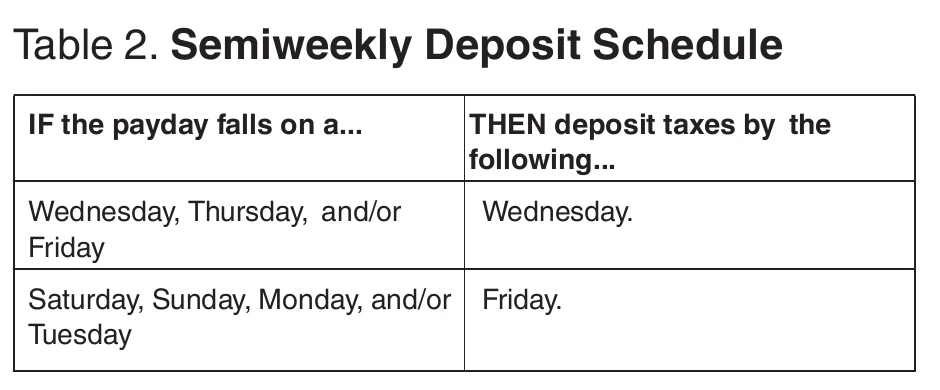
For semiweekly depositors, wages paid Wednesday through Friday normally produce a deposit due the following Wednesday. The $4,000 is therefore due Wednesday 4 November in this case, with no intervening federal holiday affecting the result. Wages paid Saturday through Tuesday normally follow the Friday deposit rule.
A separate monthly-status employer would normally deposit its October liability by Monday 16 November, because 15 November is Sunday. That is an independent comparison. It does not change the deadline of the employer whose $56,000 lookback established semiweekly status.
| Example employer | Wages paid | Ordinary deposit due |
|---|---|---|
| Semiweekly, $56,000 lookback | 30 October 2026 | 4 November 2026 |
| Independent monthly-status employer | 30 October 2026 | 16 November 2026 |
Schedule B records liability, not the bank movement
The semiweekly employer records the $4,000 on fourth-quarter Schedule B, Month 1, line 30. That is the date wages were paid. Recording it against 4 November instead would confuse the payment of tax with the event that created the liability.
Reconcile Schedule B's quarterly total to Form 941 line 12, then reconcile deposits separately to payment confirmations and the bank. A matching quarterly total does not prove that each liability was assigned to the correct day or deposited on time. Conversely, an October liability can be correctly settled by a November payment.
For each pay run, retain actual payday, tax liability, applicable schedule, due date and payment confirmation. Monitor the relevant deposit period for the $100,000 next-day override. Check business-day and holiday rules and the payment channel's cutoff before submitting. A date entered in a payroll calendar shows an instruction; the confirmation shows what was submitted. Filing the quarterly return is a separate task.
Sources and context, checked :