
Form 8995-A: how wages and property can limit the QBI deduction
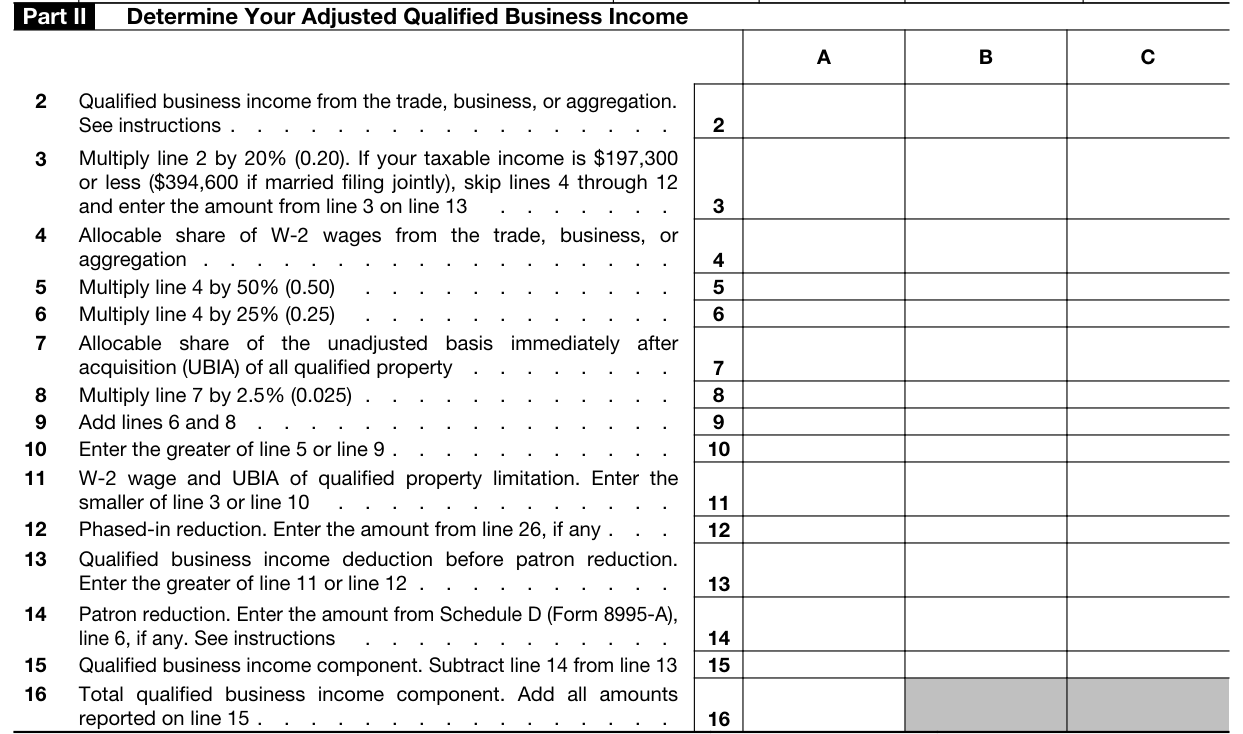
If your taxable income puts you in or above the phase-in range, tie your share of qualified business income (QBI), W-2 wages and unadjusted basis immediately after acquisition (UBIA) of qualified property to the same trade or business. Above the phase-in range, the QBI component is the smaller of 20% of QBI and the greater of two wage and property limits. In the hypothetical below, that cuts $32,000 to $25,000.
Check where taxable income falls
For 2025, the wage and property limit phases in once taxable income before the QBI deduction exceeds $197,300, or $394,600 for married filing jointly (MFJ). It applies in full above $247,300, or $494,600 MFJ. Specified service trades or businesses (SSTBs) follow separate rules and are excluded above the endpoint. Losses, aggregation, and REIT, publicly traded partnership (PTP) and cooperative items can change the result.
On a 2025 Form 1040 or 1040-SR, the IRS correction takes taxable income before the QBI deduction from line 11a less lines 12e and 13b, so discard older worksheets. Keep 2026 in a separate workpaper. Rev. Proc. 2025-32 sets 2026 thresholds and endpoints of $403,500 and $553,500 MFJ, $201,775 and $276,775 for married filing separately, and $201,750 and $276,750 for other filers.
Hypothetical 2025 single filer
A single filer has $270,000 of taxable income before the QBI deduction and no net capital gain or qualified dividends. They hold one interest in one eligible domestic business that is not an SSTB, with no losses and no other business, REIT, PTP or cooperative items. Their allocable share is $160,000 of QBI, $40,000 of qualifying W-2 wages and $600,000 of UBIA.
Taxable income is above the $247,300 endpoint, so Part II lines 2 to 13 apply the full limit. The greater limit is $25,000, and the smaller of $32,000 and $25,000 is $25,000. Part IV lines 31 to 39 cap the total at 20% of the amount by which taxable income before the QBI deduction exceeds net capital gain, including qualified dividends for this calculation. With none here, the cap is $54,000 and the deduction stays at $25,000.
| Step | Calculation | Result |
|---|---|---|
| 20% of QBI | 20% × $160,000 | $32,000 |
| Wage limit | 50% × $40,000 | $20,000 |
| Wage and property limit | 25% × $40,000 + 2.5% × $600,000 | $25,000 |
| QBI component | Smaller of $32,000 and $25,000 | $25,000 |
| Overall cap | 20% × $270,000 | $54,000 |
Sources and context, checked :
Tie each figure to its source
For a partnership or S corporation, get the section 199A statement that accompanies Schedule K-1 and resolve any missing or zero wage or UBIA figure with the issuer. For a business owned directly, use an IRS wage method and a qualifying asset schedule. Count only wages allocable to the trade, not total payroll, and keep a C corporation's own business out of the computation.
UBIA is not book net value, and land does not count because it is not depreciable. Keep these records for each asset.
- Acquisition basis and placed-in-service date
- How the asset is used in producing QBI
- Whether it was held and available for use at year end
- Depreciable period and the owner's allocable share
Sources and context, checked :
Build the tie-out before Part II
If your income puts you in or above the phase-in range, make a one-page tie-out for each business with QBI, W-2 wages and UBIA side by side and the K-1 statement, payroll report or asset schedule behind each number. Put taxable income before the deduction and qualified dividends or net capital gain on separate lines so the overall cap can be checked.
Sources and context, checked :