
S corporation shareholder health premiums: reconcile the W-2 wage boxes
Hypothetical: an S corporation owner reviews a draft W-2 and finds box 1 is $7,200 higher than boxes 3 and 5. It looks like a payroll error. It may instead be the health insurance the corporation paid for the owner during the year. This article covers US federal payroll reporting of those premiums for shareholder-employees who own more than 2 percent. It does not cover state tax, plan design, reasonable compensation or the owner's personal deduction calculation.
Who counts as a more-than-2% shareholder
Section 1372 treats a person as a 2-percent shareholder if they own more than 2 percent of the outstanding stock or more than 2 percent of the combined voting power on any day of the tax year. Stock attributed under section 318 counts toward the test, so direct holdings alone may not settle it. Owning exactly 2 percent directly, with nothing attributed, does not exceed the threshold.
Because the test looks at any day of the year, ownership that falls below the line partway through the year does not remove the status for that year.
Sources and context, checked :
Why box 1 differs from boxes 3 and 5
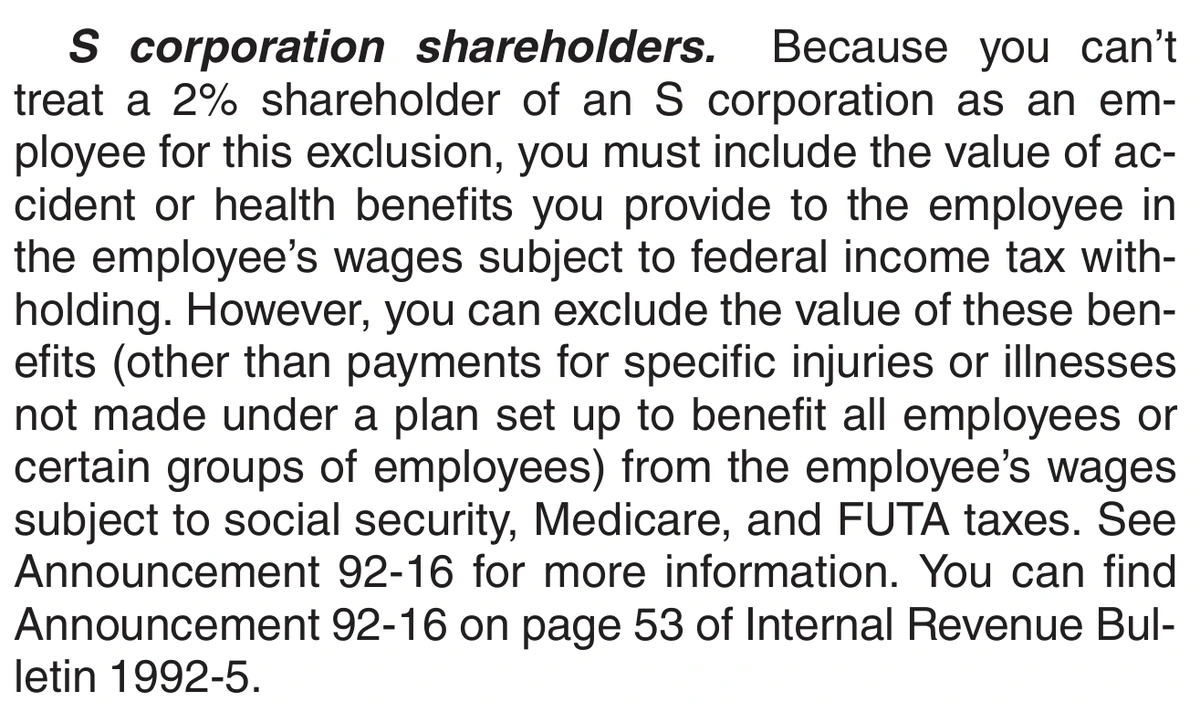
IRS guidance treats premiums paid on behalf of a more-than-2% shareholder-employee as wages for income tax withholding, so they belong in W-2 box 1. When the payments are made under a plan or system for employees generally, or for a class of employees, that meets the exclusion conditions, the premiums are excluded from Social Security, Medicare and FUTA wages. They stay out of boxes 3 and 5. Publication 15-B (2026) states the same treatment.
Without that qualifying plan or system, the payroll tax exclusion should not be assumed.
Sources and context, checked :
Payment and reimbursement records
Notice 2008-1, which current IRS S corporation guidance still relies on, addresses policies held in the shareholder's own name. Such a policy can count if the corporation pays the insurer directly, or if the shareholder pays, supplies proof of payment and the corporation reimburses in the same tax year. In both cases the premiums must be reported as wages on that year's W-2.
If the shareholder pays personally and the corporation never reimburses, the notice treats the plan as not established by the corporation for section 162(l). The timing of reimbursement is therefore a payroll question, not just a cash question.
A hypothetical reconciliation
This is an original hypothetical covering payroll wage bases only. Assumptions: for calendar year 2026, the shareholder-employee owns 100 percent throughout and receives $60,000 in cash wages, with no other benefits or payroll adjustments. The corporation pays $600 a month directly for 12 months under an established accident and health plan that meets the FICA and FUTA exclusion conditions. All premiums are reported in 2026 box 1. No payroll tax, withholding or personal deduction is calculated.
The $7,200 difference traces to one documented benefit. It is not an unexplained payroll error and it is not an owner distribution.
| Item | Calculation | Amount |
|---|---|---|
| Health premiums paid | 12 × $600 | $7,200 |
| Box 1 wages | $60,000 + $7,200 | $67,200 |
| Box 3 Social Security wages | Premiums excluded under the stated assumptions | $60,000 |
| Box 5 Medicare wages | Premiums excluded under the stated assumptions | $60,000 |
Sources and context, checked :
The personal deduction is a separate test
Box 1 reporting does not by itself produce a deduction on the shareholder's individual return. Section 162(l), in the official text current through Public Law 119-134 of 20 October 2026, sets its own conditions, including an earnings limit and a month-by-month test. No deduction is allowed for any calendar month in which the taxpayer is eligible to participate in a subsidized health plan maintained by an employer of the taxpayer, the taxpayer's spouse, a dependent or a child who has not reached age 27 by the end of the year. The Instructions for Form 7206 (2025) are supplementary filing guidance for that year's form. Those facts belong with the individual return preparer.
- Confirm stock percentage, voting power and attributed ownership for every day of the year.
- Reconcile insurer statements to corporate payments and any shareholder reimbursement evidence.
- Check that reimbursements fall in the same tax year as the premiums.
- Confirm payroll setup puts premiums in box 1 and that the exclusion conditions support leaving them out of boxes 3 and 5.
- Send the premium schedule and notes on other plan eligibility and earnings to the individual return preparer.
Before the W-2 is issued
Write the box 1 to box 3 difference on the reconciliation with its source: the premium schedule. If a difference cannot be traced to a documented benefit, resolve it before filing rather than explaining it afterwards.
Sources and context, checked :