
Sole proprietor insurance: separate business cover from owner health
Two insurance payments can leave the same bank account and land in different places on the return. For a 2025 Schedule C filer, a qualifying business liability premium goes on Schedule C line 15 and reduces business profit. The proprietor's own health premiums stay off Schedule C. If they qualify, they go on Schedule 1 line 17, and they do not reduce net earnings for self-employment tax.
Read what each policy covers
A single Insurance account can hide several tax treatments. The bank account that paid and the name on the policy do not decide the route, so read who and what each policy insures. These routes come from the 2025 Schedule C instructions and Publication 334, and they apply to a sole proprietor.
| Cover | 2025 route | Watch for |
|---|---|---|
| Business liability, malpractice and other business-risk cover | Schedule C line 15 if it is an ordinary deductible business premium | The actual policy matters, not just its title |
| Accident and health cover for employees | Schedule C line 14 | This route does not take the proprietor's own plan |
| The proprietor's own health plan | Not Schedule C; Schedule 1 line 17 if it qualifies | Monthly eligibility and the earnings limit |
| Policy replacing the proprietor's lost earnings from sickness or disability | Not deductible as business insurance | Business-overhead disability cover is treated differently |
| Self-insurance reserves | Not deductible as business insurance | Setting money aside is not buying cover |
| Insurance on a mixed-use vehicle | Allocation rules apply | No separate deduction when you use the standard mileage rate |
Sources and context, checked :
Owner health cover is tested by month
The policy can be in your own name or the business name, provided the plan is established under the business. Eligibility then runs month by month. Exclude any month in which you were eligible at any time for an employer-subsidized health plan, including a spouse's plan, even if you declined the coverage. Eligibility for only part of a month still excludes that whole month.
The deduction is also limited by qualifying earned income from that business, adjusted as the worksheet or form requires. Gross receipts are not the measure, and a positive Schedule C profit does not guarantee the full amount. If you have Marketplace premium tax credits, coordinate them under Publication 974. Do not deduct the same premiums again on Schedule A.
Sources and context, checked :
A hypothetical 2025 return
This hypothetical sole proprietor is filing for 2025 with $50,000 of Schedule C profit before the listed insurance. They pay a $1,200 qualifying current-year liability premium and $6,000 of health premiums, spread evenly over 12 months under an established plan. They were eligible for their spouse's employer-subsidized medical plan from October to December, though they did not enroll. There is no Marketplace credit, long-term-care premium or other complication, and the computed earnings limit is at least $4,500.
The $1,200 brings Schedule C profit down to $48,800. The $4,500 does not reduce Schedule C profit or self-employment earnings, even though both payments are called insurance. This shows the deduction routes only and is not a full income-tax calculation.
| Step | Amount |
|---|---|
| Schedule C profit before the listed insurance | $50,000 |
| Liability premium on Schedule C | $1,200 |
| Schedule C profit after the liability premium | $48,800 |
| Owner health premiums for 12 months | $6,000 |
| Excluded for October to December, at $500 a month | $1,500 |
| Potential Schedule 1 deduction, subject to the earnings limit | $4,500 |
Worksheet or Form 7206
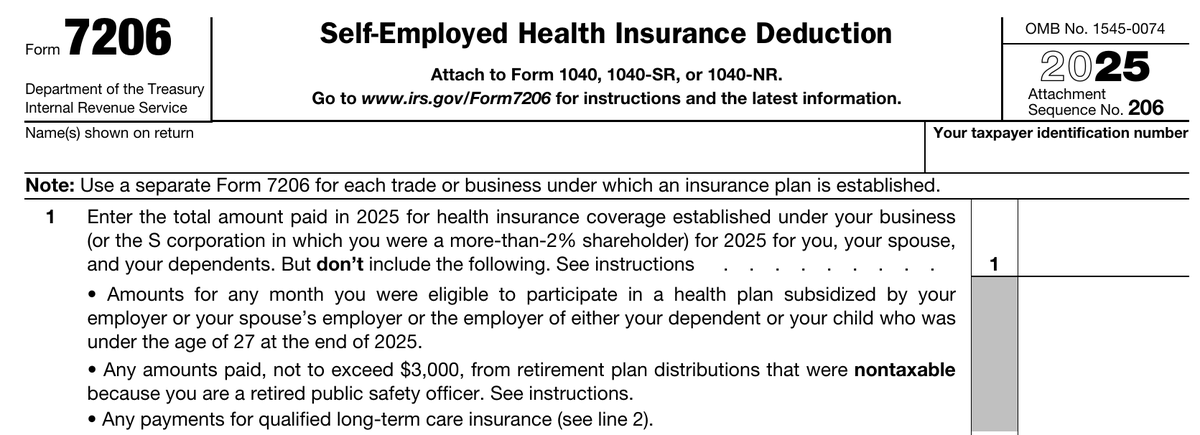
Form 7206 is not mandatory for every filer. The 2025 instructions let simple eligible cases use the Form 1040 worksheet. They require the form in listed situations, including more than one source of self-employment income, Form 2555 and qualified long-term-care premiums.
The 2025 form sets out the logic in one place: monthly exclusions, the earned-income calculation and a final deduction at the lower of premiums and earnings. These are 2025 final editions, so use the correct version for any other year. They apply here to Schedule C filers. Partners and S corporation shareholders are outside this guide.
Split the ledger before year end
Our practical suggestion is to replace the single Insurance code with three: business-risk premiums, employee cover and proprietor health premiums. Beside the third, keep a 12-month grid showing any employer plan available to you or through a family member.
Move any proprietor health premium out of operating expenses before you run the year-end profit figure. Left there, it would reduce Schedule C profit and self-employment earnings by mistake.