
US repairs and equipment: the $2,500 safe harbor is an election
A small business has two items to classify: three laptops invoiced at $7,200 in total and a $3,200 maintenance bill. It is tempting to treat $2,500 as the line between expensing and capitalizing. US federal income tax rules work differently. The de minimis safe harbor is an annual election for qualifying costs, and a cost above the limit must be tested under the normal capitalization and deduction rules.
What the election requires
Without an applicable financial statement (AFS), the safe harbor generally covers qualifying tangible property costing no more than $2,500 per invoice or per item substantiated by the invoice. With an AFS, the limit is $5,000. An ordinary bookkeeping report is not automatically an AFS.
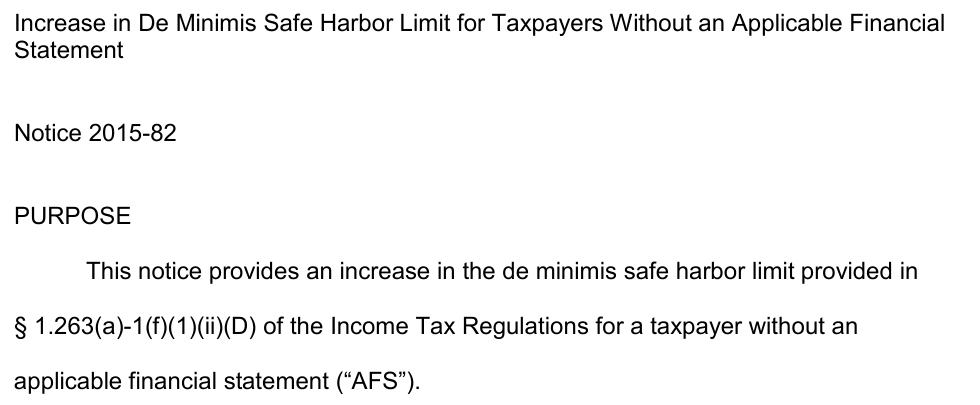
The $2,500 figure is not a new 2026 allowance. Notice 2015-82 raised the no-AFS limit from $500 for taxable years beginning on or after January 1, 2016.
The books must also match. The business expenses the qualifying amount under a consistent procedure or policy that existed at the start of the tax year. Without an AFS, that procedure need not be written. With an AFS, it must be. The tax safe harbor cannot override a lower qualifying amount used for book expensing. The annual election then works as follows:
- Attach a statement headed Section 1.263(a)-1(f) de minimis safe harbor election to the timely filed original federal return, including extensions.
- Include the taxpayer's name, address, taxpayer identification number and a declaration making the election.
- Apply it to every expenditure that meets the criteria that year.
- Treat it as an annual election, not a Form 3115 accounting method change.
Sources and context, checked :
Above the limit is not automatically capital
A cost above the ceiling is simply outside this safe harbor. The normal rules then apply, including the materials and supplies rules where relevant. Ordinary and necessary repairs may be deductible. Acquisitions, production and improvements generally must be capitalized unless another rule permits a deduction.
An improvement is a betterment, a restoration or an adaptation to a new or different use. Identify the unit of property first. For a building, analyze the structure and each relevant building system.
The safe harbor has its own limits. Inventory and land are excluded, and section 263A can still require capitalization into produced or resale property. Do not assume that dividing an improvement into cheaper parts brings it within the limit.
Sources and context, checked :
A hypothetical purchase and repair bill
Assume the business has no AFS and makes a valid, timely election. It has a start-of-year policy of expensing qualifying tangible items costing no more than $2,500, and it expenses these laptops in its books. Each laptop is independently usable, used for business and shown on the invoice at an all-in qualifying cost of $2,400. No inventory, land, personal use or section 263A capitalization is involved.
The $7,200 invoice total does not by itself deny safe harbor treatment because each separate item is within $2,500. The $3,200 bill needs a different question: what did the work do? The answer depends on the unit of property and whether the work was a betterment, restoration or adaptation.
| Item | Cost | Safe harbor result | Next step |
|---|---|---|---|
| Three laptops at $2,400 each | $7,200 | Each item is within $2,500 | Apply the election and match the book treatment |
| Maintenance bill | $3,200 | Outside the safe harbor | Review the work under the repair and improvement rules |
What to keep in the tax file
These are federal income tax rules. They do not set a financial reporting capitalization policy or decide state tax treatment. Before year end, assemble the following:
- Itemized invoices and all-in acquisition cost details.
- The existing book policy, the actual ledger treatment and the annual election.
- For spending outside the safe harbor, the asset or system, the defect, the work completed and whether capacity, condition or use changed.