
W-9 vendor onboarding: collect tax identity before the 1099 decision
In this hypothetical example, a US business pays a freelance designer $700 in March, $650 in July and $800 in November 2026. No single invoice looks large enough to matter, so nobody asks for tax details until January, when the year's payments total $2,150 and someone needs the designer's name and taxpayer identification number (TIN) to consider a Form 1099-NEC. Collecting Form W-9 when the vendor is set up avoids that chase. The form gives you identity and federal tax-status information. Whether a 1099 is due still depends on who was paid, for what, by which method, in which year and how much.
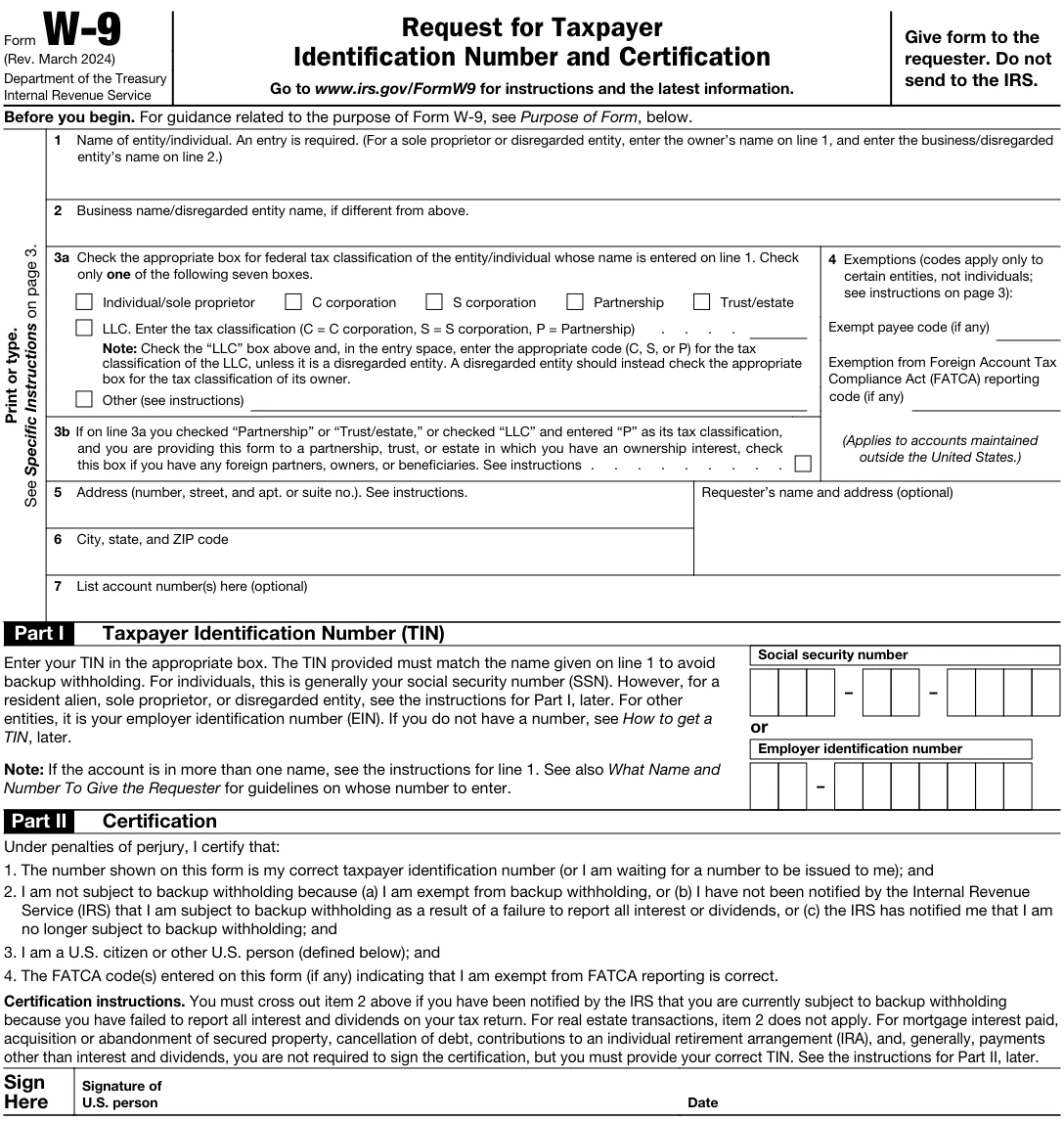
What the form tells you
The IRS sets out the order of work for independent contractors. First decide whether the person is an independent contractor or an employee. If they are a contractor, ask them to complete Form W-9, which supplies their name and TIN, and keep it in your files for four years.
The payee gives the W-9 to you, not to the IRS. The current form is the March 2024 revision. A sole proprietor or a disregarded entity puts the owner's name on line 1 and any business or disregarded entity name on line 2. An LLC is not automatically a corporation: the box on line 3a depends on how the LLC is classified for federal tax purposes. The requester instructions say the W-9 is for US persons, including resident aliens. A foreign person should give you the appropriate Form W-8 or Form 8233 instead.
The form has limits. It does not decide whether someone is a contractor, because that decision comes before you ask for it. And it does not confirm who owns the bank account you are about to pay, so bank details need their own verification.
Count the year, not the invoice
For payments for services made in 2026, the IRS information-return overview gives a $2,000 reporting threshold. Before 2026 the figure was $600, so older checklists and vendor-setup notes may be out of date. The same page explains that backup withholding can make a Form 1099-NEC necessary regardless of the amount, and that not every payment or payee belongs on that form. Publication 1099, dated 19 March 2026, carries the general instructions for the 2026 year.
The opening example only works with its assumptions stated. The designer is a non-exempt US individual properly classified as an independent contractor, providing business services during calendar year 2026. Every payment is a direct bank transfer, nothing is withheld, and there are no card or third-party network payments, because payment method is one of the facts that affects reporting.
| Work invoiced | Paid | Amount |
|---|---|---|
| Brand refresh | March 2026 | $700 |
| Brochure layout | July 2026 | $650 |
| Trade show graphics | November 2026 | $800 |
| Total for 2026 | $2,150 |
Sources and context, checked :
Reading the total
No invoice reaches $2,000, but the annual total does. If every other reporting condition applies, this payee belongs in the 2026 Form 1099-NEC review, and the W-9 already on file means that review starts with a name and TIN rather than a request.
The reverse is not safe. A total of $1,950 would not by itself prove that no return is needed if backup withholding applied or the payments fell into a different reporting category.
When the TIN is missing or wrong
The IRS explains that a missing or incorrect TIN can require backup withholding at 24% on reportable payments to the contractor, under the conditions it describes. That is a decision for whoever owns your information reporting, made on the facts of each payee. Withholding 24% from every invoice whenever a form looks incomplete is not a substitute for that decision.
Sources and context, checked :
A vendor file built for January
The IRS guidance gives the sequence. The controls below are our recommended workflow. Asking for the form before the first payment is good practice, not a universal legal deadline.
- Request the W-9 during vendor setup, once the worker-status decision is recorded.
- Check the names, TIN, federal tax classification and any relevant certifications against the form instructions, and resolve inconsistencies with the payee before relying on the form.
- Keep the form, which carries a TIN, in restricted storage. The payment-run export only needs to show whether a W-9 has been collected and reviewed.
- Track annual payments by payee and by payment method, and record the reporting decision, who made it and which year's IRS guidance it relied on.
- Escalate foreign status, any tax withheld and missing or incorrect TINs before anyone pays or reports mechanically.
Before the next payment run
List every US service provider paid in 2026 whose vendor record has no reviewed W-9, add up each one's year-to-date payments by payment method, and send that list to the person who will make the 1099 decisions.