
Break-even after a discount: the extra units a price cut needs
A proposal reaches the owner: take 10% off a product that sells for 50. It sounds like a modest concession. Each unit carries 30 of variable cost and fixed costs are 12,000 a month, so the discount moves break-even from 600 units to 800. The business would need to sell a third more just to cover its costs. The arithmetic shows how much volume a price cut needs. It cannot show whether that volume will come.
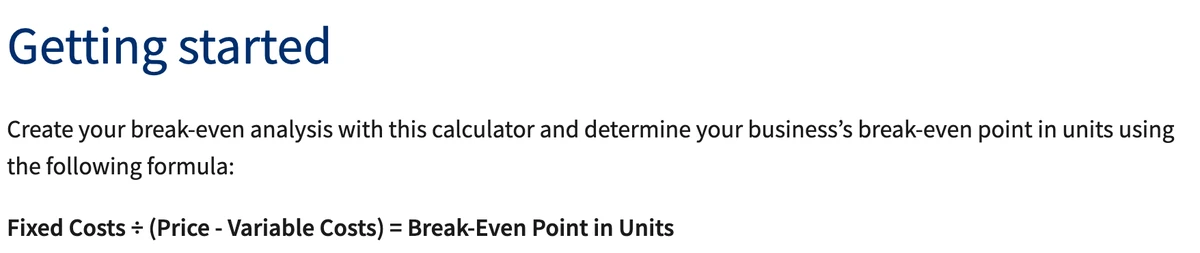
The formula
The US Small Business Administration's guide gives the standard calculation: fixed costs divided by the selling price per unit less the variable cost per unit. The difference between price and variable cost is the contribution each unit makes towards fixed costs. Dividing fixed costs by the contribution margin ratio instead gives break-even as a sales value.
The formula assumes one product or service, costs measured over one consistent period, and mixed costs already split into their fixed and variable parts. The result is an estimate. We read it as the volume at which the stated costs are covered, not as proof that a product or business is viable.
Sources and context, checked :
The discount in numbers
This is a hypothetical monthly scenario in generic currency units. It ignores tax, financing and inventory timing, and assumes fixed costs and the variable cost per unit stay the same across this range of activity.
The price fell by 10%, but contribution per unit fell by 25%, because the whole cut comes out of the 20 left after variable costs. That is why break-even needs 200 more units, an increase of a third. Selling the same 600 units at the lower price gives 600 x 15 - 12,000, a loss of 3,000 a month, where the full price exactly broke even.
| Line | Current price | After 10% discount |
|---|---|---|
| Price per unit | 50 | 45 |
| Variable cost per unit | 30 | 30 |
| Contribution per unit | 20 | 15 |
| Contribution margin ratio | 40% | 33.3% |
| Fixed costs per month | 12,000 | 12,000 |
| Break-even units | 600 | 800 |
| Break-even revenue | 30,000 | 36,000 |
Units and ratios answer different questions
Contribution per unit gives break-even in units: 12,000 divided by 15 is 800. The ratio gives it in revenue: 12,000 divided by one-third is 36,000. Use whichever matches how the sales target is set, but work both out from the same price and cost.
The arithmetic works from the cost side too. If a supplier raised the variable cost from 30 to 35 while the price stayed at 50, contribution would also fall to 15, and break-even would also rise to 800 units. A price cut and an equal per-unit increase in variable cost reduce contribution by the same amount.
More than one product
With several products, break-even depends on an assumed sales mix. If product A contributes 20 a unit and product B contributes 10, selling them in equal numbers averages 15, so 800 units in total cover 12,000 of fixed costs. At one A for every three B, the average falls to 12.50 and break-even rises to 960 units. These are fixed-mix scenarios, not predictions. A discount that moves buyers from one product to the other changes the answer.
Where the model stops working
Constant costs hold only within a range. Capacity limits, overtime, stepped rent or staffing, and input prices that change with volume all break the model, and 800 units may sit outside the range where 12,000 of fixed costs still applies. Contribution is also not cash generated, not gross profit under every accounting policy and not taxable profit. Write down which costs were left out of the fixed total next to the result.
Before approving the discount
Take the 800-unit figure to whoever forecasts sales and ask four things: what evidence supports selling 200 more units at the lower price, how many full-price sales the discount will replace, whether 800 units can be produced or delivered without new fixed costs, and when the discount ends. If the answers are thin, the discount is a bet on volume the business cannot yet see.