
Dividends after year end: when the payable belongs in next year
A company with a 31 December 2026 year end first becomes legally obliged to pay a £12,000 ordinary equity dividend on 20 January 2027. Payment follows in February, before the accounts are authorised in March. Describing it as a dividend from 2026 profits does not create a December liability. Under UK-adopted IAS 10, a dividend declared after the reporting date is not accrued back into that year. The hypothetical comparison below shows why the obligation date matters more than the profit year or payment date.
Find the act that creates the obligation
IAS 10 paragraphs 12 and 13 prohibit a year-end liability for dividends to equity holders declared after the reporting date. If declaration occurs before the accounts are authorised, the absence of a year-end obligation still prevents recognition at that date. The dividend instead requires the applicable disclosure.
IAS 32 paragraph AG13 explains that an issuer of non-puttable ordinary shares assumes a liability when it formally acts to make a distribution and becomes legally obliged to shareholders. A declaration can do that, depending on its legal effect. A board recommendation or proposal awaiting another approval need not do so.
This article assumes cash dividends on ordinary shares classified as equity under UK-adopted full IFRS. Governing law and the company's documents determine the necessary approvals. Nothing here decides whether a distribution is legally permitted or whether sufficient distributable profits exist.
The same £12,000 dividend in two independent cases
Assume a 31 December 2026 reporting date and authorisation on 31 March 2027. There are 10,000 identical ordinary equity shares, giving a £1.20 dividend per share. Each declaration below is assumed to create an unconditional legal obligation immediately, with no further approval required. There are no tax effects.
In the December case, record Dr retained earnings or distribution £12,000; Cr dividend payable £12,000 when the binding act occurs. IAS 32 paragraphs 35 and 36 recognise distributions to equity holders directly in equity. This dividend is not an operating expense.
In the January case, recognise neither a distribution nor a payable for this dividend in the 2026 figures. On 20 January 2027, record the £12,000 distribution and payable in the new period. A proposal in December that had not yet bound the company would not change that conclusion.
| Independent alternative | 31 December 2026 treatment | 15 February 2027 payment |
|---|---|---|
| Binding declaration on 20 December 2026 | £12,000 reduction in equity and £12,000 payable | Clear the existing payable against bank |
| First binding declaration on 20 January 2027 | No 2026 payable or distribution; disclose the later dividend | Clear the payable recognised in January against bank |
Sources and context, checked :
Keep payment out of the recognition test
In either alternative, payment is Dr dividend payable £12,000; Cr bank £12,000. It clears the liability and does not create another distribution. The bank date cannot retrospectively create a December obligation.
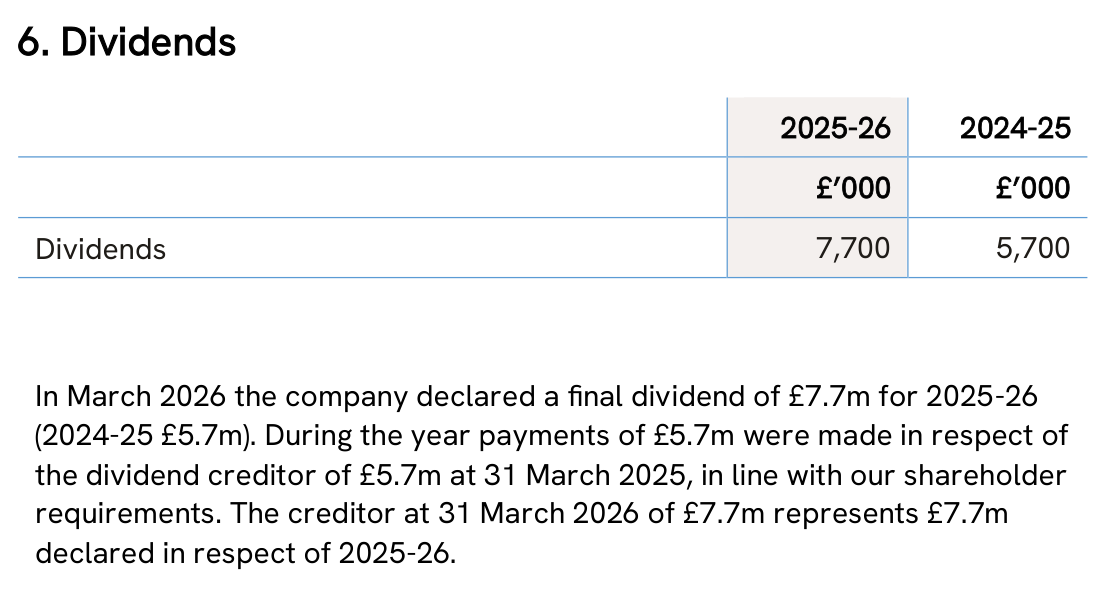
Ordnance Survey's 2025/26 note 6 illustrates the separation in published accounts. It reports a £7.7 million dividend declared in March 2026 and a £7.7 million year-end creditor. The £5.7 million cash paid instead settled the creditor from 31 March 2025. That is an example of a pre-year-end declaration, not evidence that this company declared a dividend after year end.
Sources and context, checked :
Disclose through the authorisation date
For accounts using IAS 1 before IFRS 18 adoption, paragraph 137(a) requires disclosure of dividends proposed or declared before authorisation that were not recognised as a distribution during the period, including the related amount per share. In the January alternative, those figures are £12,000 and £1.20.
IAS 10 paragraphs 17 and 18 require the authorisation date and who authorised the accounts to be disclosed. Subsequent-events consideration ends at authorisation, rather than filing. Keep that date beside the declaration date when preparing the dividend note.
The ordinary-equity conclusion must not be extended to every instrument named a share. Dividends on liability-classified instruments follow different IAS 32 treatment. Noncash distributions and tax effects also need separate work. For the next dividend, put the resolution, governing approval requirement, date the company became bound, reporting date and payment evidence in one file before recording the payable.