
Foreign-operation translation: reconcile the reserve movement to the rates
Translating a euro subsidiary into sterling produces an exchange difference that does not belong in profit. Under UK-adopted full IFRS for a 2026 annual period, assets and liabilities use the closing rate, income and expenses use transaction rates or an average that faithfully approximates them, and the difference goes to other comprehensive income and a separate component of equity. That movement can be explained rather than plugged.
Which rate goes with which line
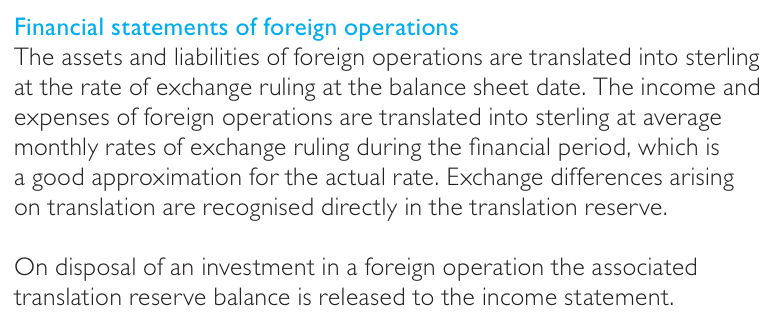
When a subsidiary's functional currency differs from the group's presentation currency, its already-correct functional-currency package is translated, not rebooked. Assets and liabilities are translated at the closing rate. Income and expenses are translated at the rates on the transaction dates, and an average is only a practical approximation where it faithfully reflects those rates. The resulting exchange differences go to other comprehensive income and accumulate in a separate component of equity, with a share allocated to any non-controlling interest.
The example assumes no early adoption of IFRS 18 or the 2027 IAS 21 presentation-currency amendment and no IFRS 19 reduced-disclosure election. It is not FRS 102, IFRS for SMEs, Ind AS or US GAAP. Both currencies are exchangeable and neither economy is hyperinflationary, which follows different rules. Normal consolidation procedures still apply, and exchange differences on intragroup monetary items do not automatically disappear.
Worked hypothetical: a wholly owned euro subsidiary
All figures here are hypothetical, with rates expressed as GBP per EUR1. The subsidiary is wholly owned throughout, with no goodwill, acquisition fair-value adjustments, intercompany transactions, dividends, capital movements, other OCI, tax effects or disposals, and no opening translation reserve.
On 1 January its net assets and share capital are EUR100,000, established when the rate was GBP0.80, so opening translated net assets and historic share capital are GBP80,000. During the year it records EUR100,000 of income and EUR80,000 of expense, a profit of EUR20,000. GBP0.85 is assumed to approximate the actual transaction rates faithfully, because of when activity occurred and the absence of significant fluctuations. That is an assumed, supported approximation, not permission to use any annual average. At 31 December assets are EUR180,000, liabilities EUR60,000 and the closing rate GBP0.90.
Equity before this year's translation reserve is historic share capital GBP80,000 plus current profit GBP17,000, total GBP97,000. Translated net assets are GBP108,000. The GBP11,000 gap is the year's OCI translation gain, and GBP80,000 + GBP17,000 + GBP11,000 = GBP108,000.
| Translated item | Calculation | GBP |
|---|---|---|
| Assets | EUR180,000 × 0.90 | 162,000 |
| Liabilities | EUR60,000 × 0.90 | 54,000 |
| Closing net assets | 162,000 - 54,000 | 108,000 |
| Income | EUR100,000 × 0.85 | 85,000 |
| Expense | EUR80,000 × 0.85 | 68,000 |
| Current profit | 85,000 - 68,000 | 17,000 |
| Historic share capital | EUR100,000 × 0.80 | 80,000 |
| Translation OCI | 108,000 - 80,000 - 17,000 | 11,000 |
Sources and context, checked :
Prove the reserve movement before posting it
The GBP11,000 has two parts. Opening net assets of EUR100,000 moved from GBP0.80 to GBP0.90, adding EUR100,000 × (0.90 - 0.80) = GBP10,000. This year's EUR20,000 profit was translated at GBP0.85 but sits in closing net assets at GBP0.90, adding EUR20,000 × (0.90 - 0.85) = GBP1,000. Together they agree to the translated equity gap.
Shortcuts break the bridge. Translating income and expense at the closing rate gives GBP18,000 profit, overstating the properly translated GBP17,000 by GBP1,000. Translating assets and liabilities at the average is also wrong. A historical-cost asset owned by the subsidiary is translated at the closing rate in this presentation step. That differs from a foreign-currency transaction in the subsidiary's own books, where a historical-cost item acquired in a currency other than the euro is measured at the historical rate on initial recording.
The EUR120,000 closing net assets must first agree in euros. OCI cannot hide missing entries, a reversed rate direction or a broken trial balance. Transaction-level exchange differences already recorded by the subsidiary stay in its results. These are presentation-currency worksheet figures, not a remeasurement journal in the euro ledger, and eliminating the parent's investment against subsidiary equity is a separate step.
What changes the bridge
Goodwill and fair-value adjustments arising on acquiring a foreign operation are expressed in its functional currency and translated at the closing rate. Disposal has a separate reclassification rule, and partial disposals differ depending on whether control, significant influence or joint control is lost. A write-down is not a partial disposal. Dividends, tax, non-controlling interests, hedges and net-investment loans also change the bridge, so the simple GBP11,000 should not be extrapolated to them.
The financial statements disclose the exchange differences in OCI with a reconciliation of the equity component, and any difference between presentation and functional currency. Keep the approved functional-currency package, dated rates with their direction, support for any average, opening translated net assets, dated equity movements and an OCI reconciliation separating rate effects from ledger corrections.
Sources and context, checked :
- IAS 21 The Effects of Changes in Foreign Exchange Rates (UK-adopted, at 1 January 2026), paragraphs 47-48
- IAS 21 The Effects of Changes in Foreign Exchange Rates (UK-adopted, at 1 January 2026), paragraphs 48A-48C beginning on page 15, continuing with paragraphs 48D-49
- IAS 21 The Effects of Changes in Foreign Exchange Rates (UK-adopted, at 1 January 2026), paragraph 52(b) beginning on page 16, and paragraph 53