
Lease or service contract: check who controls the identified asset
A manufacturer signs a three-year agreement headed 'production support services'. It names machine M7, gives the manufacturer exclusive use and lets it decide what M7 produces and when. The heading does not settle the accounting. Under IFRS 16, a contract contains a lease if it conveys the right to control the use of an identified asset for a period of time in exchange for consideration. Control means the customer obtains substantially all the economic benefits from using the asset and has the right to direct its use. That assessment comes at inception, before anyone builds a lease schedule.
Is there an identified asset?
This article covers full IFRS. FRS 102, IFRS for SMEs and US GAAP are separate frameworks, and not every small business applies IFRS 16. The M7 agreement and the contract compared with it below are hypothetical, with their terms assumed.
An asset can be identified explicitly, by a serial number in the contract, or implicitly, when only one asset can practically fulfil it. A named machine is not the end of the test, because a supplier's right to substitute another asset can defeat identification. That right is substantive only if the supplier has the practical ability to swap the asset throughout the period of use and would benefit economically from doing so. A right to replace the asset for repairs or a technical upgrade does not, by itself, make substitution substantive. If the customer cannot readily determine whether the right is substantive, the standard presumes that it is not (IFRS 16 paragraphs B13 to B19).
The IFRS Interpretations Committee tested these rules in detail in an agenda decision published in April 2023. It explains existing requirements rather than adding new ones, and it does not answer every question about control of use.
Who gets the benefits and makes the decisions
The customer must obtain substantially all the economic benefits from using the asset and have the right to direct how and for what purpose it is used (paragraph 9 and B9). In practice that means decisions such as which products the machine makes, how many and when. Limits that protect the supplier, such as safety rules, do not by themselves take those decisions away (B24 to B30).
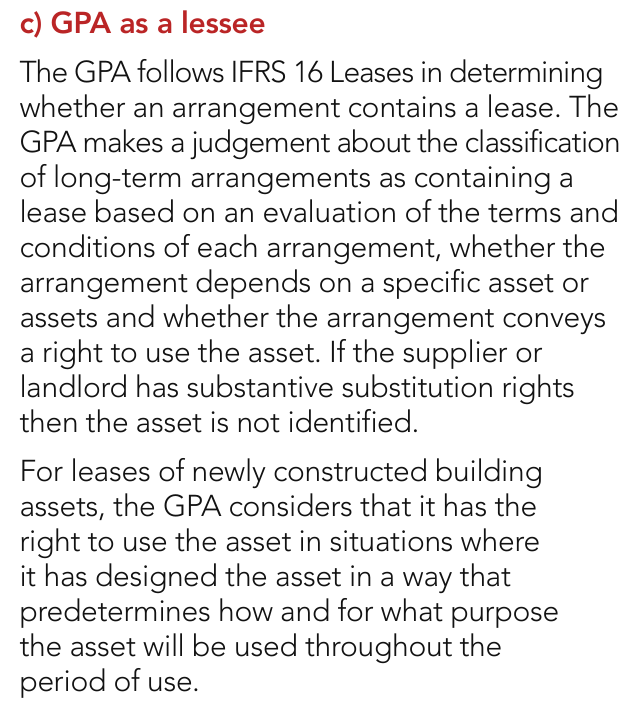
Sometimes the important decisions are fixed in advance. The customer can then still direct use if it has the right to operate the asset, or to direct others to operate it, without the supplier changing those instructions, or if it designed the asset in a way that predetermines how it will be used (B24(b)). The Government Property Agency's 2025/26 accounts discuss specific assets, substitution rights and buildings designed for a predetermined use in their lease judgement note, which shows how these conditions appear in a published disclosure. Supplying an operator does not automatically make a contract a service, and operating an asset is not always the same as directing its use.
Two contracts, two answers
On the assumed facts, the M7 agreement contains a lease: the machine is identified, the supplier's replacement right is limited to repairs and upgrades, and the customer decides what is produced and when. The output agreement is a service, because the supplier chooses its machines and keeps the decisions about how they produce the order. The three-year term is part of the scenario, not a classification threshold. Exclusive use alone does not prove control, and a dedicated asset is not automatically leased.
| Fact | M7 agreement | Output agreement |
|---|---|---|
| Asset | Machine M7, specified | Any machine from the supplier's fleet |
| Supplier's right to replace | Only for repair or a technical upgrade | Supplier chooses which machines to use |
| Products, quantities and timing | Customer decides, within safety limits | Supplier schedules production to fill the order |
| Conclusion on these facts | Contains a lease | Service |
Before anyone builds a schedule
Keep the signed contract and a one-page conclusion covering the asset, the substitution evidence, the benefits and the decision rights. Ask operations who can actually change outputs, timing and use, and test any substitution clause against the supplier's real ability and incentive to swap the asset rather than accepting the wording. Record who made the assessment and which contract version was reviewed, so a later change in terms prompts a fresh look. A lease and a maintenance service can sit in the same contract; separating components and applying any recognition exemptions come after this classification, not before it.