
Petty cash replenishment: count the fund and record each expense once
The petty cash custodian asks for 315 to bring the tin back to its approved 500. A bank transfer for 315 shows that money left the account. It does not show that the tin held 185, that the vouchers record genuine business payments, or that nobody has already posted those expenses. Before approving a top-up, count the cash, list the vouchers and check that together they equal the approved fund. Then use one posting method, so each expense reaches the ledger once.
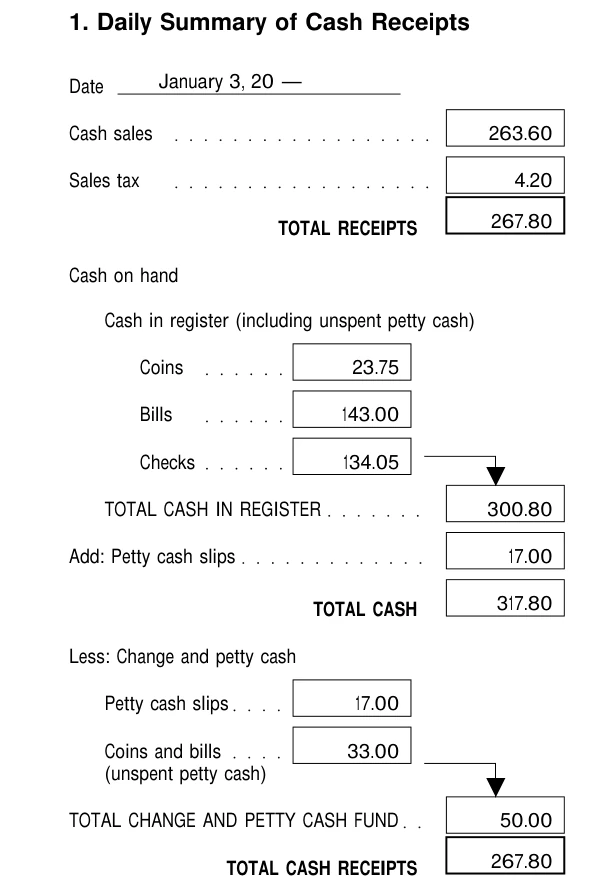
How a fixed fund works
IRS Publication 583 (December 2024) illustrates the method with a sample business that keeps a fixed $50 petty cash fund. Each payment from the fund gets a petty cash slip with the receipt attached. At any point, the unspent cash plus the slips should equal $50. When the fund is replenished, the outstanding slips are reimbursed and their amounts recorded in the appropriate expense columns of the check disbursements journal.
The $50 and the sample dates are teaching figures, not a required amount.
Sources and context, checked :
Controls from one written policy
Cornell University's petty cash guidance shows what a written policy can add. It requires receipts that show the date, the recipient, the amount paid and the business purpose. Funds are kept locked, the custodian is separate from the person who reviews the fund, and the fund is reconciled at least monthly and at every replenishment. Its accounting guidance charges replenishments to operating accounts and leaves the approved fund account alone unless the fund itself changes.
Those are Cornell's rules for Cornell. A business can borrow the ideas but still has to set its own fund size, review frequency and approvers.
Sources and context, checked :
Worked example: expenses recorded at replenishment
This example is hypothetical, in generic currency units, with taxes excluded. The fund was set up with 500 by debiting petty cash and crediting bank. Payments are kept as vouchers and not posted until replenishment. The office supplies were used straight away, so they are an expense rather than stock.
At the count, the vouchers show office supplies of 200 and postage of 115, a total of 315. The cash counted is 185. 185 + 315 = 500, so the fund is complete and the replenishment entry is:
| Account | Debit | Credit |
|---|---|---|
| Office supplies expense | 200 | |
| Postage expense | 115 | |
| Bank | 315 |
After the top-up
The tin goes back to 500 in cash. The petty cash account in the ledger stays at 500 throughout, and the 315 of expenses appears once, at replenishment. Mark each voucher as reimbursed with the replenishment batch reference so it cannot be presented again.
If expenses are posted when paid
Some software posts each receipt as it happens, debiting the expense and crediting petty cash. Under that alternative method the ledger petty cash balance should already read 185 at the count, and the replenishment is a debit to petty cash of 315 and a credit to bank of 315. Debiting the expenses again would count them twice.
Pick one method, write it down and keep to it. Under either method, the ledger balance does not prove the cash exists. Only a count does that.
When the count comes up short
If the count finds 180 instead of 185, then 180 + 315 = 495, leaving 5 unexplained. Recount, look for a missing voucher and talk to the custodian before approving anything. Writing a voucher for 5 of supplies so the top-up becomes 320 hides the problem. If a cash over and short entry is needed, the accounting owner should approve and document it.
Period end needs attention too. Valid vouchers that have not yet been replenished are still expenses of that period, so agree with the accounting owner how they will be recorded if the top-up falls after the close. A receipt supports the payment. It does not by itself establish tax deductibility or VAT recovery.
At the next replenishment
Ask for the denomination count sheet and the voucher list together, check their total against the approved fund, and confirm which posting method the ledger uses before the transfer is released.