
CIS deductions: verify first, then check the materials cost
In this hypothetical, a contractor receives a £4,300 invoice from a construction subcontractor: £3,000 labour, £1,200 for materials and £100 travel. HMRC has told the contractor to deduct 20%. The quick approach is to strip out the £1,200 materials line and apply 20% to the rest, but that understates the deduction. Under current UK Construction Industry Scheme (CIS) guidance, the contractor removes what the subcontractor actually paid for the materials, not what it charged for them. This assumes the contractor has already decided the subcontractor is genuinely self-employed and that the work falls within CIS.
Verification sets the rate, not the status
Before paying a new subcontractor, the contractor verifies them with HMRC. A subcontractor used before must be verified again if they have not appeared on the contractor's returns in the current tax year or the previous two. HMRC's answer sets the treatment: deduct at 20%, deduct at 30%, or pay gross. A subcontractor saying they have registered is not a basis for choosing a rate.
The name and tax details must match HMRC's records exactly. Keep the verification result and reference, and any later notice that changes the payment status.
Verification answers one question: how CIS payments are treated. It does not prove the subcontractor is self-employed. That decision, and whether the work is within CIS at all, belong in a separate record made beforehand. Gross payment status removes the deduction but not the contractor's CIS reporting duties.
What comes out before the rate applies
Before applying the rate, the contractor takes out any VAT charged and the cost of materials the subcontractor bought directly for the job. Only the subcontractor that paid for the materials can have that cost excluded. Fuel for travelling is not a materials cost, and CIS 340 includes travel and subsistence in the amount the deduction is calculated on.
The materials figure is cost, not selling price. Where the subcontractor is not VAT registered, its materials cost includes the VAT it paid. Where it is registered, the cost excludes VAT. CIS 340 tells contractors to check and keep evidence of the direct materials cost, and warns that if the materials element is overstated, the contractor can be left with an underdeduction. Receipts are the obvious evidence, though HMRC's shorter guide allows a reasonable estimate where none exist. Write down how any estimate was reached.
The hypothetical worked through
In this original hypothetical, the subcontractor is not VAT registered, so there is no construction reverse charge to calculate and no VAT on the invoice to remove. It bought qualifying materials for this job for £900, including VAT it cannot recover. It has no other direct costs. The contractor pays on 30 October 2026.
The £300 gap between the materials price and their cost stays in the base, and so does the £100 travel. If HMRC had directed 30%, the deduction would be £1,020 and the payment £3,280. These figures do not extend to VAT-registered subcontractors under the reverse charge or to complex plant arrangements.
| Item | Amount |
|---|---|
| Gross invoice | £4,300 |
| Less direct materials cost | £900 |
| Deduction base | £3,400 |
| CIS deduction at 20% | £680 |
| Paid to subcontractor | £3,620 |
| Deduction if the £1,200 materials price were removed instead | £620 |
| Underdeduction from using the price | £60 |
Sources and context, checked :
The statement and the paper trail
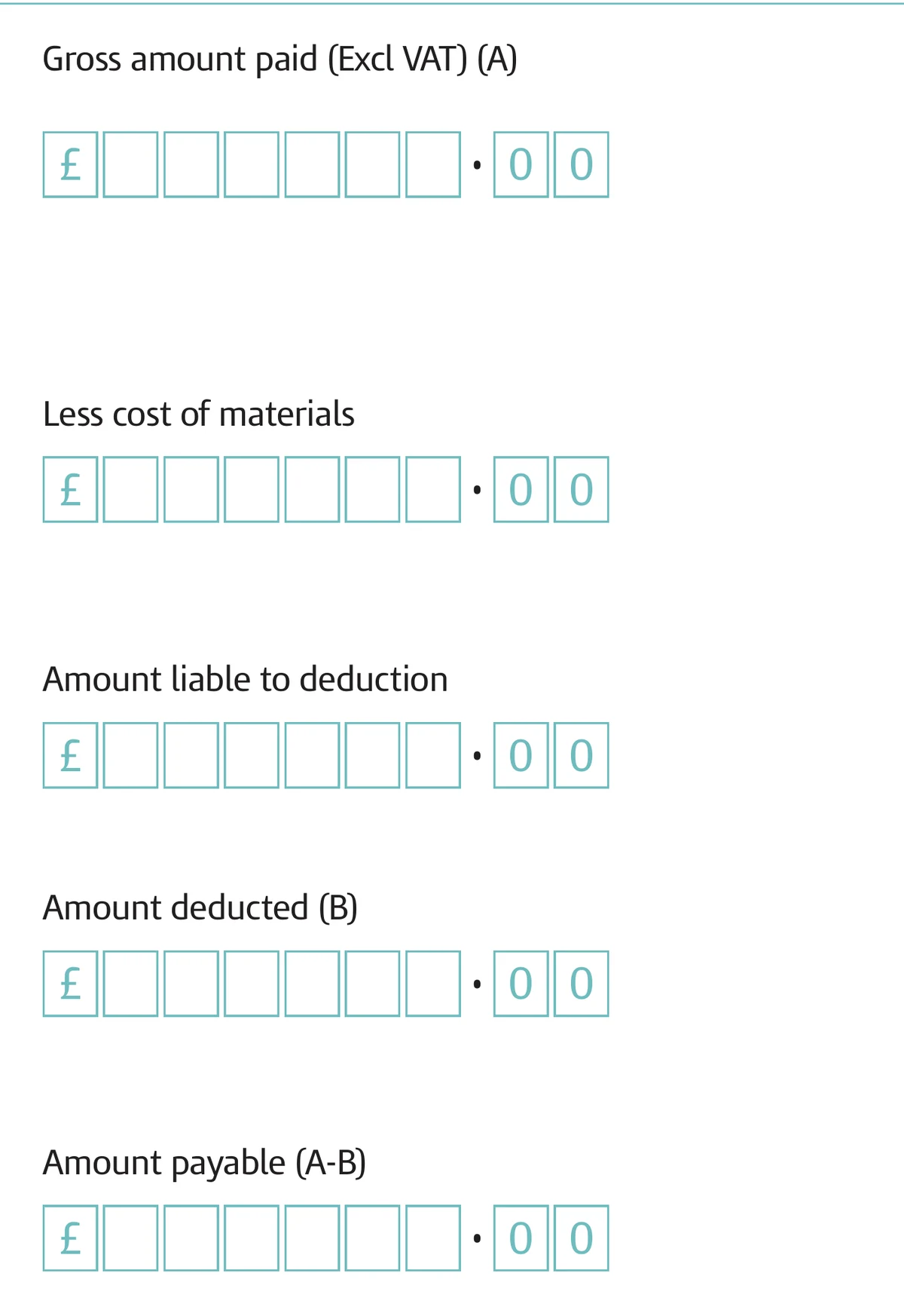
Each subcontractor who has had tax deducted must receive a written payment and deduction statement within 14 days after the end of the tax month. The 30 October payment falls in the tax month ending 5 November 2026, so its statement is due by 19 November 2026. One statement can cover all of that month's payments. It must show the gross payment, the materials cost and the amount deducted. HMRC's sample form is optional. A verification number is needed only where an unmatched subcontractor was deducted at the higher rate. For subcontractors paid gross, a statement is good practice rather than a requirement.
If a materials line is round or close to the full price, ask for the receipts before the payment run, not after HMRC asks.
- Employment status and CIS scope decision, recorded separately from verification
- Exact name and tax details, verification result and reference, and any later rate notices
- The invoiced materials price alongside the direct cost, with receipts or the basis of a reasonable estimate
- Invoice total reconciled to cash paid and tax withheld
- Statement figures agreed to the monthly return
Sources and context, checked :