
PAYE payments: reconcile the HMRC charge and the payment allocation
Your bank shows £3,900 paid to HMRC on 2 November 2026, yet the online account still shows the tax month to 5 October unpaid. Leave payroll alone for now. Work through what payroll reported, what HMRC charged and where the payment landed. FPS and EPS submissions drive the charge and the payment reference drives the allocation, so the fix depends on which of them went wrong.
Rebuild the charge for one tax month
Tax months run from the 6th to the 5th, so start by checking that each payday belongs to the month you are testing. The monthly amount starts with deductions on Full Payment Submissions (FPS) for the previous tax month, then falls by claims on an Employer Payment Summary (EPS) submitted before the 19th of the current tax month. An EPS received after the 19th counts against the next period. The standard electronic deadline is the 22nd, or the 19th for a postal cheque. Employers who pay HMRC quarterly must still report payroll on or before payday.
In this hypothetical, a monthly employer has FPS liability of £4,200 for 6 September to 5 October 2026 and a legitimate £300 recovery correctly claimed by EPS before 19 October. It pays late by bank transfer, on 2 November, using an incorrect reference. The figures exclude interest, penalties and any other balance.
| Item | Amount |
|---|---|
| FPS liability for the tax month | £4,200 |
| EPS recovery | (£300) |
| Expected principal charge | £3,900 |
| Bank payment on 2 November 2026 | £3,900 |
Sources and context, checked :
Check which reference the payment used
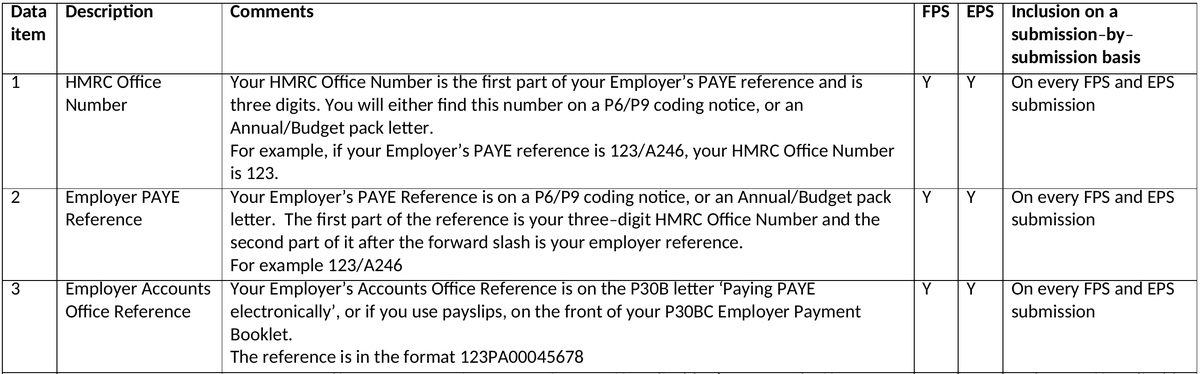
With £3,900 on both sides, the question moves to allocation. Employers have two similar-looking identifiers. The Accounts Office reference has 13 characters. The employer PAYE reference contains an office number and a slash. HMRC's RTI data item guide for 2026 to 2027 defines them separately, and a payment needs the Accounts Office reference.
For early or late payments by the methods HMRC lists, add 4 digits after the Accounts Office reference: the last two digits of the year the tax year ends, then the two-digit tax month or the two-digit month the quarter ends. A late payment for 6 September to 5 October 2026 belongs to the tax year ending 2027 and tax month 06, so the suffix is 2706. Update the digits each time. HMRC's online payment service works them out for you, and a recurring Direct Debit has its own collection mechanics, so this is not a manual step for every method.
HMRC warns that a wrong reference may delay a payment or pay a different bill. Its guidance is to contact the employer helpline and ask for the payment to be moved.
Allow for the update, then trace the money
HMRC says the online account should update within 6 working days of payment, and its payroll errors guidance says to check that FPS and EPS submissions were sent in time for the account to update. A gap inside that period does not show the payment failed. A bank debit proves cash left the account, but it does not prove HMRC allocated it correctly.
That guidance also says a difference can come from submissions or from missing or misallocated payments, so match the finding to its route. The table is our summary, not an HMRC procedure.
| What you find | What it points to | Next step |
|---|---|---|
| Payment missing after the update period, or on another bill | Missing or misallocated payment | Match the bank details and reference, ask the employer helpline to trace the payment, and ask for it to be moved if it was misallocated |
| EPS reached HMRC after the 19th | Recovery counts in the next period | Reconcile it there |
| FPS or EPS figures are wrong | Genuine reporting error | Correct it through the proper FPS or EPS route |
| Interest, penalty, specified charge or older balance | A separate balance | List it separately and follow its own route |
Leave correct payroll alone
Do not submit an FPS that reduces real deductions by £3,900 just to match the cash. A misallocated payment does not change what employees earned or what was deducted. Moving the payment does not cancel any interest or penalties either, and an open query is no reason to delay a payment that is genuinely due.
For the helpline call, we suggest having the tax month, the Accounts Office reference and suffix that should have been used, the reference actually used, the bank date and amount, and the accepted FPS and EPS for the month. This is our practical suggestion. If the trace later finds a true FPS or EPS error, correct it separately and keep the request to move the payment running.