
Construction reverse charge: who accounts for the VAT?
A UK subcontractor finishes a £5,000 standard-rated building job for a VAT-registered contractor and issues an invoice that does not add the £1,000 VAT. If the domestic reverse charge applies, that is correct, because the contractor accounts for the VAT instead. If a condition fails, the same invoice is wrong. Check the customer and the supply before choosing the invoice wording.
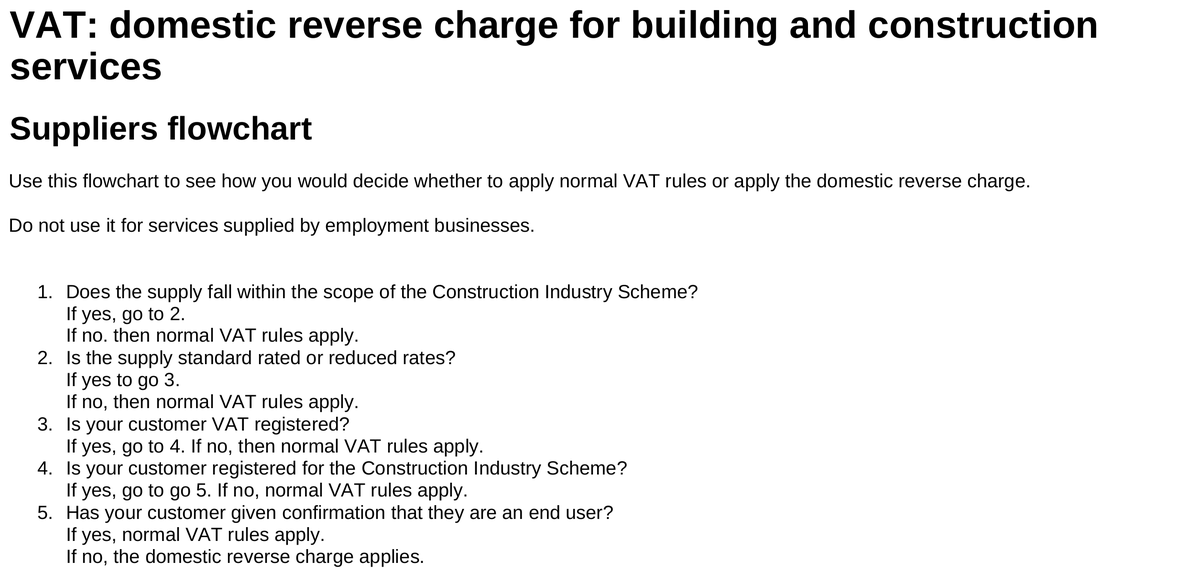
Test the supply first
The domestic reverse charge concerns UK construction services within the Construction Industry Scheme (CIS), not overseas place of supply questions. It is neither zero rating nor an exemption, and the industry name alone does not decide whether it applies. All of these points need checking.
- Both supplier and customer are VAT registered.
- The payment is reportable under CIS.
- The service is standard or reduced rated. Zero-rated supplies stay outside the reverse charge.
- The supply is not of workers by an employment business.
- The customer has not given written notice that it is an end user or intermediary supplier.
Status needs evidence
End users do not make onward supplies of the construction services they buy. To move to normal VAT treatment, that status must be notified in writing. Believing a customer is an end user is not enough. A main contractor working for a private householder also does not become an end user of the subcontract work.
Contractors for CIS may not appear in the customer registration check. Where required, ask them to confirm that they report under CIS rather than treating a failed lookup as the answer.
Goods supplied with construction services normally follow the reverse charge treatment. Standalone goods, staff from employment businesses and some professional services are treated differently.
Invoice wording and a hypothetical £5,000 job
The invoice needs the normal VAT invoice information, a reverse charge reference and a statement that the customer accounts for the VAT. It should show the VAT due or the rate, but the VAT must not be included in the amount charged.
In this hypothetical, a UK VAT-registered subcontractor makes one standard-rated qualifying supply to a UK VAT-registered contractor. The payment is reportable under CIS. There is no end user or intermediary notice, no employment business and the customer can fully recover the VAT. The VAT is £5,000 × 20% = £1,000.
The £5,000 is the invoice amount before any separate CIS deduction. It is not a guaranteed cash payment of £5,000, and this example shows no CIS calculation.
The fully entitled customer has net VAT of nil, but must still record the VAT and the purchase. A customer that cannot recover all its input VAT has a different result.
The customer's purchase goes in box 7 only. That differs from the overseas services reverse charge, where purchases generally also enter box 6.
| VAT return box | Supplier | Customer |
|---|---|---|
| Box 1 | No VAT on this sale | £1,000 |
| Box 4 | No entry for this sale | £1,000 where fully recoverable |
| Box 6 | £5,000 | No entry for this purchase |
| Box 7 | No entry for this sale | £5,000 |
Cash accounting and the contract file
The reverse charge cannot be handled through VAT Cash Accounting, so it does not defer this VAT. A business can stay on cash accounting for its transactions outside the reverse charge, which means these sales and purchases need separate handling in the records.
Set up the contract file before the first invoice, because a change of status can reverse who accounts for the VAT.
- Keep the checked VAT numbers and CIS reporting evidence.
- Document the supply classification and VAT rate.
- Retain any written customer status notice.
- Use a reverse charge invoice code and reconcile it to the correct return boxes.
Sources and context, checked :