
UK VAT return errors: calculate the net amount, then choose the route
A £15,000 net VAT error does not always require the same correction route. For ordinary non-deliberate errors in submitted UK returns, compare the net VAT with the limits and the discovery period's box 6. Then check individual errors and disclosure separately. Eligibility to adjust a return does not promise freedom from penalties.
Establish what is an error and how much VAT it changes
An error found before submission can be corrected in the records before filing. Once the affected return has been submitted, HMRC sets out method 1, an adjustment on a current return, and method 2, separate notification. A valid later credit note, bad-debt claim or annual partial-exemption adjustment is not automatically an error in the original return.
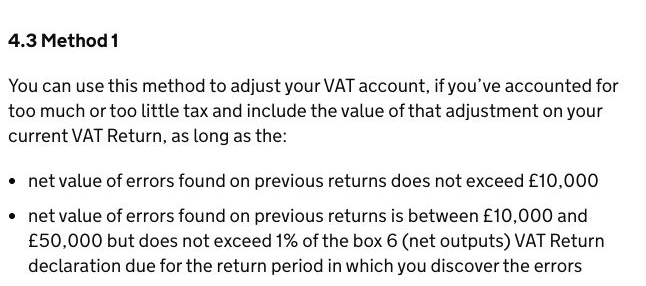
For eligible non-deliberate errors, method 1 is available when the net error is £10,000 or less. Above £10,000 and up to £50,000, it is available only if the amount does not exceed 1% of box 6 for the period in which the error is discovered. Method 2 is required above the limits and can also be chosen voluntarily.
Calculate the VAT effect, rather than adding gross invoice values. Amounts due to HMRC and amounts due to the business move the net in opposite directions. Use the actual discovery-period box 6, rather than sales from an old erroneous return. Identify deliberate errors separately; they require notification and must not be folded into the ordinary method 1 calculation.
Sources and context, checked :
One net error, two discovery-period sales totals
The following circumstances and amounts are hypothetical. A review on 30 October 2026 identifies non-deliberate errors in previously submitted 2026 returns, all within the applicable correction time limits. Earlier returns omitted £12,000 of output VAT and overclaimed £10,000 of input VAT. A separate eligible input VAT omission means £7,000 is due to the business.
The net amount due to HMRC is £12,000 plus £10,000 minus £7,000, or £15,000. None of the individual errors exceeds either example's applicable limit, so the separate immediate-notification condition does not alter these examples.
Business A has discovery-period box 6 of £1,600,000. One per cent is £16,000. Its £15,000 net error is below that amount and below £50,000, so it may use method 1, adding £15,000 to box 1. It may instead choose method 2.
Business B is an independent case with the same error amounts but box 6 of £1,400,000. One per cent is £14,000. Its £15,000 net exceeds that limit, so method 2 is required. The same errors produce a different route because the relevant discovery-period figure differs.
| Error | Additional VAT due to HMRC |
|---|---|
| Output VAT omitted | £12,000 |
| Input VAT overclaimed | £10,000 |
| Eligible input VAT omitted | Minus £7,000 |
| Net error | £15,000 |
Do not let netting or the return adjustment hide another task
If an individual error already exceeds the applicable limit, use the immediate method 2 notification rule rather than waiting for other errors to offset it. A £60,000 net error requires method 2 regardless of box 6. Deliberate conduct also changes the route.
Method 1 is not itself the disclosure used for penalty purposes. Assess reasonable care, carelessness and any separate notification needed for potential penalty reductions. Do not treat a current-return adjustment as a guarantee that interest or penalties cannot arise. Time limits also depend on the type of correction; one universal four-year deadline does not describe every case.
Keep an error log showing original period, discovery date, reason, evidence, input or output direction and VAT amount. Attach the net calculation, actual box 6, conduct assessment, chosen route and submission reference. Finally reconcile the accounting records and VAT control so the same correction is not posted both through the underlying record and again as a return adjustment.
Sources and context, checked :