
Company-car private fuel: repay all of it or keep the charge
In this hypothetical, an employee drives a company car with private fuel throughout the 2026 to 2027 tax year. The employer records £1,200 of private fuel, including commuting, and requires the employee to pay it all back. By 6 July 2027 the employee has repaid £1,190. The £10 gap does not create a £10 benefit. It leaves the full fuel benefit in place, worked out from an annual multiplier rather than from what was spent. This covers ordinary company-car fuel reported on Form P11D, not payrolled benefits. It excludes salary sacrifice and other optional remuneration, vans, employee-owned cars, electricity and part-year cases.
How the fuel benefit is calculated
The fuel benefit is separate from the car benefit. Its cash equivalent is a fixed annual multiplier times the same appropriate percentage used for the car. For 2026 to 2027, HMRC's Employment Income Manual gives the multiplier as £29,200, citing SI 2025/1254, and HMRC's current travel rates table lists the same figure.
HMRC's Chapter 13 guidance on taxable fuel, last updated 7 April 2025, still explains the mechanism but shows older multipliers. Take the 2026 to 2027 amount from the current manual and rates table.
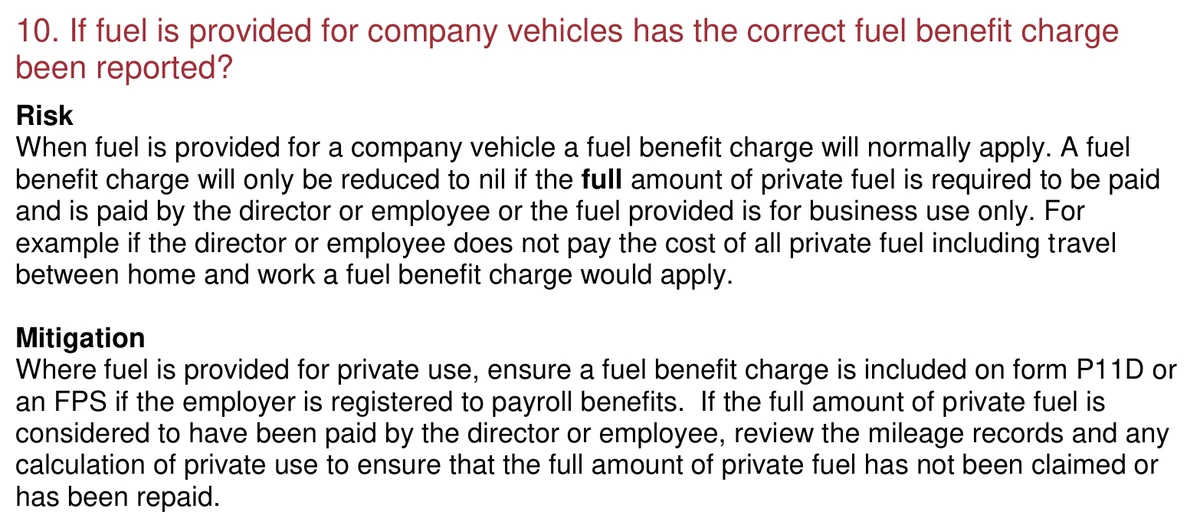
The repayment test is all or nothing
The benefit falls to nil only if two things happen. The employee must be required, during the year, to make good the whole cost of private fuel, and must actually do so by 6 July after the tax year ends. For 2026 to 2027, that is 6 July 2027. Private use includes ordinary commuting. Payment can be made directly or through deductions from net pay.
Paying back part of the cost reduces nothing. The benefit is not cut pound for pound by what was repaid.
A separate rule can reduce the benefit when private fuel is permanently withdrawn part way through the year. If private fuel is provided again later in the same year, that reduction is lost. The example here assumes no withdrawal.
Sources and context, checked :
The hypothetical in numbers
In this original hypothetical, the car's appropriate percentage is assumed to be 25%. It is an input, not worked out from emissions. Private fuel is available all year with no reductions. For illustration only, the whole benefit is taxed at an assumed marginal rate of 40%. Employer Class 1A NICs on taxable benefits are 15% in 2026 to 2027.
With £10 unpaid, the benefit is £7,300. It is not £10, and it is not £7,300 minus £1,190. Under these assumptions, a £10 shortfall leaves the employee with £2,920 of tax and the employer with £1,095 of Class 1A. These figures leave out the separate car benefit and any VAT.
| Item | Amount |
|---|---|
| Fuel benefit: £29,200 × 25% | £7,300 |
| Employee Income Tax at assumed 40% | £2,920 |
| Employer Class 1A at 15% | £1,095 |
| Fuel benefit if the full £1,200 is repaid by 6 July 2027 | £0 |
| Fuel benefit if only £1,190 is repaid by that date | £7,300 |
If benefits are payrolled
Voluntarily payrolled benefits follow separate operational guidance. Where private fuel is payrolled and its cost was not known at the year end, that guidance uses a 1 June point in the following year. Payroll teams should work from it rather than apply the 6 July date from this P11D example.
Sources and context, checked :
Records that settle the question
Advisory fuel rates can help set a reimbursement figure, but they are not compulsory and they are not VAT fuel scale charges. Whatever method sets the private cost, reconcile every pound by 6 July.
- The vehicle, its appropriate percentage and the multiplier for the year
- Opening and closing odometer readings, classified journeys and private miles including commuting
- Fuel statements and the method used to cost private fuel
- The in-year requirement to repay the whole private cost
- Dated net-pay deductions or bank receipts, reconciled to the full private cost by 6 July 2027
- Car benefit and VAT checked separately