
Company charitable donations: the tax deduction stops at available profits
Your company's accounts show £1,000 of profit after a £3,000 cash gift to a charity was expensed. For Corporation Tax, add the expensed gift back when calculating taxable trading profit, then deduct it once as a qualifying charitable donation in the accounting period the company paid it. That deduction can reduce profits to nil but no further. In an ordinary standalone company, any excess is not a trading loss and does not carry to the next return.
Check that the payment is a qualifying gift
HMRC says cash gifts to a charity or community amateur sports club (CASC) may reduce Corporation Tax. A loan the charity must repay, a dividend and a gift conditional on the charity buying property from the company or a connected person do not qualify.
What comes back to the donor matters too. A benefit to the company or people connected with it can disqualify a gift if it goes above HMRC's published limits, so test the actual arrangement against those limits. A genuine business sponsorship follows a different expense route, which means a payment to a charity is not automatically a donation.
This article covers ordinary cash gifts by a company. Personal Gift Aid, donated equipment, land or shares, distributions by a charity-owned subsidiary and group surrenders have separate rules.
Sources and context, checked :
Add the gift back, then deduct it once
HMRC's manual says qualifying donations are not deducted in computing income from a source. The relief comes later, against total profits after other reliefs except group relief, in the accounting period when the gift is paid. A gift sitting in the ledger as an expense therefore has to be added back when you work out trading profit. Leaving it there and also claiming it as a qualifying donation would deduct it twice.
The hypothetical table assumes a standalone trading company, an ordinary cash gift paid in the period to an eligible charity, no benefit or sponsorship, no group relief and no other tax adjustments or reliefs. The second column is a separate illustration of the cap.
| Line | Main example | Cap example |
|---|---|---|
| Accounts result after expensing the £3,000 gift | £1,000 profit | £1,000 loss |
| Add back the gift | £3,000 | £3,000 |
| Profits before the qualifying donation | £4,000 | £2,000 |
| Qualifying donation relieved | £3,000 | £2,000 |
| Taxable total profits | £1,000 | £0 |
| Gift left unrelieved | £0 | £1,000 |
Sources and context, checked :
Stop the relief when profits reach nil
In the cap example the accounts show a loss, yet the add-back leaves £2,000 of profit, so the gift has produced no trading loss. Relief stops at £2,000 because the deduction cannot take those profits below nil. HMRC's claim guidance says an excess cannot create a trading loss or carry to the next return, so in this standalone case the other £1,000 gets no relief.
The deduction lowers taxable profit. It is not a refund of the gift, and the tax saved depends on the company's own position, so do not assume a 25% saving.
Sources and context, checked :
Date the gift and tie it to the return
The payment date decides the period. If the board approves a gift before the year end and the company pays it afterwards, the relief belongs to the later period, even if the accounts carry an accrual at the year end.
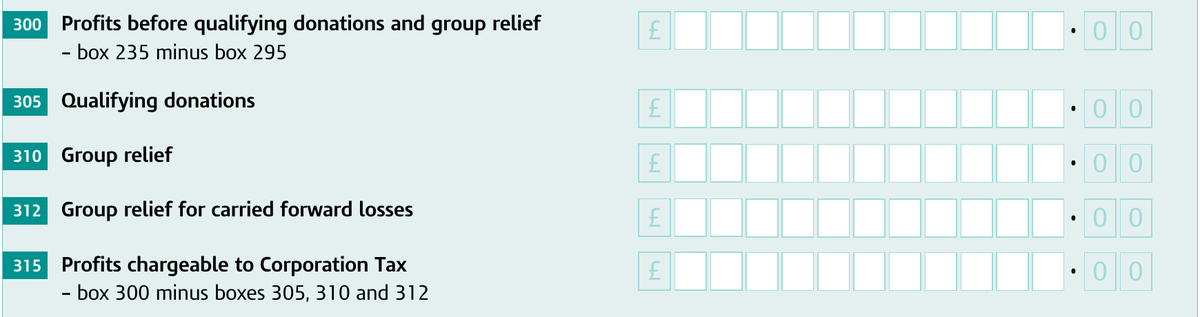
HMRC tells companies to claim cash gifts through qualifying donations in the Company Tax Return for the payment period. On the 2026 CT600, box 300 holds profits before qualifying donations and group relief, and box 305 holds qualifying donations.
We suggest one short working for each gift. This is our practical control, not an HMRC requirement. Record the recipient and why it is eligible, confirm that no benefit, repayment or connected transaction exists, and attach the payment evidence and the acknowledgement. Then show the add-back, the profits available and the amount relieved, and agree the figures to CT600 boxes 300, 305 and 315. If the cap applies, mark the excess as unrelieved so nobody brings it into next year's computation.
Sources and context, checked :