
Confirmation statement or annual accounts: keep two filing dates
A confirmation statement and annual accounts are separate Companies House filings, and completing one does not satisfy the other. The confirmation statement confirms that the company information on the public register is correct. Annual accounts report the company's financial performance for its financial year. A private limited company needs both dates in its calendar, each copied from the register, and separate evidence for each filing.
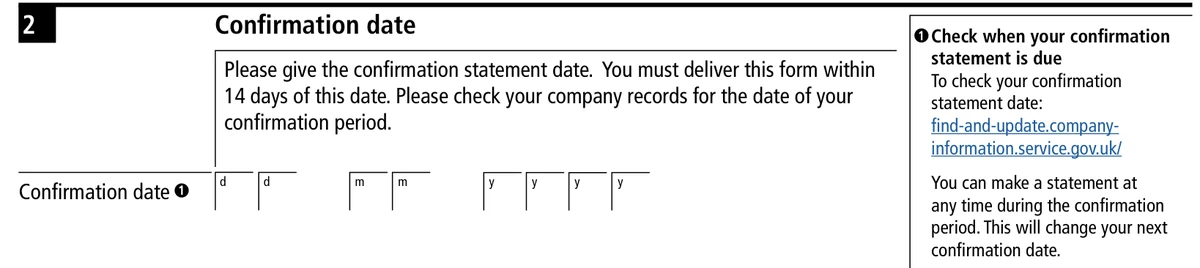
What the confirmation statement confirms
Companies House requires a company to review its information and file at least one confirmation statement every 12 months. The review period runs from incorporation or from the date of the last confirmation statement. The company then has up to 14 days after the review period ends to file. Filing early is allowed and starts a new review period.
The review is a check of public details. Before filing, compare the register with the company's own records for each item listed here.
Some changes must be reported on their own forms rather than through the confirmation statement. If the check turns up a new director, a moved office or a changed controller, confirm which form that change needs before treating the statement as the fix.
- Registered office address
- Directors, and the company secretary if there is one
- The address where company records are kept
- Share capital and shareholders
- The SIC code describing what the company does
- People with significant control
Sources and context, checked :
Director identity verification on the current form
The current published CS01 form is version 7.0, marked 02/26. It includes a confirmation relating to director identity verification.
Companies House guidance says a personal code is needed for every director when filing, unless that director's code has already been provided. Before the filing session, check which directors' codes are still missing and gather only those, so the submission does not stall.
Accounts run on a separate clock
For a private limited company, annual accounts are ordinarily due 9 months after the end of the financial year. First accounts normally have a deadline of 21 months from incorporation. Public companies have different rules and are outside this article.
The two filings are set by different events, so one date cannot be worked out from the other. Avoid counting forward from an incorporation anniversary, and avoid assuming that a change to the financial year moves the confirmation statement date. Copy each due date from the official register, record it as its own line, and note the date it was checked.
Sources and context, checked :
Hypothetical example: two December deadlines
In this hypothetical, the register shows a confirmation statement due on 14 December 2026 and annual accounts due on 31 December 2026. These are assumed register dates for illustration, not a calculation of any company's legal deadlines.
The team files the CS01 on 10 December, saves the Companies House acknowledgment and marks that task complete. The accounts task stays open. It closes only when the accounts have been submitted separately and accepted. Once the register updates, the team copies the next confirmation statement date from it.
| Filing | Register date | Position on 11 December | Evidence |
|---|---|---|---|
| Confirmation statement | 14 December 2026 | Filed on 10 December | Filing acknowledgment |
| Annual accounts | 31 December 2026 | Still open | Acceptance, once submitted |
Records worth keeping for each filing
A short file for each filing makes the next review faster and shows who checked what. A practical set includes the items below.
Correcting accounts that have already been filed is a different task with its own steps.
- Both due dates as copied from the register, with the date someone checked them
- The confirmation statement checklist, noting who confirmed each register item
- Copies of any separate forms filed for changes found during the review
- A note of which directors have supplied identity verification codes
- The confirmation statement acknowledgment, stored apart from the accounts evidence
- The accounts as submitted and the Companies House acceptance