
Authorise the Corporate Interest Restriction reporting company for each period
An earlier appointment no longer carries over. For a period of account ending on or after 31 March 2026, the group appoints an eligible reporting company for that period, and more than half of the period's eligible companies must authorise it. With four eligible companies, two approvals fail and three succeed.
The rule for the new periods
Finance Act 2026 section 61 substituted paragraph 1 of Schedule 7A to the Taxation (International and Other Provisions) Act 2010. An eligible company was a UK group company at some time in the period and was not dormant throughout it. Section 61(21) applies the new appointment rules to periods of account ending on or after 31 March 2026.
HMRC's overview explains the move from at least half to more than half. HMRC also confirms there is no group appointment deadline under the new rule. The return filing deadline applies separately.
Sources and context, checked :
Counting a hypothetical group
A worldwide group is preparing its return for the period ending 30 June 2026 to allocate a disallowance to specific companies. Four companies were UK group companies during the period and none was dormant throughout. A fifth UK subsidiary was dormant throughout and is excluded. The subsidiary is separate from the worldwide group’s ultimate parent. There are no other eligible companies.
This count covers the appointment of the reporting company. Allocating a disallowance involves a separate consent decision.
| Authorisations | Share of four | Outcome |
|---|---|---|
| 2 | Exactly half | Fails |
| 3 | More than half | Passes if duly authorised and the appointee is eligible |
Sources and context, checked :
Authorising and notifying
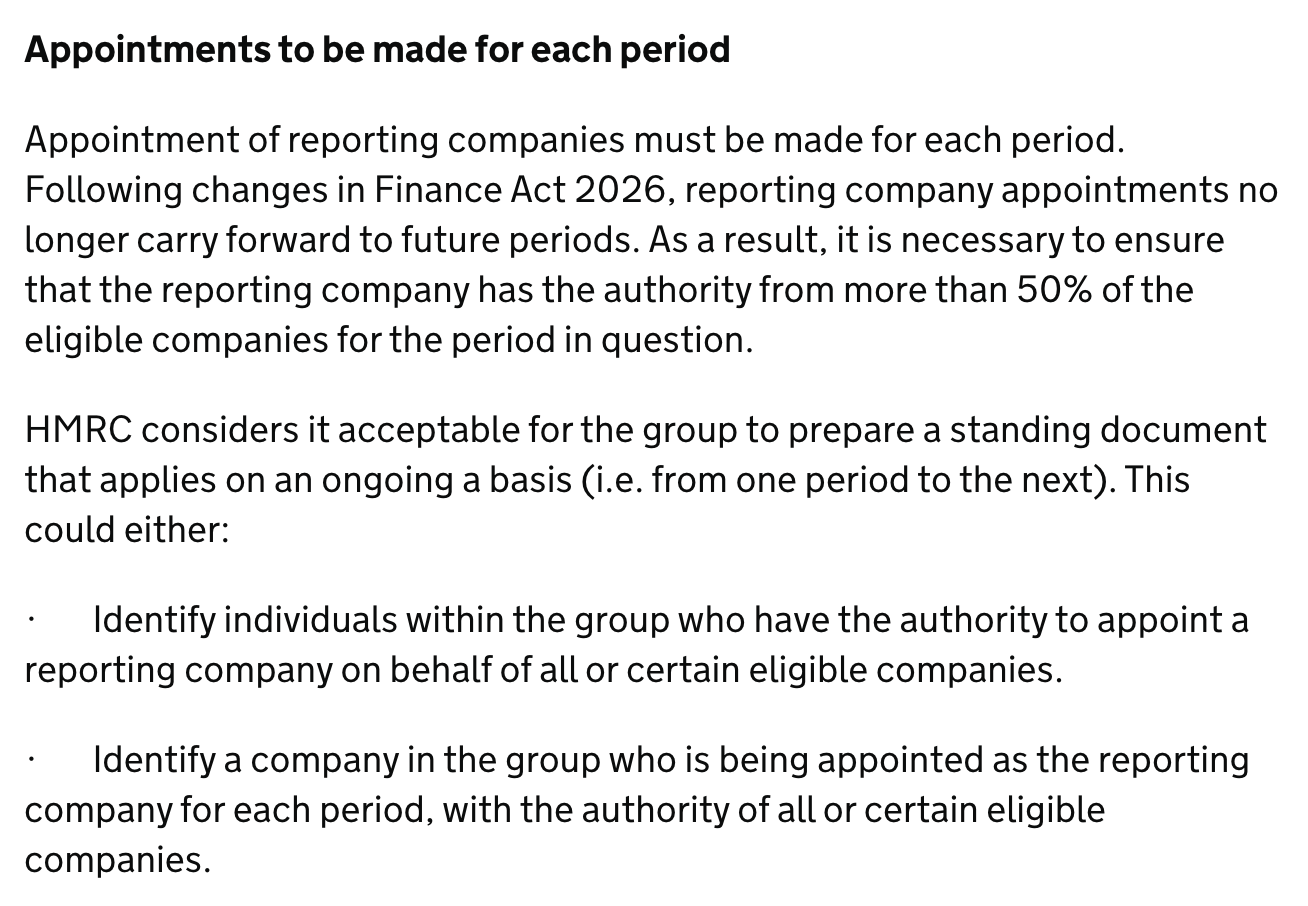
Automatic carryover of earlier appointments has ended, so each period needs an authorised appointment. HMRC accepts a standing document that explicitly authorises the appointment for each period or empowers named people to make the appointment. Authorisation can follow the group's own valid internal process.
One officer may act for several companies if authorised to bind each one. Where a standing document names that officer, the officer can make the appointment for every company they are authorised to bind. Record that authority for each company counted.
Give notice of the appointment as soon as reasonably practicable to the ultimate parent of the worldwide group and to each company that was a UK group company during the period and was not dormant throughout it. In the hypothetical, the dormant subsidiary falls outside that notice list. Circulating the filed return is a separate duty to each UK group company that was in the group during the period.
Sources and context, checked :
Evidence file
Keep one evidence file for each period so the majority count can be rebuilt from the records.
For your next qualifying period, build the dated entity list and complete the authorisation count before return work starts. Recount after any group change and diary the filing deadline separately.
- Dated, period-specific entity list with UK membership and dormant status
- Evidence that the appointee is eligible
- The authorisation count and supporting evidence, including any standing document
- Appointment notice recipients, copies of the notices and the return receipt
Sources and context, checked :