
PAYE Settlement Agreements: reconcile the tax and Class 1B bill
Start from the categories in the signed P626. Gross up the VAT-inclusive cost of each benefit at the recipient's marginal rate. Then apply Class 1B at 15% for 2026 to 2027 to the grossed-up tax plus only those benefit values that would normally attract Class 1 or Class 1A NICs. HMRC calculates the bill after you report, so treat your own recalculation as a finance control and match it to the PSA reference and the bank payment.
Start with the signed agreement
A finance team has a benefits invoice register totalling £1,400 for two staff groups and a PSA bill to settle. Before anyone grosses up a figure, open the signed P626. It sets out the categories HMRC has agreed the PSA covers, and anything outside those categories needs separate treatment.
A PSA is voluntary and, once agreed, enduring. It can cover benefits and expenses that are minor, irregular or impracticable to put through payroll or report individually. Exempt items stay out of the calculation altogether. If no agreed items arise in a year, HMRC still expects the agreed values to be reported, which can mean a nil report.
Sources and context, checked :
Build a cost and rate schedule
Each line of the schedule needs the VAT-inclusive cost of the benefit, the recipient's tax area and the marginal rate that applies to them. HMRC's GfC1 guidance says to include employees earning below the personal allowance and, where an employee pays no tax with that employer, to use their first chargeable rate. Scottish rates can differ from those elsewhere in the UK, so record the tax area on every line.
Where attributing each benefit to an individual is impracticable, GfC1 describes using an agreed reasonable method or a representative sample. Agree the method with HMRC; applying an average rate across the whole population is a different thing.
You can report through PSA1 online or send an informal calculation by post. Either way, report costs including VAT by region and tax band, and include every benefit recipient.
Sources and context, checked :
A hypothetical 2026 to 2027 calculation
The 15% Class 1B rate for this hypothetical comes from HMRC's 2026 to 2027 employer rates.
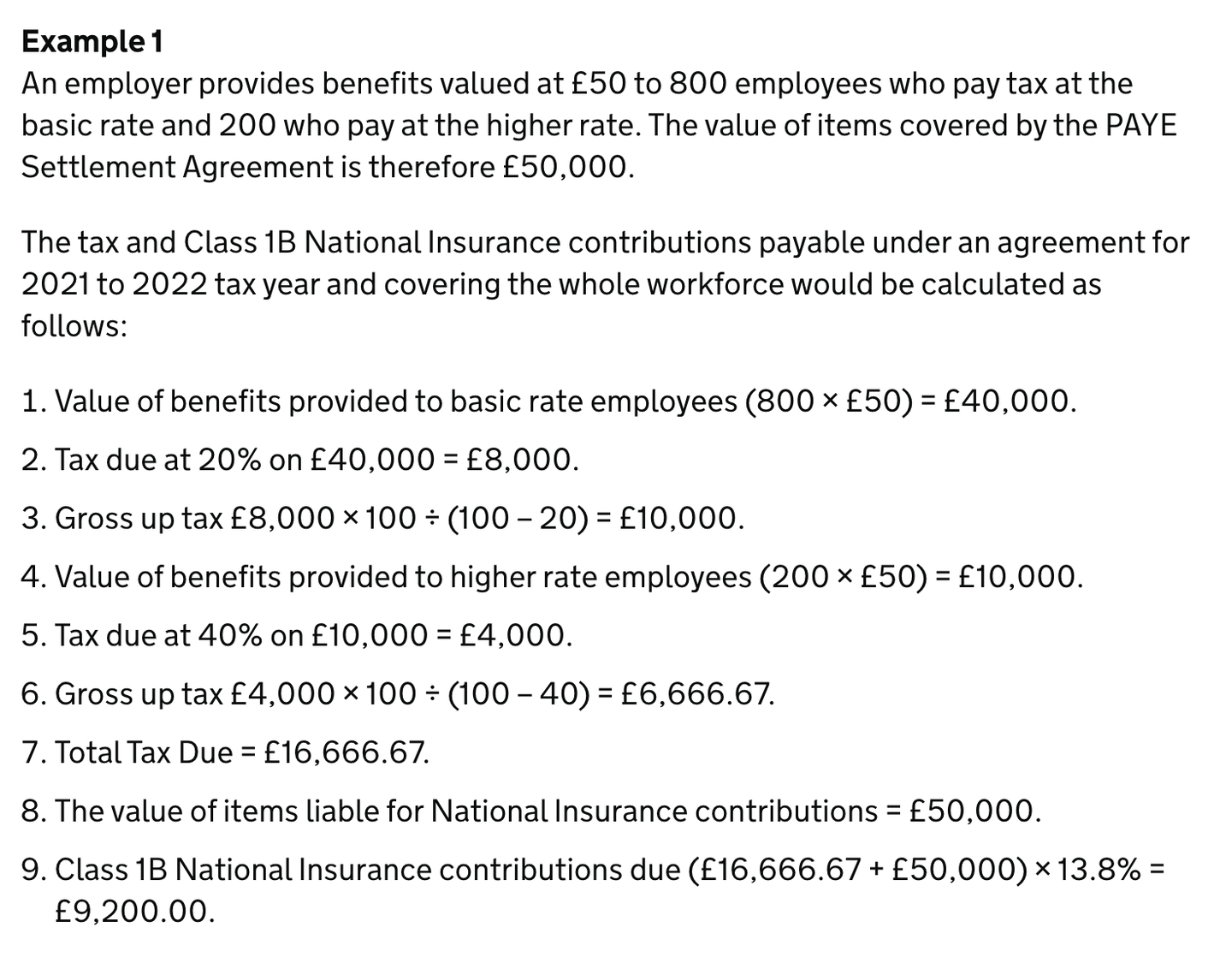
Assume England only and a valid existing PSA that expressly covers both groups' taxable benefits. Assume also that all of the benefit cost would normally attract Class 1 or Class 1A NICs. Full costs including VAT are £800 for a group taxed at 20% and £600 for a group taxed at 40%. Each cost is grossed up at the recipient's rate: tax equals cost multiplied by the rate, divided by one minus the rate.
The £900 is the figure to compare with HMRC's calculation. The £2,300 is the full cost to the employer once the £1,400 of benefits is included.
| Line | Working | Amount |
|---|---|---|
| Group taxed at 20% | £800 × 0.20 ÷ 0.80 | £200 |
| Group taxed at 40% | £600 × 0.40 ÷ 0.60 | £400 |
| Total grossed-up tax | £200 + £400 | £600 |
| Class 1B at 15% | (£1,400 + £600) × 15% | £300 |
| Payable to HMRC | £600 + £300 | £900 |
| Total employer outlay | £1,400 + £900 | £2,300 |
Keep the Class 1B base separate
The Class 1B base includes all the grossed-up tax, plus only those original benefit values that would normally attract Class 1 or Class 1A NICs. In the hypothetical every benefit meets that test, so the base is £2,000.
In a real register, tag each line for NIC status before totalling. A line that would not normally attract NICs still contributes its grossed-up tax to the base, while its own cost stays out.
Sources and context, checked :
Reporting, payment and evidence
HMRC asks for PSA calculations by 31 July after the tax year ends. Payment is due by 22 October if made electronically or 19 October if sent by post. HMRC works out the bill after you report, so your own recalculation acts as a check on that figure.
Pay using the PSA charge reference or, if it has not arrived, the enduring PSA reference as GfC1 describes; do not delay payment while waiting, and do not use a monthly PAYE reference.
Open the signed P626 and tag every line in the benefits register with its agreed category, tax area, marginal rate and NIC status before preparing the report HMRC asks for by 31 July.
- Signed P626 showing the agreed categories
- Cost and rate schedule with VAT-inclusive cost, tax area, band and NIC status for each line
- Copy of the PSA1 submission or posted calculation
- PSA charge reference or enduring PSA reference used for payment
- Bank remittance matching the total payable
Sources and context, checked :