
Trivial benefits: keep a running total for each close-company director
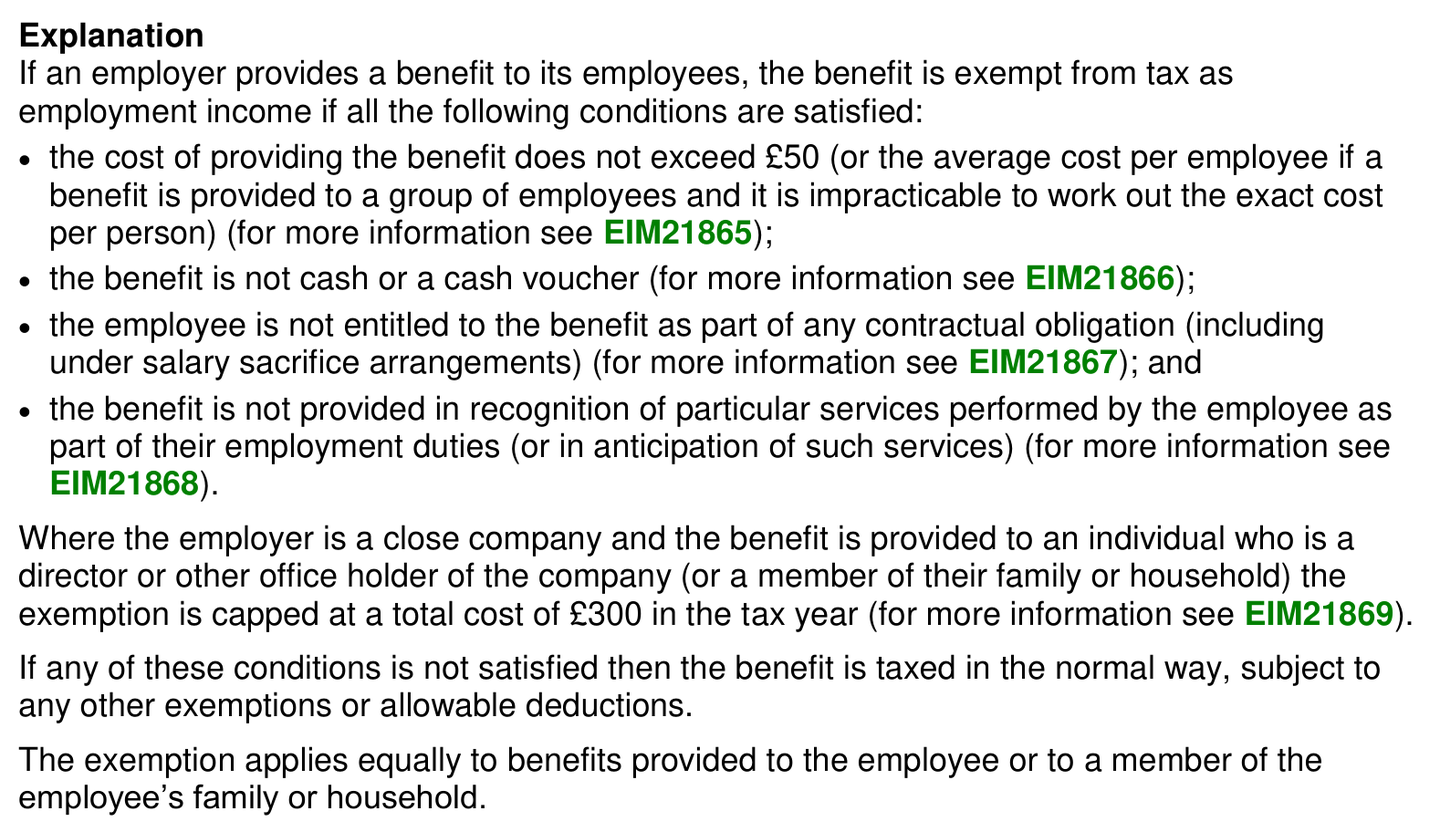
Test each whole gift first: a VAT-inclusive cost of £50 or less, no cash or cash voucher, no contractual entitlement or salary sacrifice, and no link to particular work. For a close-company director, also check the £300 tax-year cap before treating a gift as exempt. A gift that takes the total above £300 fails in full, and earlier exempt gifts stay exempt.
The gift planned for November
An office manager wants to send a £26 gift to a director of a small owner-managed company in November. Before the order goes in, payroll needs to know where the director's exempt running total for the tax year already stands.
The £300 cap applies to directors and other office holders of close companies. It limits exempt trivial benefits for those individuals; it is neither a flat allowance nor a cap for ordinary employees. A company is close for this purpose where it is controlled by five or fewer participators with their associates, or by any number of participators who are directors, together with their associates.
Sources and context, checked :
Test the whole gift first
A gift qualifies as a trivial benefit only if its cost is £50 or less, it is not cash or a cash voucher, it is not provided under a contractual entitlement or salary sacrifice, and it is not given in recognition or anticipation of particular work. An ordinary gift voucher that cannot be exchanged for cash may qualify if every test is met.
Use the VAT-inclusive actual cost per person, or a reasonable average where the precise per-person cost is impracticable to establish. Treat the components of one gift together. HMRC's examples distinguish separate gifts from several components of, or top-ups to, a single benefit, so decide what forms one gift before testing the cost. If the VAT-inclusive amount exceeds £50, the whole gift fails.
Sources and context, checked :
A hypothetical running total
Each gift in the running tally is a separate, spontaneous gift that otherwise passes the gift-level tests. Assume no other exemption applies and there is no salary sacrifice. These sums test the exemption; they do not compute any tax.
Six earlier gifts of £48, £49, £47, £45, £48 and £45 total £282. The proposed £26 gift would bring the total to £308, so it fails in full and the six earlier gifts remain exempt. Separately, a gift of £44 plus £8.80 VAT costs £52.80 and fails the £50 test outright, whatever room remains under the cap.
| Gift | VAT-inclusive cost | £50 test | Cap test | Exempt running total |
|---|---|---|---|---|
| Six earlier gifts | £282 in total | Each passes | Within £300 | £282 |
| November gift | £26 | Passes | £308 would exceed £300 | Earlier £282 remains exempt |
| Unrelated gift, tested separately | £52.80 | Fails | Not reached | No change |
Sources and context, checked :
Rules that shape the tally
Keep the tally generally per individual per employer, and record the date each gift was provided, which may differ from the date the invoice was paid. EIM21869 sets out the cap. Gifts to the director's family or household members can count towards it, and EIM21870 explains the attribution rules, so review each such gift against that guidance.
A gift that exceeds the remaining capacity is wholly outside the exemption, and earlier qualifying gifts stay exempt. Where several gifts are provided on the same day, they can be ordered in the most favourable way. Where the history is mixed or attribution applies, review the records against the legislation and HMRC guidance before treating a later benefit as exempt.
Record and review each gift
Qualifying trivial benefits need no tax, NIC or reporting. When a gift fails, review the reporting and NIC treatment for that particular item. Gifts and non-cash vouchers do not necessarily follow the same treatment, so assess each failed item on its own facts and pass the outcome to whoever runs the payroll reconciliation.
Before the November order is placed, test the £26 gift against the director's exempt running total for the tax year.
- Provision date and recipient, including any family or household link
- Description showing whether the item is one gift or part of a larger benefit
- VAT-inclusive cost per person, or the basis of a reasonable average
- Result of the cash, contractual entitlement, salary sacrifice and particular-work tests
- Exempt running total before and after the gift
- Treatment decided for any gift that fails
Sources and context, checked :